
Creating The Market Before Competing In It
How an emerging mobility operator broke through regulatory gridlock by helping government design the market it wanted to enter
Industry: Mobility & Transportation
Capabilities: Market Entry | Government Strategy | Regulatory Design | Commercial Strategy | Change Management
Geography: Middle East

An emerging micromobility operator had the technology, capital and vehicles required to enter one of the Middle East's most attractive urban markets. What it did not have was a viable path to operate.
The conventional market-entry playbook had stalled. Fleets had been imported, teams assembled and infrastructure established, yet regulatory approvals remained elusive. Other operators faced similar challenges. Some that attempted to deploy without explicit authorization saw vehicles removed from public streets, reinforcing the risks of proceeding without government support.
The underlying problem was not simply opposition to micromobility. The category was new, there was little regional regulatory precedent, and authorities had limited incentive to devote significant resources to designing an entirely new framework for a nonessential transport category.
The response was counterintuitive: stop waiting for government to create the market and help government create it.
A regional leadership team developed a regulatory framework alongside authorities, reframed micro-mobility as part of the broader urban transport system, cultivated private-sector demand before public approval was secured and designed controlled pilots in areas deliberately selected to demonstrate the category under favorable, but credible, conditions.
Regulated deployment followed within months. Initial pilots provided temporary exclusivity in selected areas, helped establish an early user base and created a position from which the operator could participate in shaping the market as additional competitors entered. The approach subsequently became a repeatable model for expansion into other markets across the region.
The Macro Situation for a Micro Market
Shared micromobility was expanding rapidly across the United States and Europe. Venture-backed operators were deploying large fleets of electric scooters and bicycles as cities experimented with a new form of short-distance mobility.
The Middle East appeared to offer many of the characteristics that should have made the category attractive: affluent consumers, rapidly developing cities, significant investment in transport infrastructure and governments eager to position their cities alongside leading global urban centers.
Yet international operators encountered an institutional difference that their established market-entry models had not adequately anticipated.
Obtaining a trade license did not necessarily mean obtaining permission to operate on public streets.
For companies accustomed to markets where commercial licensing and the ability to deploy were more closely connected, this distinction created a significant problem. Operators could establish companies, import equipment, lease warehouses and hire employees only to discover that another, more ultimate, layer of government authorization was required before a single vehicle could legally be deployed.
Approvals did not necessarily arrive quickly. In fact, they were likely never going to arrive.
Requests could move between stakeholders without resolution. Authorities had limited precedent for determining where scooters should operate, how fast they should travel, where they should be parked, how operators should be licensed, how fleets should be controlled or how responsibility for safety and enforcement should be divided.
Some smaller operators attempted to bypass the process and deploy anyway. Those vehicles were swiftly removed or confiscated, demonstrating that the "launch first and negotiate afterward" approach that had sometimes characterized micro-mobility's expansion elsewhere was unable to succeed.
Meanwhile, capital remained stranded.
Across the emerging regional industry, tens of thousands of vehicles would ultimately be imported, supported by warehouses, employees, logistics providers and other infrastructure. For operators unable to secure approval, every additional delay meant continuing cost without corresponding ride revenue.
The conventional response was to continue lobbying for approval.
The newly installed regional management, however, reached a different conclusion.
The Challenge Was Not Opposition. It Was Incentive.
The stalled regulatory process initially looked like a government-relations problem.
It was, instead, re-diagnosed as an institutional incentive problem.
For an operator, the economics of delay were immediate. Vehicles sitting inside warehouses represented unproductive capital. Employees and facilities continued generating costs. Every month without deployment pushed the operation further from recovering its investment in an already precarious business model.
The incentives facing government were almost the reverse.
Micro-mobility was an unfamiliar and nonessential category. Creating a regulatory framework meant additional work: determining safety standards, establishing operating rules, coordinating different government stakeholders, identifying appropriate locations, designing enforcement mechanisms and deciding how multiple private operators should eventually be managed.
Absent a strong institutional directive, there was little to no reason for an individual government stakeholder to assume that additional responsibility.
The asymmetry was straightforward:
The operator urgently needed a regulatory framework. The regulator did not urgently need to create one.
Continuing to submit proposals and wait, therefore, did little to change the underlying equation.
The new regional management team brought a solution - write the the framework for them.
But there was also an internal obstacle.
The operator's established processes had largely been developed around European and North American experience. Regional and headquarters teams initially resisted the idea that the company should assume work normally expected of the regulator.
Why should a private company write government policy?
In principle, it shouldn't have to.
In practice, insisting on that distinction meant preserving an organizational principle while vehicles remained unused and costs continued accumulating.
The market-entry strategy therefore shifted from asking "How do we convince government to approve us?" to a different question:
"What is preventing government from approving this category, and can we remove that obstacle ourselves?"
Reframing the Category
Before designing regulation, government first needed a reason to care about the category.
The proposition was therefore reframed.
Rather than presenting scooters primarily as vehicles that private operators wanted permission to deploy, micromobility was positioned as a missing component of an increasingly sophisticated urban transport ecosystem.
Cities across the region had invested heavily in metros, buses, taxis, aviation infrastructure and other forms of mobility. Shared scooters and bicycles could be presented as another piece of that system: a flexible last-mile option connecting people with destinations that larger transport modes could not efficiently serve.
International adoption provided further validation. If leading cities in Europe and North America were experimenting with micromobility, adopting the category could also reinforce the region's ambition to remain associated with emerging urban technologies.
This changed the conversation.
The question was no longer simply whether an individual scooter operator should receive permission to use public space.
It became:
How should a modern city incorporate an emerging form of mobility into its transport system?
That was a question the operator could help answer.
But the final hurdle was still the base hurdle - the companies needed a regulatory framework ‘originating’ from regulatory body.
Removing the Cost of Saying Yes
The team proposed working with government to develop the missing regulatory architecture.
The approach was deliberately collaborative. Authorities were not told that they lacked the knowledge required to regulate the category. Instead, the operator offered its international operating experience as an input into a framework that government could ultimately adopt, modify and own.
The resulting work addressed the practical questions preventing approval.
Where should scooters be permitted? What speeds were appropriate? How should parking work? What safety standards should apply? How many vehicles should operators be allowed to deploy? Where should geofencing be required? How many operators could the market reasonably accommodate? How should pilots transition into competitive tenders?
Commercial considerations were incorporated as well.
Potential structures allowed government to participate in the economics of the emerging market through revenue-sharing arrangements, with provisions governing percentages, ramp-up periods and caps.
That mattered because the proposition was no longer asking government merely to expend institutional resources accommodating a private operator. A successful category could support transport objectives, contribute to the city's innovation positioning and create an additional revenue stream.
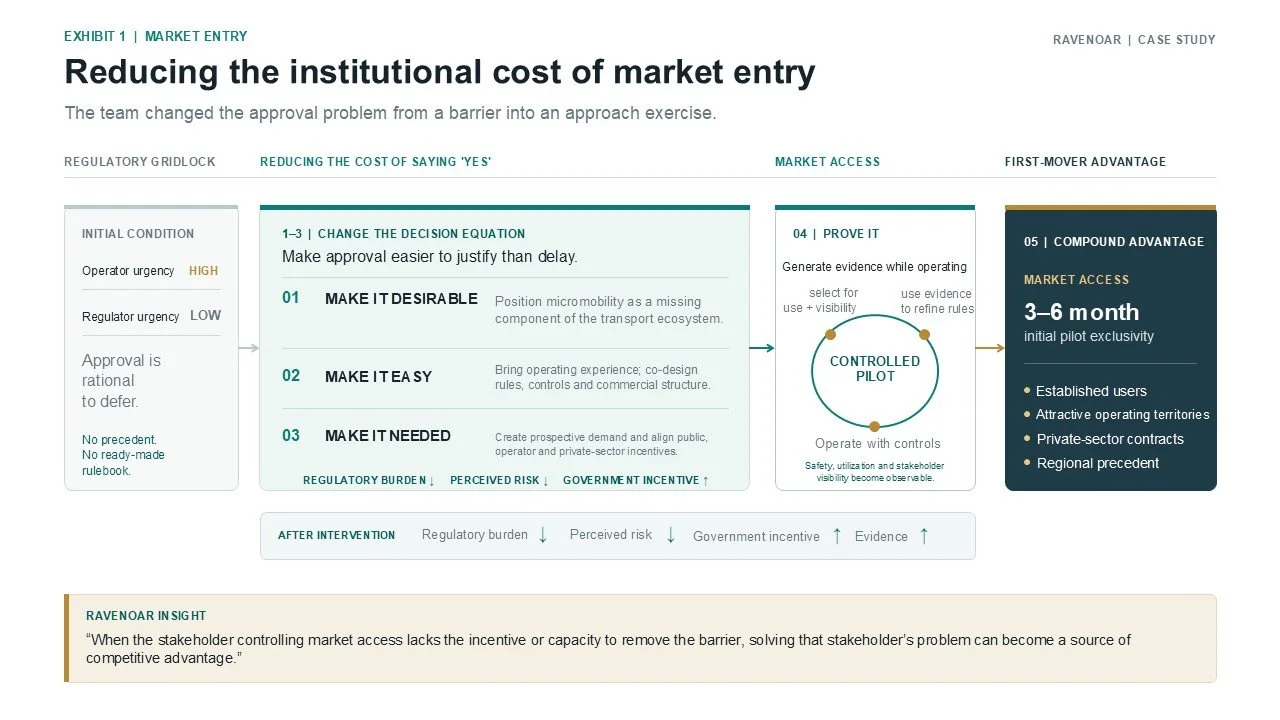
The regulatory proposition therefore addressed three different barriers simultaneously:
Make the category desirable. Make regulation easier. Make participation worthwhile.
Building Demand Before Approval
Regulatory work did not occur in isolation.
While discussions with transport authorities progressed, the commercial team simultaneously cultivated relationships with large private developers, master-planned communities, university environments and other controlled developments.
These locations were particularly important in Gulf cities, where significant amounts of pedestrian activity occur within large privately managed districts rather than exclusively on conventional public streets.
The operator could not yet fully deploy, but it could establish prospective commercial relationships.
Those relationships served two purposes.
First, they created a pipeline that could be activated once regulatory approval arrived.
Second, they strengthened the government proposition. Authorities were not being asked to authorize a hypothetical category for which demand might eventually emerge. Large institutions were already expressing interest in deploying the service once the regulatory pathway existed.
Market development and regulatory development therefore reinforced one another.
Prospective demand made regulation easier to justify; regulatory progress made prospective customers more willing to commit.
Designing the Pilot to Learn and to Succeed
Once government became receptive, attention shifted to the pilot.
This presented another strategic choice.
A pilot is often treated as a neutral experiment: choose an area, deploy a product and observe what happens for a specified time.
But location could materially determine the outcome.
A pilot launched in an area with limited footfall might produce weak utilization and suggest that the category lacked demand. A deployment in a poorly suited road environment could generate safety incidents and strengthen the case for restriction. Conversely, an artificially protected environment might produce results that could not be replicated elsewhere.
Local knowledge was therefore used to recommend areas combining three characteristics:
High potential utilization
Manageable safety risk
Strong public visibility
The objective was not to manufacture an artificial success. It was to avoid allowing poor experimental design to determine the fate of an otherwise viable category.
Initial pilots were granted in selected areas, typically with three-to-six-month periods of exclusivity.
The regulatory framework then continued to evolve through operating experience.
The team met regularly with authorities to review what was happening on the ground. Speed restrictions could be adjusted. Areas could be geofenced. Parking requirements could be tightened. Safety measures could be introduced as actual user behavior became visible.
Some compromises challenged the original operating model.
More restrictive parking zones, for example, reduced some of the convenience associated with fully dockless systems. Geofencing created technical and cost considerations around location accuracy. Safety incidents created pressure for additional protective measures.
Each decision therefore required balancing government confidence against the risk of progressively regulating the product into commercial impracticality.
Regulation became less a document written before launch than an iterative operating system developed through the pilot itself.
First-Mover Advantage Began to Compound
The initial value of the strategy was obvious. Scooters and e-Bikes could finally operate.
The larger value emerged afterward.
Because the operator had helped establish the regulatory pathway, it was among the first approved participants and had influence over the selection of initial pilot locations.
The exchange was calculated. We write the policy for you and in turn we get to select our zones.
That mattered when additional operators eventually entered.
The original company had already established vehicles, users and operating history in some of the most attractive areas. Because each operator maintained its own application and customer ecosystem, moving an established operator out of a successful zone was not necessarily neutral.
The incumbent could make a credible government-facing argument.
Users in the area had already downloaded the application, registered for the service and become familiar with the product. Replacing that operator with a new company would introduce unnecessary disruption simply to re-create an existing service.
The commercial objective, that of retaining attractive territory, could therefore be framed around continuity for users and government.
Temporary first-mover advantage became increasingly embedded.
At the same time, private relationships cultivated during the regulatory process could now be converted into operating agreements. Large developments and controlled communities that had been waiting for formal approval could proceed with deployments.
Ridership expanded as fleets and operating areas grew, eventually reaching tens of thousands of rides per day across operators in the developing markets.
The intervention had therefore accomplished more than obtaining a permit.
It had changed the company's position from an applicant waiting for a market to exist to an incumbent participating in shaping the market's development.
From Iso-Experiment to Regional Playbook
The significance extended beyond the initial cities.
The initial leading regional cities served as influential benchmarks for neighboring countries. Once regulated micro-mobility was visibly operating there, conversations elsewhere changed.
Other governments still faced many of the same questions. They had limited direct experience regulating the category and still required frameworks governing safety, operations, fleets and commercial arrangements.
But one variable had changed.
There was now regional precedent.
Authorities elsewhere could see that major neighboring cities had permitted the category. The perceived risk of experimentation declined, while the risk of appearing behind regional peers increased. The ultimate incentive for Middle East adoption.
The original approach could therefore be re-used and adapted: establish the category's relevance, bring regulatory knowledge to the table, work collaboratively with authorities to write their frameworks for them, structure pilots and develop mutually beneficial commercial arrangements.
What began as a solution to regulatory gridlock became a repeatable market-entry playbook across the region.
The Outcome
The strategy solved the problem it was designed to solve.
A regional operation facing prolonged regulatory uncertainty moved from stalled approvals to regulated deployment in a matter of months. Initial pilot arrangements provided temporary exclusivity in selected areas. Early deployment created user familiarity and strengthened the operator's position as the market subsequently opened to additional competition.
Private-sector relationships cultivated in parallel could be converted into deployments once regulatory approval was established. The regulatory approach was subsequently adapted to support expansion into additional regional markets.
Just as importantly, the experience demonstrated the limits of the intervention.
Creating a market did not automatically make the underlying industry profitable.
Shared micromobility remained economically challenging. Revenue-sharing arrangements, operational costs, fleet economics and the broader structural characteristics of the industry continued to constrain profitability. Individual territories could perform better than others, but regulatory success could not by itself repair the economics of the global business model.
That distinction matters.
A successful strategy should be judged against the problem it was designed to solve.
The problem here was market access.
And market access was unlocked.
RavenOar Perspective
Sometimes the fastest way to solve your problem is to solve somebody else's first.
International expansion often assumes that a successful operating model can be transported from one geography to another with relatively minor adaptation.
That assumption can be expensive.
Processes developed in mature home markets encode assumptions about institutions, incentives, regulation and decision-making. When those assumptions change, repeating the process more forcefully does not necessarily improve the outcome.
Local knowledge therefore should not be treated simply as a relationship-building capability. It can be a strategic capability.
Someone who understands how an institution actually makes decisions can identify barriers that may be invisible from an organizational chart or conventional market-entry plan. The stakeholder formally responsible for an issue may not always possess the practical authority to resolve it. A regulatory delay that appears to require greater persuasion may actually require a different incentive structure. A government that appears resistant may simply have little reason to devote scarce institutional attention to an unfamiliar problem.
The response should not be to caricature those differences or assume that one system is inherently superior to another.
It should be to adapt.
In this case, the critical insight was recognizing the asymmetry between the parties. The company desperately needed regulation. Government did not desperately need micromobility.
The solution was therefore to change the exchange.
The operator contributed knowledge, regulatory architecture, operating experience and a controlled environment in which the category could be tested. Government received a lower-risk route to introducing an emerging mobility model for a marketing victory.
In return, the operator could negotiate something economically meaningful: speed to market, pilot access, temporary exclusivity, favorable operating areas, commercial terms or simply the advantage of being first.
This principle extends well beyond transportation.
Companies entering unfamiliar markets frequently spend enormous resources trying to convince governments, customers, partners or internal stakeholders to behave differently.
Sometimes that is necessary.
But another question should be asked first:
What would have to become easier, safer or more valuable for the stakeholder controlling our outcome to say yes?
Answering that question may reveal that the most effective route around a barrier is not to push against it.
It is to remove it.
Case Study Note
This case study draws on work led by a RavenOar team member in a prior professional role. Organizations and certain identifying details have been generalized to preserve confidentiality. Quantitative references are presented at an appropriate level of aggregation and are intended to indicate scale rather than provide audited operating results.
