
Knowing What Not to Build
How a Middle Eastern transport authority turned digital disruptors into partners—and learned that controlling a market does not mean owning every capability within it

A major Middle Eastern city had a taxi problem. Depending on how the perspective one took.
Its regulated taxi fleet was extensive. The government controlled licensing, market access and much of the institutional architecture surrounding the service. Multiple franchise operators provided vehicles across the city and taxis remained an important component of the urban transport fabric.
But the way customers accessed that system belonged to another era.
Most journeys began with a passenger standing on the street and hailing a passing vehicle. A legacy mechanism in all markets.
Telephone bookings existed, but represented a small share of demand. Drivers positioned themselves physically according to experience, intuition and instructions from their individual operators. Even shift patterns could materially affect availability with several franchisees changing drivers at similar times, finding a taxi during certain periods could become unexpectedly difficult.
Meanwhile, ride-hailing platforms were changing what customers expected from mobility. Ultimately creating a new standard.
A passenger could now open an application, identify a nearby vehicle, request it from a precise location and know that it was coming. The platform could simultaneously observe demand across the city and dynamically match customers with available drivers. The government approved taxis were cut off from this ecosystem - by their own volition.
For international visitors in particular, the difference was significant. A familiar application removed the need to understand the local taxi system at all.
Now the traditional taxi industry was no longer competing solely on price, fleet size or vehicle availability. Convenience itself had become part of the product.
The government's initial instinct was typical and predictable: build its own digital capability and compete.
The alternative presented by the team was much more uncomfortable.
“Don't build it.”
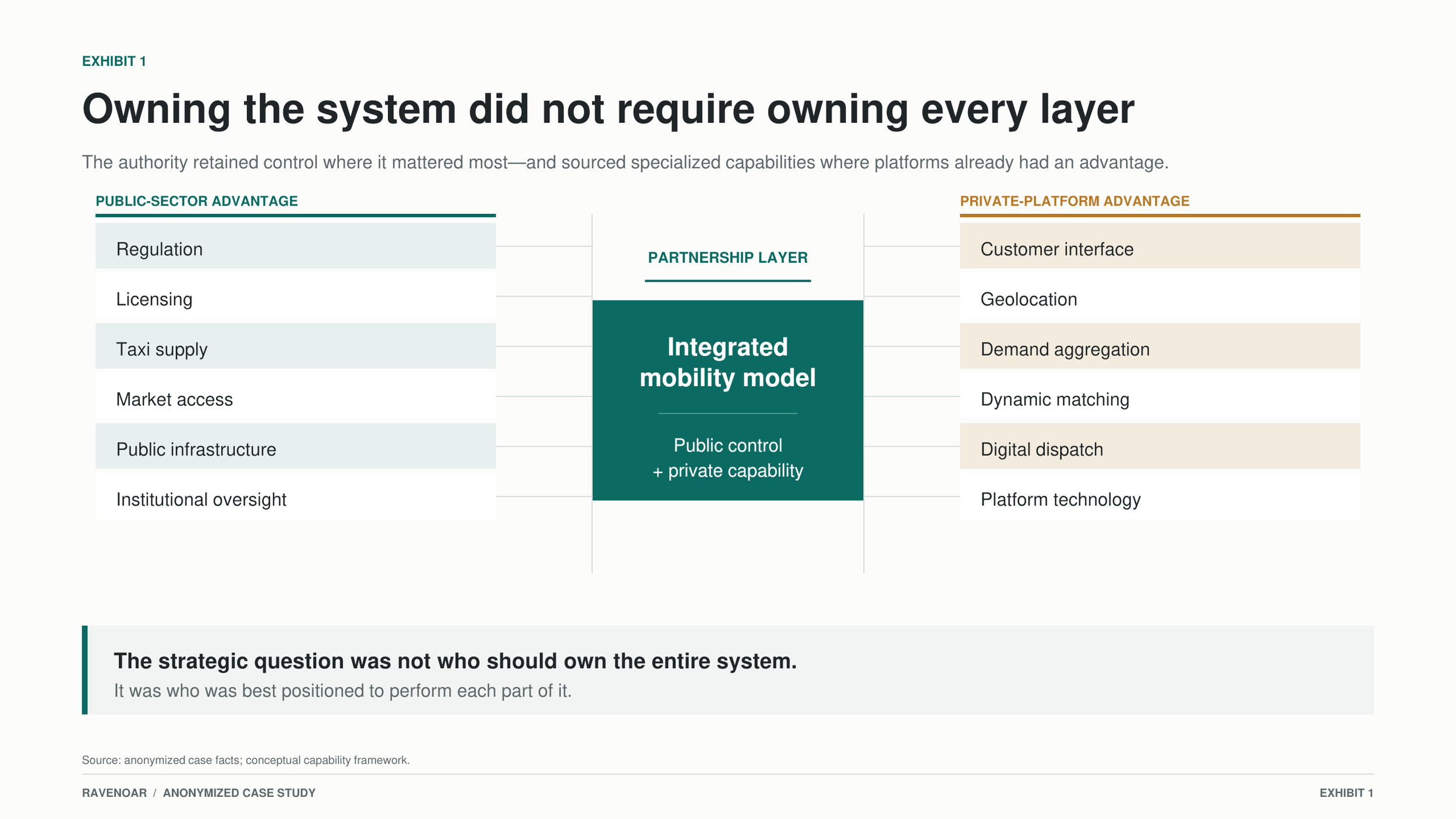
Owning the system was not the same as owning every capability
The authority had enormous structural advantages. It regulated the taxi market. It controlled access to the system. It oversaw a substantial fleet operating across the city.
What it did not possess was the accumulated digital capability of companies whose businesses had been built around geolocation, customer acquisition, digital dispatch, demand aggregation and real-time matching globally.
Recreating those capabilities would require the authority to compete with technology companies at precisely what those companies had been designed to do.
The proposed alternative was conceptually simple but politically unheard of: put regulated taxis onto existing external ride-hailing platforms.
The taxis would remain regulated taxis. Government would continue controlling the transport system. The platforms would simply provide the digital interface and matching capability, receiving compensation for the demand they generated.
Rather than treating the ride-hailers as competitors, the authority could treat them as infrastructure partners. A win-win.
The argument encountered substantial resistance.
Part of that resistance was commercial. The taxis belonged to the regulated ecosystem and generated revenue within it. Why should some of that economics be shared with an external technology company? The answer seemed obvious. The internal politics made it seem unreasonable.
One part was institutional and cultural.
There was a strong preference for government ownership and visible control. The ride-hailing companies had been perceived as disruptors of the established transport model. Using their technology could therefore be interpreted not simply as outsourcing a capability, but as conceding territory to companies the authority was supposed to regulate and temper.
There was also exuberance and inherited confidence that government could simply build its own alternative.
The strategic disagreement therefore went considerably deeper than whether one application was better than another.
It concerned what ownership actually meant.
Controlling the transport system did not necessarily require controlling every capability within it.
The commercial evidence was also becoming harder to ignore for the regulator.
Inconveniently for the ‘tradionalists’, trips per taxi had declined during a period of overall market weakness. At the same time, customers increasingly valued the certainty and convenience offered by digitally booked mobility. It was a perfect storm.
The authority couldn’t protect its economics on each traditional transaction while gradually losing transactions to a more convenient alternative. Sacrificing a small portion of the economics associated with digitally generated demand in exchange for bringing more demand into the regulated taxi fleet was now a lifeline.
The distinction was now between protecting the share of a transaction and increasing the number of transactions available to share.
Partner before partnership becomes necessity
The timing created another strategic consideration.
The ride-hailing companies themselves did not hold unlimited bargaining power.
They were legally operating in the market, but their businesses remained dependent on a workable relationship with the regulator. Ride-hailing companies globally were still navigating questions about their long-term regulatory status, and becoming institutionally embedded within a government transport ecosystem offered something valuable: greater legitimacy and security.
That created a negotiating window for the team.
The authority had regulated supply, market access and third-party approvals. The platforms had technology, customers and demand-generation capability. Each possessed something the other wanted.
Had the authority instead spent several years developing its own application, achieved limited adoption and then returned to the platforms because its internal solution had failed, the bargaining position could have been substantially different.
Dependence would have been visible.
The lesson was straightforward:
Partnerships are often most valuable before they become necessary. Once necessity becomes obvious, leverage may already have shifted.
The simplest solution proved impossible
The original proposition was deliberately uncomplicated.
Integrate the taxi fleet with existing ride-hailing platforms. Pay those platforms a nominal fee per transaction for the value they created. Government avoids building technology that already existed elsewhere.
That option was not something the government was willing to accept.
Control of the system, customer relationship, data and economics remained too important. Simply placing public-regulated taxi supply onto somebody else's platform did not provide sufficient institutional ownership, particularly for the optics of the media narrative.
The theoretically cleaner solution therefore collided with organizational reality.
The answer, and ultimate solution, became a separately structured joint venture between government and a private mobility platform, with government retaining majority ownership.
From a pure efficiency perspective, this created complexity that did not need to exist. A commercial integration could have achieved much of the same, if not all, functional outcome with considerably less structural machinery.
But strategy is implemented by institutions, not spreadsheets and optimal ideas.
The new joint venture provided something the simpler model could not: a bridge between private-sector capability and public-sector control.
Government could participate without believing it had surrendered the system to the disruptor. The private platform gained a much deeper relationship with the regulator and access to a major regulated fleet. Both parties could claim ownership of the outcome.
The optimal theoretical structure had given way to the optimal implementable one.
That distinction became fundamental to getting the initiative through.
Getting to ‘yes’ required saying ‘no’
Agreement on the concept did not mean agreement on the deal.
Multiple potential technology partners were invited to participate in a competitive process. Their enthusiasm varied considerably.
For some, creating a dedicated structure with government represented unnecessary complexity. Existing platforms already had the technology. Why create an additional entity simply to do something their systems could already perform?
Some prospective participants had little appetite for the arrangement at all. Others participated while remaining reluctant to accept the structural requirements imposed by government.
Even selecting a preferred partner did not guarantee a transaction. Negotiations with prospective partners failed before a party willing to accept the eventual structure could reach agreement with the authority.
Once negotiations progressed, another complication emerged.
There were not simply two parties sitting across a table.
Government departments had different objectives. Commercial teams could see the potential for incremental demand and revenue. Operational teams faced greater disruption to existing ways of working. Taxi franchisees themselves were divided.
Multiple consulting and advisory teams were also involved. Some represented government interests; others advised the ride-hailing companies. Like lawyers advocating for their respective clients, each could rationally seek to maximize its principal's position.
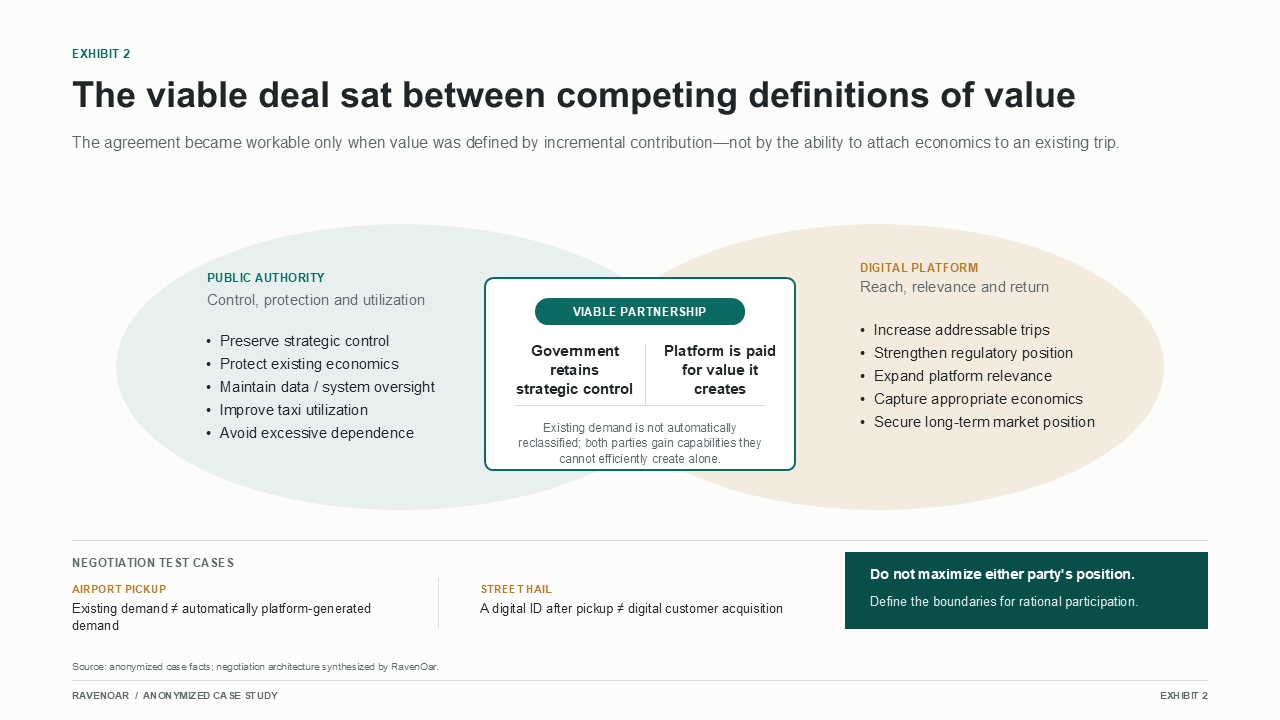
The problem was that a transaction cannot survive if every participant succeeds in maximizing only its own position.
Someone had to distinguish between a legitimate commercial requirement, a negotiating position and an unreasonable demand.
That occasionally meant pushing back against government, even from internal government divisions.
It also meant pushing back firmly against the platform.
One of the clearest disputes concerned airport journeys.
Airport taxi demand already existed. Passengers arriving at the airport were already being directed toward regulated taxis. Allowing the platform to receive economics from those journeys merely because those taxis also participated in the digital ecosystem could transfer existing value without the platform generating additional demand.
The principle was therefore one of incrementality.
If the platform generated or facilitated the journey, compensation was justified.
If the journey would have occurred independently, attaching a platform identifier to it did not necessarily mean the platform had created value.
The same issue appeared with traditional street hails.
Suppose a passenger stopped a taxi on the street and only afterward entered an account or identification number associated with the digital service. Should that journey suddenly become a platform-generated trip?
The position taken in the negotiations was ‘no’. The platform had not acquired the passenger, matched the vehicle or generated the journey.
Apparently minor questions - including the treatment of the meter's starting charge colloquially known as the ‘flagfall’ - could materially redistribute economics when repeated across a large fleet and millions of potential journeys.
The objective therefore wasn't to maximize government's share of every conceivable transaction. Nor was it to make the proposition as lucrative as possible for the technology partner.
It was to establish the boundaries within which both parties could rationally participate.
That is a different role from conventional advocacy.
Sometimes the person trying to get a deal done has to tell their own side that its demands are unreasonable.
The app was only the visible layer
Even after the commercial structure was agreed, simply connecting taxis to a digital interface would not capture the full benefit.
The existing taxi system operated according to a fundamentally different logic.
Drivers had historically circulated according to their own experience and knowledge of the city. Franchise operators could direct drivers toward areas where they expected demand. Years of accumulated intuition informed where vehicles should be at different times.
Ride-hailing technology challenged that operating model.
Demand could now be observed dynamically. A request could be directed toward an appropriate nearby vehicle. Drivers had defined periods in which to respond. If one did not accept the request, it could move to another available driver.
Supply could increasingly follow real-time demand rather than historical assumptions about demand.
For some franchise operators, this represented more than technological modernization.
It meant relinquishing part of their traditional operational discretion to a system they did not control.
The platform also brought different expectations around the driver relationship. Its model placed greater emphasis on driver engagement, responsiveness, behavioral standards and dignity as part of the service proposition.
Integrating the two systems therefore required behavioral change from drivers and operators as well as technological change.
This distinction matters far beyond taxis.
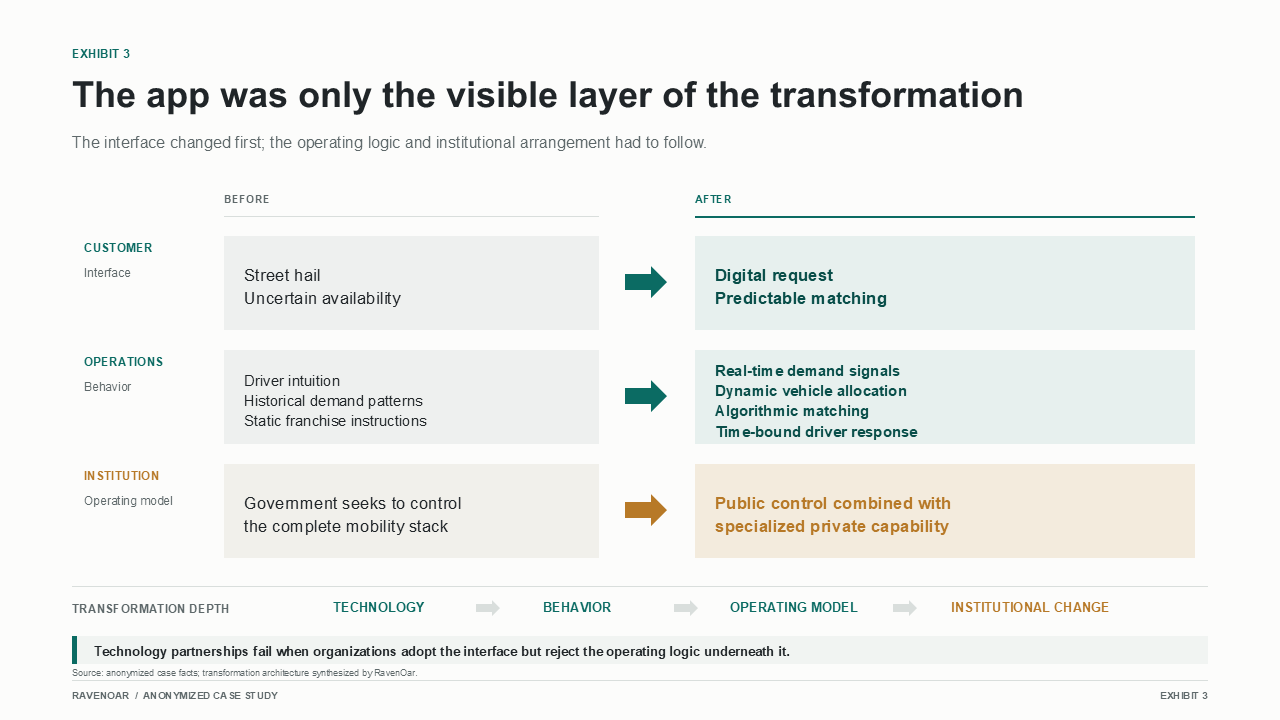
Organizations frequently believe they have adopted a technology because they have deployed its interface. But the value of a technology may depend on adopting the operating logic underneath it.
Installing dynamic dispatch while continuing to position vehicles according to static instructions would preserve much of the inefficiency the technology was intended to remove.
Technology partnerships fail when organizations adopt the interface but reject the operating logic underneath it.
The transformation therefore occurred across three levels simultaneously.
Level 1 - Customers moved from uncertain street hailing toward digitally requested, predictable mobility.
Level 2 - Operations moved from predominantly intuition-led positioning toward dynamic matching of supply and demand.
Level 3 - Institutionally, government moved from attempting to control the entire mobility stack toward combining public control with private capability.
Each transition required somebody to relinquish something.
Ownership changed the politics
The joint venture initially represented a compromise required to overcome institutional resistance.
After formation, however, that same ownership structure produced an unexpected advantage.
Government was now the majority owner.
The initiative could no longer easily be characterized internally as diverting business toward an outside disruptor. Its success was directly aligned with the government's own economic interests.
The incentives changed.
There were inevitable implementation problems as the new operating model was introduced. Vehicles were progressively added rather than moving the entire ecosystem at once. Drivers, franchise operators, government stakeholders and the technology platform had to learn how the new system would operate in practice.
But adoption accelerated.
Customers embraced the convenience of digital booking. Waiting times fell materially. Taxi revenues improved. More vehicles were progressively incorporated until the digital system extended across most of the city's taxi ecosystem.
What had once been considered a threat to the incumbent model increasingly became part of the infrastructure through which that model operated.
Years later, digitally ordering a taxi had become normal behavior for many customers familiar with the city's transport ecosystem.
The disruptor had not displaced the regulated taxi system.
It had helped modernize it.
Knowing what not to build
Organizations confronted by disruption often ask the same question:
How do we build our version of this?
Sometimes that is the wrong question.
The more useful questions are what capabilities genuinely differentiate the organization, which capabilities it must control and which ones somebody else already performs substantially better.
The transport authority possessed enormous advantages that no ride-hailing platform could easily reproduce: regulatory authority, licensed supply, institutional legitimacy, market access and a deeply established physical transport network.
It did not follow that the authority also needed to become a world-class consumer technology company.
Recognizing that distinction required putting aside an instinct common to powerful incumbents: the belief that because they own the underlying system, they should own every layer built upon it.
But identifying the right strategic answer was only the beginning.
Institutional pride mattered. Government control mattered. Commercial interests mattered. Existing franchisees mattered. Operational teams mattered. Driver behavior mattered. External advisers mattered. And the economics of the private partner, mattered.
The original, simpler solution could not survive all of those constraints.
The joint venture could.
That made the eventual structure a compromise—but not a strategic surrender.
The architecture changed while the underlying idea survived.
And that may be the more important lesson.
Strategy is often presented as the search for an optimal answer. In practice, the hardest strategic problems involve determining which elements of that answer must be protected and which can be compromised in order to make change possible.
RavenOar Insight
Owning the market does not mean you should own every capability within it.
Organizations can respond to disruption by trying to replicate the disruptor, particularly when partnering appears to concede control. But ownership and capability are not the same thing.
The better approach may be to identify which parts of the system genuinely require institutional control and which can be performed more effectively by an external partner.
Doing so requires more than recognizing comparative advantage. It requires designing incentives that make collaboration rational, rejecting value claims that cannot be justified, changing the operating model beneath the technology, and sometimes accepting a structurally imperfect solution because it is the one capable of being implemented.
Knowing what to build is strategy. Knowing what not to build can be just as important.
