
When Growth Makes the Business Worse
How a venture-backed mobility company discovered that fixing execution could not fix fundamentally broken unit economics
Industry: Tech & Transportation
Capabilities: Market Entry | Government Strategy | Regulatory Design | Commercial Strategy | Change Management
Geography: Middle East

A struggling business often produces a familiar diagnosis. The strategy is usually sound but execution is weak.
This brings in the usual remedy points. Sales team needs to sell harder. Procurement needs better terms. Government relationships need strengthening. Local management needs upgrading. Costs need tightening. Once those problems are fixed, growth should follow—and scale should eventually improve the economics.
That was broadly the assumption facing a venture-backed mobility technology company attempting to expand across Africa, Southeast Asia and the Gulf.
The company had built its proposition around technology-enabled employee transportation. Instead of employers contracting directly with bus operators and dedicating entire vehicles to fixed groups of workers, the platform would aggregate demand, pool passengers and dynamically allocate capacity. In principle, technology could allow multiple groups traveling along compatible routes to share vehicles, reducing the number of buses required.
It was an appealing proposition.
In practice, the regional operation had stalled.
When an interim regional manager was brought in to stabilize and expand the business, the Gulf operation had only a handful of clients. Government relationships were underdeveloped. The company's legal structure was poorly suited to parts of the market it wanted to serve. Supplier relationships required attention. The local organization lacked some of the transport and commercial capabilities needed to operate in a highly regulated environment.
These looked like execution problems.
Over the following six months, many of them were addressed.
Clients increased. Market coverage expanded. Supplier terms improved. Regulatory relationships strengthened. The team was rebuilt.
Yet the more effectively the operation was managed, the harder it became to ignore a more fundamental conclusion:
The business was growing, but the economics were not getting better.
The turnaround had uncovered a problem that better execution alone could not solve.
The problem looked like underperformance
The company had developed much of its operating experience in comparatively fragmented transport markets. Its expansion into the Gulf represented a different proposition.
The regional headquarters had recently been established in a major Gulf commercial center, but the local setup reflected limited understanding of how the market actually worked.
Among the first issues was corporate structure.
The business had been established through a free-zone structure that created complications when pursuing certain government and government-related opportunities. In a market where licensing, road access, procurement rules and relationships with transport authorities could materially affect the ability to operate, this was not a minor administrative issue.
The regional organization also needed restructuring. Transport procurement required people who understood fleet economics and could negotiate with large bus operators. Supplier relationships needed greater discipline. Some legacy relationships raised concerns around conflicts and procurement integrity. Commercial targeting lacked a sufficiently localized understanding of how sophisticated buyers purchased transportation.
These were all solvable.
But underneath them sat a larger question that had received considerably less attention:
What economic value was the platform actually creating?
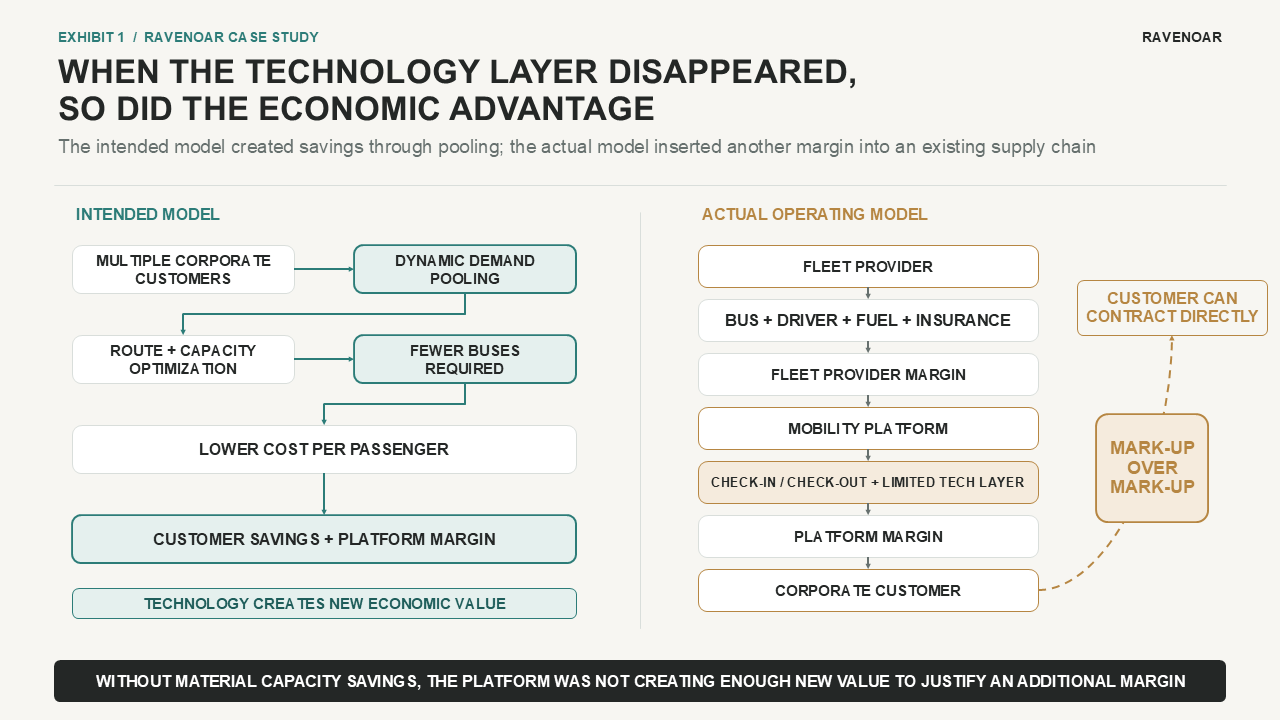
The theoretical answer was technology.
The platform's proposition resembled a large-scale corporate version of pooled ride-hailing. Rather than every employer purchasing dedicated bus capacity, passenger demand could theoretically be combined.
Workers would check in through the platform. The system would understand where passengers needed to travel, determine compatible journeys and dynamically allocate vehicles. Changing traffic conditions and passenger demand could influence which bus collected which passengers.
If the system could transport the same number of people with fewer buses, the economics could become compelling.
A customer might previously require ten buses. Effective pooling and routing might allow the same demand to be served with eight. Part of that saving could accrue to the customer and part to the technology provider.
The platform would therefore earn its margin because it had created an economic surplus.
But that was not how the system was functioning in practice.
Routing required substantial prescheduling. Outputs could be inconsistent. The system was not dynamically reallocating passengers and vehicles in response to real-time conditions in the manner required to generate the promised optimization.
What remained was useful, but much narrower: a digital check-in and check-out layer, some passenger visibility and supporting technology around what was otherwise a relatively conventional shuttle operation.
Without optimization, the economic proposition changed completely.
The company was effectively renting buses from established fleet operators and reselling that transportation to corporate customers.
And that created an immediate problem.
A double mark-up pitch
The Gulf bus market was not particularly mysterious to sophisticated buyers.
Vehicle specifications were regulated. Established fleet operators were known. Large organizations understood approximately what different classes of buses cost. Many prospective customers already contracted directly with precisely the same operators from which the technology company needed to source its vehicles.
The platform therefore found itself in an uncomfortable position.
A bus operator needed to earn its margin.
The technology company then needed to place another margin on top.
The customer, meanwhile, could often identify the underlying supplier and approximate cost.
Without technology creating material savings elsewhere in the system, the obvious customer question became difficult to answer:
Why should we pay you more for a bus service we can procure directly?
The initial response was to attack the procurement problem.
Management approached major fleet owners with a straightforward proposition: the platform could aggregate significant demand and bring them additional customers in exchange for preferential fleet pricing.
Longer-term agreements were pursued to provide greater certainty over vehicle costs. Locking prices for several months could at least reduce the risk that a major supplier would suddenly increase rates after the platform had committed to customer pricing.
Negotiations did improve terms. They did not improve them enough.
Even substantial procurement discounts could not consistently create enough room between the underlying fleet cost and the price customers were prepared to pay.
And longer commitments introduced a different risk.
A short supplier agreement left the platform exposed to price increases. A longer agreement reduced that risk—but if a customer cancelled while the platform remained committed to vehicle capacity, the company could be left paying for buses it no longer needed.
One risk had simply been exchanged for another.
Fixing the Operation
The turnaround nevertheless continued.
Government relationships were rebuilt and the regulatory approach became more structured. The company's legal setup was addressed so that its corporate presence better matched the requirements of the market it was trying to serve.
The local organization was professionalized. People with transportation and supplier-negotiation backgrounds were brought into key roles. Procurement practices were tightened and problematic legacy relationships were removed.
Commercial strategy changed as well.
Rather than pursuing only customers already familiar with the local fleet market, the team identified organizations entering the region that had not yet established transportation arrangements. These customers were less likely to have existing relationships with bus operators and sometimes valued having a single party organize the entire solution.
The team also looked for organizations located close enough geographically that passenger demand could be combined manually.
In effect, people began recreating some of the optimization that the technology was supposed to provide.
The approach worked commercially.
Client numbers increased. Market coverage expanded materially within months.
But the improvement revealed something uncomfortable.
Growth had returned without economic viability returning with it.
Growth became the problem
Some new contracts operated around break-even at best. Others were taken on at slight losses as headquarters continued to emphasize expansion.
From a top-line perspective, this could still look encouraging. More customers meant more passengers. More passengers meant more buses moving. More buses meant higher gross transaction volumes and higher reported revenue.
But every new customer also required additional capacity.
And because the underlying technology was not materially reducing that capacity requirement, scale did not fundamentally change the equation.
In some cases, it made it worse.
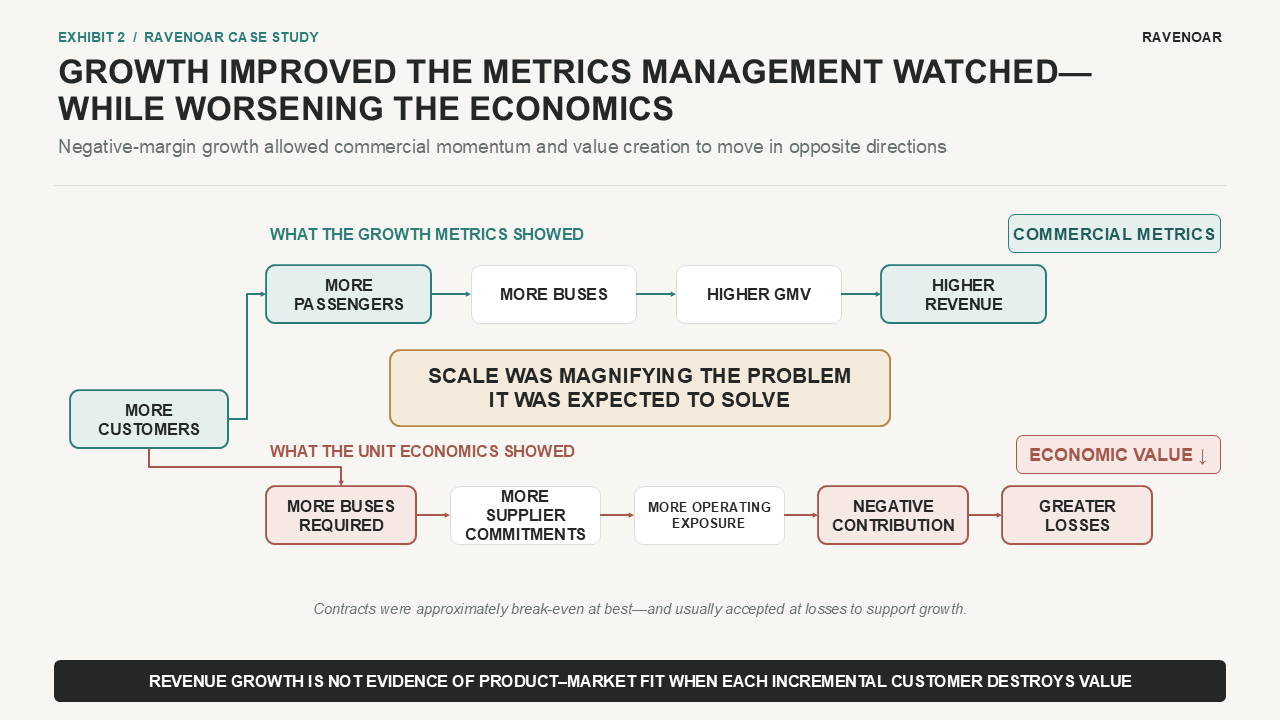
This created a dangerous divergence between the metrics management was emphasizing and the economics underneath them.
Customers increased. Market coverage increased. Revenue increased.
Yet contribution economics remained negative.
A company measuring commercial momentum primarily through gross transaction volume could therefore conclude that the regional turnaround was beginning to work at exactly the same moment that the economics suggested the opposite.
The distinction was especially important in the venture environment of the period, when rapid top-line expansion could receive substantially more organizational attention than near-term profitability.
But no amount of enthusiasm around GMV could change the underlying arithmetic.
If each additional contract produced a negative contribution, then signing more contracts did not move the business toward profitability.
It moved the business further away from it.
Scale was magnifying the problem it was expected to solve.
The market had removed the hiding places
The Gulf also revealed another weakness in the expansion thesis.
A business model developed in a fragmented transport market cannot automatically be transplanted into a highly regulated and comparatively transparent one.
In fragmented markets, fleet quality can vary widely. Supplier pricing may be opaque. Customers may have limited visibility into available capacity. Standards may differ substantially between operators.
An intermediary can create value simply by organizing that fragmentation. Aggregation, standardization and access can themselves become products.
A more regulated market changes the equation.
When vehicle standards are clearer, credible suppliers are known and sophisticated customers understand prevailing prices, the information asymmetry shrinks.
The intermediary then needs another reason to exist.
For this company, that reason was meant to be technology.
But examining the broader business raised an even more difficult question. Large contracts in earlier markets had generated substantial revenue and helped create confidence in the model, but revenue alone did not establish that those contracts, or the broader customer portfolio, were ever economically sustainable.
What had sometimes been interpreted as evidence that the model worked could instead be evidence that the company was capable of generating substantial transaction volume.
Those are not the same thing.
A business has not demonstrated product-market fit merely because customers will buy something.
It must eventually demonstrate that customers will buy it at a price that allows the company to create sustainable economic value.
Three options that could have worked
By this point, the turnaround had evolved into something closer to a strategic diagnosis.
There appeared to be three plausible ways to make the underlying proposition economically viable.
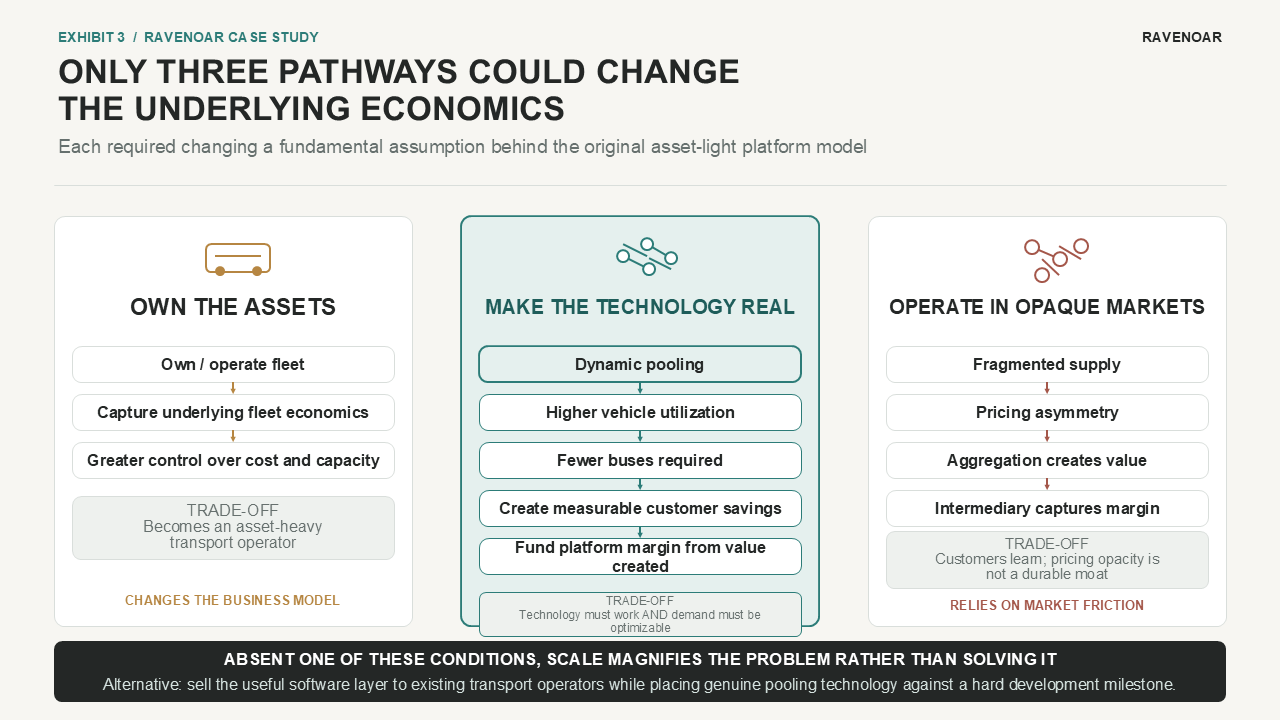
The first was to own the assets.
If the company purchased and operated buses itself, it could capture economics currently earned by fleet suppliers. It would gain greater control over vehicles, drivers and operating costs.
But this would fundamentally change the company.
Instead of an asset-light technology platform orchestrating third-party transportation, it would increasingly resemble an asset-heavy transport operator with capital requirements, utilization risks and operational complexity that come with it.
The second option was to make the technology genuinely work.
This preserved the original thesis.
If dynamic pooling could consistently reduce the physical fleet required to transport a given passenger base, technology would create measurable economic value.
The important metric would no longer be how many buses passed through the platform. It would be how many buses the platform could eliminate from the customer's existing requirement while maintaining service quality.
That difference could finance the business.
But there was another constraint. Even perfect technology needed optimizable demand. Customer locations, passenger origins, working patterns and journey timing had to overlap sufficiently for pooling to generate meaningful savings.
The technology had to work and the operating environment had to give it something worth optimizing.
The third route was to operate where information asymmetry remained sufficiently large.
In fragmented markets, customers unfamiliar with underlying transport costs might accept a premium in exchange for convenience, standardization and a managed service.
That could generate margin. But it would be a fragile advantage.
Customers learn. Procurement teams benchmark. Suppliers eventually approach clients directly. What begins as an information advantage can disappear once the market understands the economics.
Of the three pathways, genuine technology-driven optimization offered the clearest route consistent with the company's original proposition.
The problem was that the capability needed to prove that proposition was not functioning adequately in practice.
The alternative was to stop pretending
There was another possible strategy.
Instead of continuing to operate as an intermediary between bus owners and customers, the company could separate the useful technology it did possess from the broader business model.
The check-in/check-out system, passenger visibility and fleet-management functionality had potential value to existing transport operators and organizations already managing their own fleets.
Selling software would produce a smaller revenue story than placing large amounts of transportation revenue through a platform.
But it would also remove much of the problematic fleet economics.
The company could then place the more ambitious pooling technology against a hard development milestone.
Build it. Test it. Demonstrate that it materially reduces customer transportation costs.
If it worked, the broader platform proposition could be reconsidered. If it did not, management would have its answer.
That recommendation was less exciting than continuing geographic expansion and reporting rapid top-line growth.
It was also considerably closer to what the economics supported.
The limits of a turnaround
After approximately six months, the regional operation was better organized than the one that had been inherited.
Regulatory relationships were stronger. Supplier arrangements had improved. The corporate structure was being corrected. Procurement discipline had increased. The team contained more relevant transport expertise. More customers had been acquired and the company had expanded its market presence.
Those were genuine improvements.
They were also insufficient.
The turnaround had successfully tested many of the explanations normally offered for poor performance.
Perhaps the local team was weak. Perhaps supplier pricing was poor.
Perhaps the company lacked government access. Perhaps the legal structure was wrong.
Perhaps sales were too low.
All were addressed.
After progressively addressing those issues, the underlying conclusion became harder rather than easier to avoid.
Even better execution could not reliably produce attractive economics from the existing model.
At that point, continuing to optimize the regional operation risked confusing activity with progress.
The appropriate strategic question had changed from How do we grow this business? to Should this business, in its current form, be grown at all?
RavenOar insight: prove the economics before scaling the execution
Turnarounds often begin with an implicit assumption that the underlying business deserves to survive.
That assumption should be tested.
There are two fundamentally different questions management must answer.
Can this organization execute better?
vs
If it executed exceptionally well, would the business actually be attractive?
The first question concerns management, processes, capabilities and operations.
The second concerns structural economics.
Confusing them can be expensive.
A weak organization can obscure a good business model because poor execution prevents its economics from emerging.
But the opposite is also possible. Poor execution can provide a convenient explanation for weak performance in a business whose economics would remain unattractive even if the organization operated exceptionally well.
Fixing execution then becomes diagnostic.
Renegotiate the suppliers. Improve sales. Strengthen the team. Repair government relationships. Remove unnecessary costs. Test the obvious operational explanations.
Then look again at the unit economics.
If they improve, keep going. If they do not, management should be willing to question the premise rather than simply intensify the execution.
The danger becomes particularly acute when organizations reward growth metrics disconnected from value creation. Customer growth, geographic coverage and top-line revenue can all rise while the underlying business deteriorates.
A negative-margin business does not necessarily become a good business when it gets bigger.
It simply becomes a bigger negative-margin business.
Sometimes the most valuable outcome of a turnaround is not saving the model that management have inherited.
It is proving why that model should not be scaled.
