
When the Solution is the Problem
How challenging a multi-year restructuring uncovered a radically simpler path—and exposed the incentives that can keep transformations complex

A major Middle Eastern government authority had a structural problem.
Policy and regulatory responsibilities sat inside the same organization responsible for day-to-day operations. Regional leadership had concluded that the two needed to be separated as per global standards. The principle was straightforward, the institution responsible for setting policy and overseeing an ecosystem should not simultaneously be responsible for operating large parts of it.
What followed was considerably less straightforward.
Over several years, external advisers had examined how the separation should work. By the time implementation planning began in earnest, an extensive transformation architecture had emerged. Operating divisions would progressively move into a separate entity. Employees would transfer. Reporting structures would change. Corporate support functions would need to be replicated or reorganized. New roles and job descriptions would be created.
The process was expected to take approximately 18 to 24 months.
Six months into the implementation effort, a newly arrived team assisting the broader implementation advisory workstream asked a different question:
Why move almost the entire organization when the objective could be achieved by moving the small part that actually needed separating?
That question ultimately changed the transformation.
It also exposed a more uncomfortable question, one relevant far beyond this particular organization:
When advisers are commercially rewarded for the size and duration of a transformation, who is independently testing whether all that transformation is necessary?
A solution had gradually become a premise
Separating policy and regulatory responsibilities from operations was not a new idea.
Major consulting organizations and subsequent implementation advisers had considered the issue over a period of years. Gradually, an organizational model had become accepted: operational activities would be extracted from the existing government organization and transferred into a separate operating entity.
On paper, the logic was defensible. If one organization currently contains both regulation and operations, move the operations somewhere else.
The problem was scale.
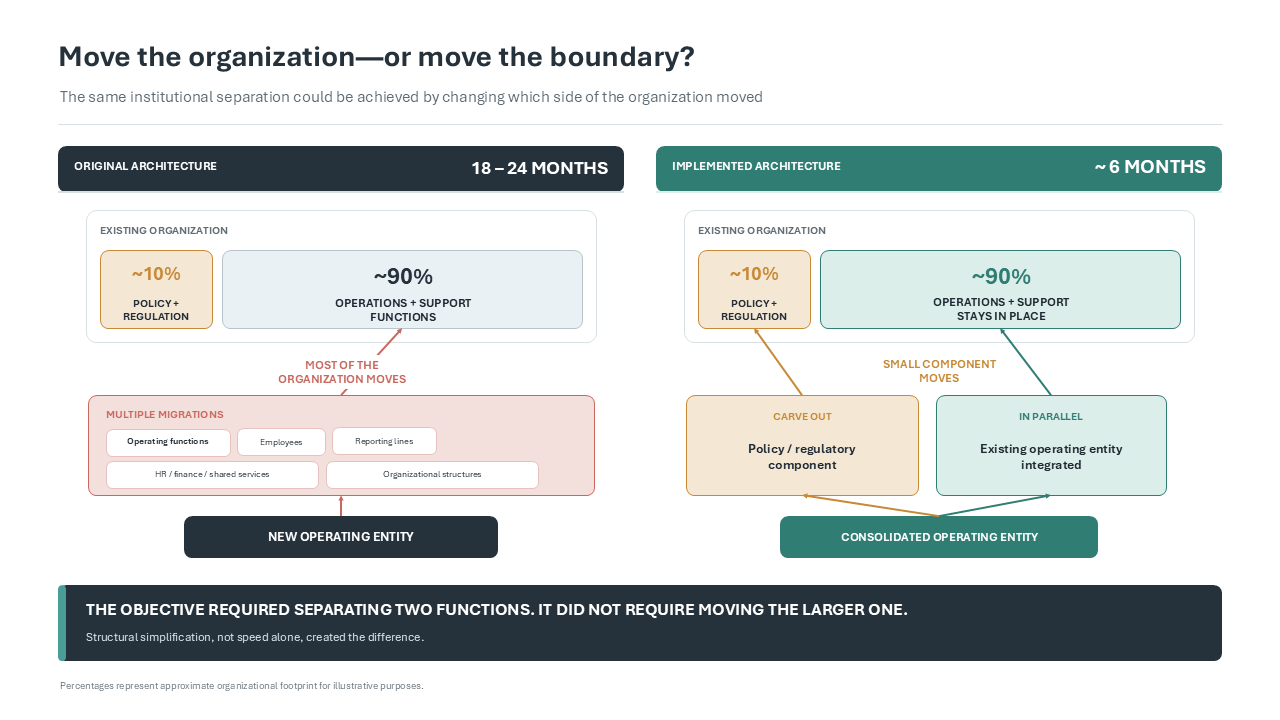
Operations represented the overwhelming majority of the existing organization. Approximately 90% in both headcount and expenses. Moving them meant transferring multiple operating divisions as well as the people, management structures and supporting infrastructure surrounding them.
HR would be affected. Finance would be affected. Organizational structures would change. Employees would move between legal entities. Roles and reporting lines would have to be redesigned. Support functions would have to be established in the appropriate organizations.
A relatively simple governance objective had therefore become a major organizational transformation.
By the time the new supplementary consulting team was involved, the underlying architecture was barely being questioned anymore. Work had moved downstream. Interviews were being conducted. New positions were being considered. Job descriptions were being written. Teams were planning how employees and functions would migrate.
The organization was no longer primarily asking:
What is the simplest way to separate policy from operations?
It was asking:
How do we successfully execute the separation model we have already chosen?
That distinction mattered.
Reopening the question everyone had stopped asking
A new supplemental advisory team joined approximately six months into the work.
Coming into the program without the accumulated assumptions of the preceding months and years created an advantage: the proposed architecture looked strange.
If perhaps 90% of the organizational footprint was operational and only a relatively small portion represented the policy and government functions that needed to remain institutionally separate, why migrate the 90%?
Why not carve out the smaller component instead?
The analogy was almost embarrassingly simple.
If eight slices of a pizza are sitting on one table and the objective is to separate one slice from the other seven, there are two ways to do it. Seven slices can be picked up individually and transferred to another table.
Or one slice can be moved.
The tables can then be renamed.
The institutional outcome is the same. The amount of organizational movement is radically different.
The alternative proposal therefore reversed the transformation architecture. Rather than progressively extracting the organization's operating divisions, most of the existing organization could remain structurally where it already was. The relatively small policy and regulatory component could be carved out and established as the government authority.
An existing operating organization could simultaneously be incorporated into what remained, creating the consolidated operating entity.
There would still be work.
The carved-out government organization required independent corporate capabilities because two legally separate entities could not simply share every support function indefinitely. Some finance, HR and other administrative responsibilities therefore needed to be established or transferred. A legal decree was required to formalize the institutional structure.
But a decree was required under the original approach as well.
What disappeared was much of the enormous migration exercise surrounding the original design.
The resistance was not only technical
Initially, the dramatically shorter alternative created skepticism.
Leadership had been presented with an 18–24 month transformation by several strategy-house organizations for years. Suddenly, another adviser was arguing that the underlying carve-out could potentially be achieved in a matter of months.
The difference itself made the alternative difficult to believe.
If the shorter route was feasible, why had years of advisory work not produced it?
The proposal therefore had to survive additional scrutiny. Its assumptions were examined. The organizational implications were considered. The legal requirements were tested.
But the resistance was not confined to questions of feasibility.
The original consultancy responsible for the longer transformation faced an unavoidable commercial problem.
A program expected to generate perhaps 18 to 24 months of implementation work was potentially being compressed dramatically. Supporting the alternative therefore meant supporting a course of action that could substantially reduce the consultancy's own future revenue.
There was a reputational dimension as well.
The alternative implicitly questioned why such an extensive transformation had been recommended in the first place. A much shorter route did not merely reduce future work; it challenged the efficiency of the existing approach.
None of this requires assuming deliberate misconduct. But it does invite questions.
Importantly, it certainly requires acknowledging incentives.
Consulting firms are professional advisers. They are also businesses.
Like law firms and other professional-services organizations, many consulting economics remain connected, directly or indirectly, to the amount of work performed. Billable-hour models make that relationship obvious, but milestone and project-based models do not necessarily eliminate it. A transformation requiring a large team for six months can generally support a larger commercial engagement than one producing the same organizational outcome in two weeks.
The client benefits when unnecessary work disappears.
The external adviser does not necessarily benefit from it.
That creates an incentive problem that clients frequently underestimate.
Complexity creates its own constituency
Commercial incentives were only part of the resistance.
By the time the alternative appeared, significant organizational effort had already been invested in the original transformational workstreams.
Even members of the second consulting unit had spent months working within its assumptions. Employees had been interviewed. Organizational structures were being examined. Job descriptions were being developed.
This is a common transformation problem.
Once sufficient effort has been invested in determining how something will be implemented, organizations become progressively less likely to revisit whether it should be implemented that way at all.
Complexity begins generating its own momentum.
It also creates stakeholders.
Under the original architecture, employees faced uncertainty about where they would eventually sit. This was particularly relevant for expatriate subject-matter experts whose existing government compensation could be attractive. Moving into a different operating organization raised questions about future employment conditions and compensation, even where no reduction had formally been proposed.
Local senior management faced a different concern.
Separating policy from operations could dramatically change organizational territory. A leader previously responsible for a large combined function might retain responsibility for only a small policy team after operational employees transferred elsewhere. Conversely, operational managers could acquire significantly greater authority inside the new operating organization via promotion.
Transformation therefore threatened not only boxes on an organization chart, but status, influence and career trajectories in a region predicated on optics and image.
The larger the migration became, the more those relationships had to be renegotiated.
The simpler architecture reduced that burden by leaving most of the organization where it already was.
From an 18–24 month program to approximately six months
The alternative ultimately won.
The final implementation was somewhat more involved than the initial carve-out concept because leadership elected to undertake another organizational integration simultaneously. An existing operating organization was merged into the structure while the policy and regulatory functions were carved out.
Even with that additional work, the restructuring was substantially completed in approximately six months rather than through the originally envisaged 18–24 month sequential migration.
Most importantly, speed did not undermine the strategic objective.
The institutional separation endured.
Years later, the basic structure created through the accelerated restructuring remains in place.
The first consultancy remained for a period while completing other assignments already under way, but was subsequently not retained for additional work.
The transformation that had once appeared to require as much as two years had not required anything close to it. Relationships change with proper information.
The consulting incentive paradox
The experience points toward a problem larger than one consultancy or one government transformation.
Clients generally hire consultants because they expect outside expertise to improve decisions, remove inefficiency and accelerate change.
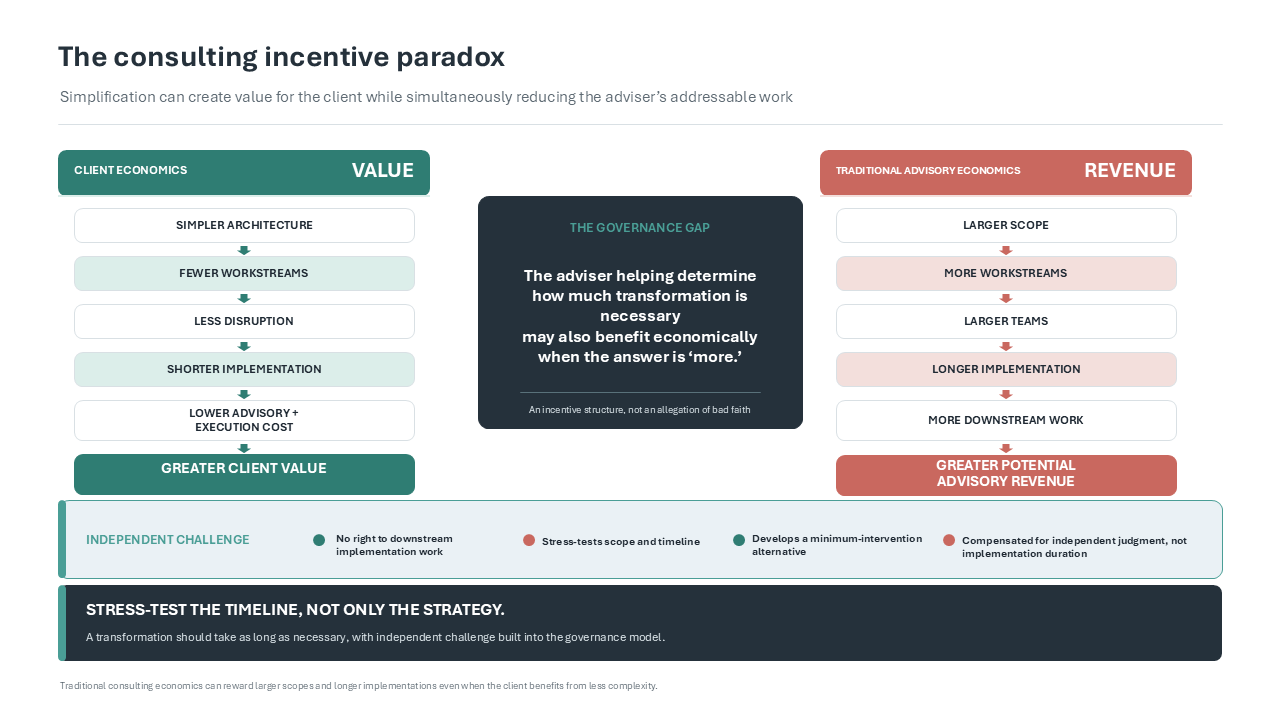
But consider the economics when the consultant discovers that the client requires dramatically less consulting than expected. Suppose an organization believes it needs an 18-month transformation involving several workstreams and a substantial consulting team.
And a new adviser discovers a structurally different solution that delivers the same outcome at a fraction of the proposed schedule.
The client wins.
Organizational disruption falls. Management capacity is released. Implementation risk can decline. Consulting expenditure falls. Benefits arrive sooner, in theory.
For the adviser, many of those same improvements can reduce the addressable engagement.
That does not mean all consultants systematically inflate programs or knowingly recommend unnecessary work. Many do, some do not. It means clients should recognize that the commercial interests of buyer and adviser are not perfectly aligned when determining how much work is necessary.
Good governance should be designed around that reality rather than pretending it does not exist.
Stress-test the timeline, not only the strategy
Organizations commonly seek second opinions about strategy.
They should do the same with transformation timelines.
If a consultant proposes an 18-month program, leadership should not merely ask whether the proposed activities are sensible. It should ask why they require 18 months.
Could they be completed in 12? Six? Three?
What specifically breaks if the timeline is compressed?
Which dependencies are genuinely sequential, and which have simply been arranged sequentially?
Which activities are essential to the outcome, and which exist because the chosen transformation architecture created them?
A shorter timeline is not inherently superior. Some transformations genuinely require years. Regulatory processes, technology migrations, workforce changes and operational dependencies can impose real constraints. Compressing them indiscriminately can create substantial risk.
That is precisely why independent challenge matters.
The objective should not be to find someone willing to promise the shortest timeline. It should be to introduce an adviser whose economics do not depend upon whether the answer is two months or two years.
One model is relatively simple: appoint an independent optimization or challenge team that is contractually prohibited from participating in subsequent implementation.
Give it the proposed strategy, scope and timeline.
Then ask:
Is this necessary? Is there a simpler architecture? What is the minimum intervention required to achieve the same outcome? And what risks genuinely prevent us from doing it faster?
Only after those questions have been answered should the organization commit to the implementation program.
The value of fresh eyes is often in reopening closed questions
There is another lesson from the restructuring.
The alternative did not emerge from months of additional analysis. It emerged because somebody new entered the program and questioned an assumption that everyone else had begun treating as fact.
That distinction matters.
Transformation teams naturally become better at answering the questions placed in front of them. Once the question becomes how do we migrate these functions?, capable consultants will develop increasingly sophisticated migration plans.
They may conduct interviews, design governance structures, create transition plans, rewrite roles and build detailed implementation roadmaps.
All of that work can be excellent.
And all of it can be unnecessary if the better question was:
Why are we migrating them at all?
Organizations therefore need mechanisms that periodically return transformations to first principles—particularly before substantial implementation expenditure becomes committed.
The further a program progresses, the harder that becomes. Work already completed becomes psychologically difficult to discard. Teams become attached to their recommendations. Careers and reputations become associated with particular approaches. Suppliers develop commercial expectations. Internal stakeholders reorganize around anticipated outcomes.
Eventually, changing direction can feel more difficult than continuing with an inefficient plan.
That is precisely when challenging it becomes most valuable.
Consultants are advisers. They are also vendors.
There is nothing inherently improper about a consultancy seeking revenue. It is a business and should be expected to behave like one.
The mistake occurs when clients forget that fact.
Consulting firms can bring expertise, pattern recognition, analytical capacity and independent perspectives that organizations cannot efficiently maintain internally. But purchasing those capabilities does not eliminate the need for procurement discipline and governance.
A client would not allow a construction contractor alone to determine how large a building needs to be and then assume that recommendation is commercially neutral.
Major transformations deserve similar scrutiny.
Scope should be challenged. Architecture should be challenged. And duration should be challenged.
In this case, leadership initially faced an 18–24 month transformation involving extensive organizational migration. Reopening the fundamental design question produced a different architecture, concentrated the unavoidable change into a much smaller organizational footprint and completed the restructuring in roughly six months—even while incorporating an additional merger.
The resulting institutional structure endured.
The lesson is therefore not that every two-year transformation can be completed in six months.
It is that no organization should commit to two years simply because the people being paid for those two years tell it that two years are necessary.
Sometimes the highest-value consulting recommendation is the one that eliminates most of the consulting.
