
When Sales Cycles Determine Success, Not The Product
How a government-backed transport operator discovered that fleet scale could not substitute for market understanding
A large government-backed transport operator had spent years managing thousands of vehicles. Taxis, limousines and other mobility services were familiar territory. Fleet procurement, driver management, maintenance and large-scale operations were established capabilities.
When the organization decided to enter school transportation, the expansion therefore appeared relatively straightforward. It had capital, operating infrastructure and experience managing vehicles at scale.
Then it began buying school buses - many of them. Approximately 300 were procured initially, followed by another roughly 200. At one stage, the ambition was to expand the fleet toward 1,200 school bus vehicles.
There was one significant problem.
The organization had not secured enough customers to use them.
When an assigned team was brought in to examine why the new division was struggling, the simple reason and prevailing explanation was straightforward: sales was failing to sell the buses.
The diagnosis reached a different conclusion.
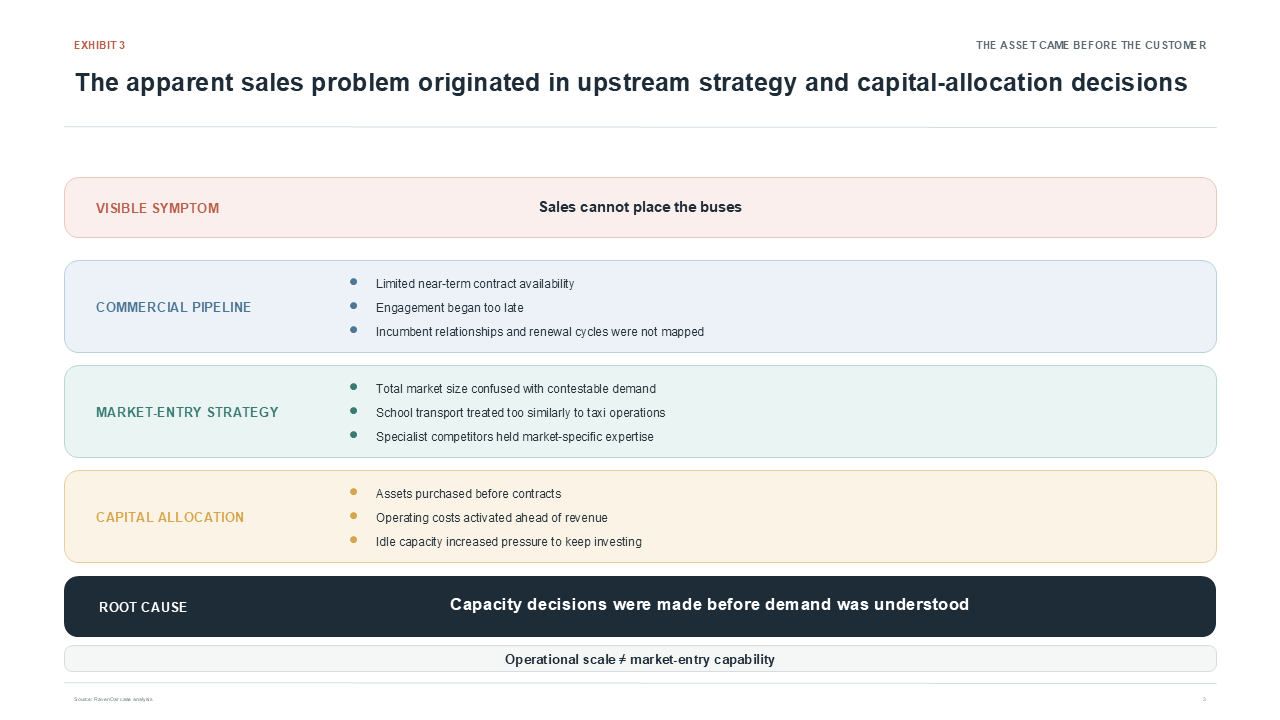
This wasn't primarily a sales problem. It was a strategy problem that had arrived at the sales department.
SCALE IN ONE MARKET DOES NOT GUARANTEE EXPERTISE IN ANOTHER
The organization's confidence was understandable. It already operated a vehicle fleet many times larger than the proposed school-bus operation. But that experience obscured a fundamental difference between the businesses.
A taxi can generally be activated and exposed to demand. Once the vehicle, driver and necessary operating requirements are in place, the asset can enter service and begin generating revenue from individual trips.
School transportation operates differently.
Demand is aggregated into contracts. Schools, parents and transport providers can be tied together through arrangements lasting one or multiple years. Hundreds of students may need to be assigned to routes. Vehicles, drivers, schedules and service requirements must be coordinated. Decisions are heavily influenced by the academic calendar.
A competitor cannot simply arrive halfway through the school year with 50 available buses and expect an incumbent contract to disappear.
The relevant question was therefore not: How large is the school-transport market?
It was: How much of that market will actually become contestable, when will it become contestable and how much of it can the provider realistically win?
That analysis should have preceded procurement.
Instead, the sequence had been reversed.
The Hidden Constraint: Contract Timing
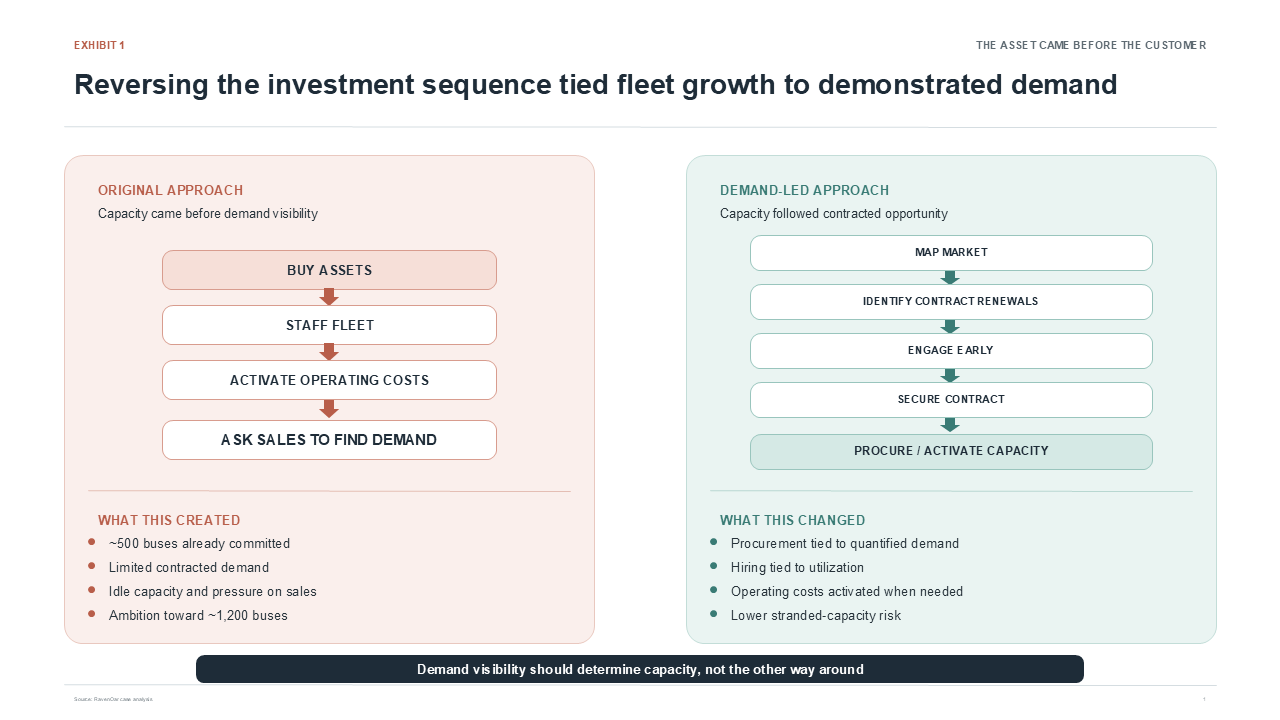
The first strategic reset was therefore to map the market rather than simply intensify sales activity.
Schools and other potential institutional customers needed to be identified. Existing transport providers had to be understood. Contract structures and renewal dates needed to be mapped. New schools entering the market represented another source of potentially contestable demand.
Most importantly, the commercial process needed to begin well before procurement.
If a meaningful contract was due for renewal in a year's time, that was the point at which engagement should begin—not several weeks before the incumbent agreement was renewed. This transformed the sales function from a team attempting to find somewhere to place already-purchased assets into a forward-looking commercial pipeline tied to identifiable demand.
It also exposed the danger of the existing expansion plan.
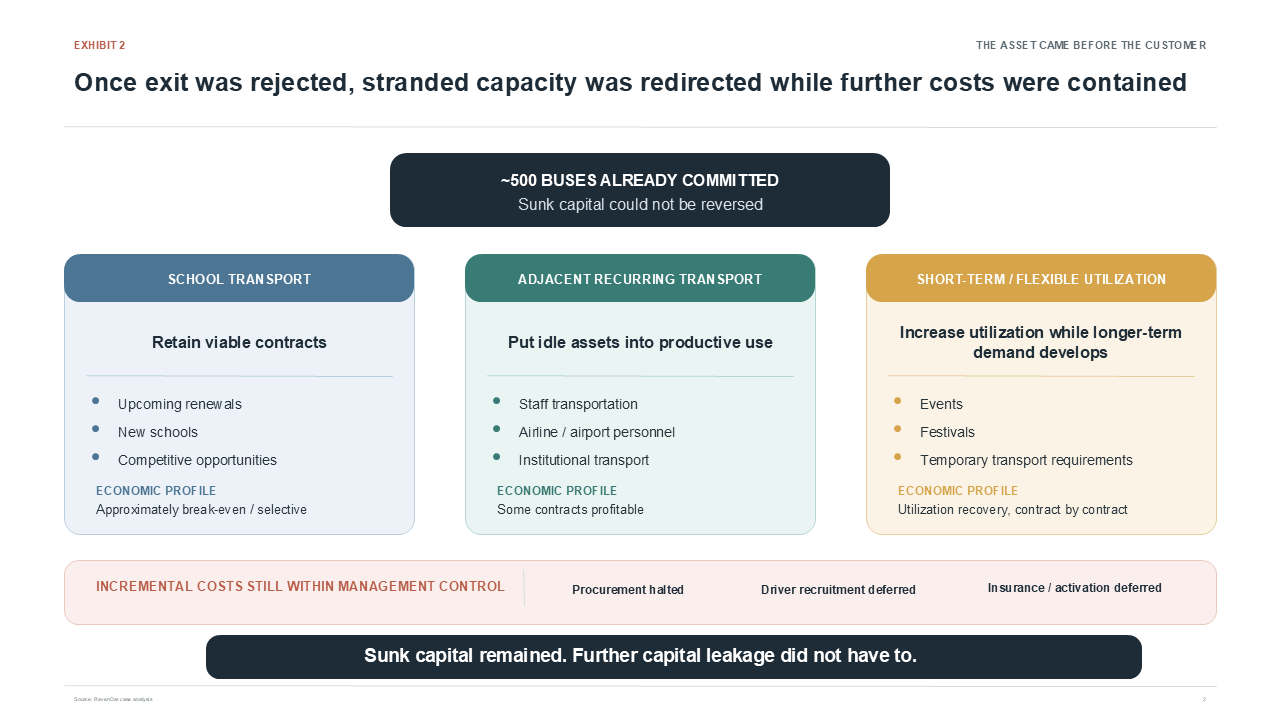
The organization had already committed to approximately 500 buses and was struggling to deploy them. Continuing toward an ambition of roughly 1,200 would not have solved that problem. It would simply have multiplied the amount of capital dependent on contracts that did not yet exist.
Further bus procurement was halted.
STOPPING THE PURCHASE WAS ONLY THE FIRST STEP
Preventing additional capital from being committed addressed the future problem. It did nothing about the hundreds of buses already purchased.
The strongest economic response would arguably have been more radical. The analysis suggested that the organization should consider exiting the school-transport business altogether.
Despite its advantages in scale, capital and institutional credibility, it was entering a mature market against specialist incumbents with established customer relationships and lower cost structures. As a large government-backed organization, its overhead base made competing economically against leaner legacy providers difficult.
Selling relatively new buses and closing the nascent division could therefore have been preferable to committing further resources simply to justify the original investment.
That recommendation was not accepted.
The challenge consequently became one of finding the best achievable outcome within that constraint.
The first principle was to avoid turning stranded capital into stranded operating expense.
A parked bus was already a sunk investment. Hiring a driver for that bus, activating insurance and incurring other operating costs before revenue existed would make those economics worse.
Driver recruitment and other avoidable costs were therefore deferred until actual contracts justified activating the vehicles. The distinction was simple but consequential.
Owning an idle asset does not mean the organization should spend more money making it operational.
RECOVERING VALUE FROM THE EXISTING FLEET
At the same time, the commercial proposition for school transportation was repositioned.
The buses were relatively new and incorporated modern technology and features. These attributes had initially contributed to the specification, and cost, of the fleet.
They did offer some differentiation. Schools themselves competed for families, and modern vehicles, technology, safety features and a higher-quality presentation could contribute to their own proposition to parents and school industrial sourcing.
The organization's government backing also provided credibility.
But neither advantage fundamentally changed the economics. Ultimately, a school bus still had to provide reliable transportation at a price sufficiently close to competing offers.
The commercial team therefore pursued the school opportunities that genuinely became available while building a longer-term pipeline around future renewals.
But the more immediate problem remained. What could be done with buses for which no school contract existed?
The answer was to stop treating them exclusively as school buses.
Vehicles were redeployed into adjacent transportation markets where appropriate. These included staff transportation, movements for airline and airport-related personnel, festivals, events and other short-term transportation requirements.
Some of these alternative contracts proved profitable.
This created a portfolio response to what had originally been conceived as a single-purpose fleet. Retain viable school contracts, pursue future school opportunities selectively and use otherwise stranded capacity wherever adjacent demand could generate acceptable economics.
THE MOST IMPORTANT CHANGE WAS THE ORDER OF DECISIONS
The school-transport operation ultimately remained within the broader organization, although it was subsequently moved within the institutional structure.
It did not become the rapidly expanding fleet originally envisioned. That was arguably the better outcome.
Existing school contracts could be maintained around approximately break-even economics, while portions of the fleet found more attractive utilization in adjacent transport activities. The organization avoided continuing the proposed expansion toward a substantially larger speculative fleet.
More importantly, its investment logic changed.
Before the intervention, the implicit sequence had been:
Buy the asset → staff it → activate it → push sales to find demand
Afterward, the governing principle became:
Identify demand → pursue the opportunity → secure the contract → activate or procure the required assets
That reversal sounds obvious. In asset-intensive businesses, it often isn't.
Large organizations can become particularly vulnerable when they possess abundant capital, established procurement functions and deep operating capabilities. The ability to buy and operate an asset can gradually become confused with evidence that the asset should be purchased.
In this case, the organization's experience operating thousands of vehicles may actually have contributed to the initial mistake.
School buses looked operationally familiar.
Commercially, they were not.
WHEN A SALES PROBLEM IS NOT A SALES PROBLEM
Perhaps the most important management lesson came from the original diagnosis.
The new division was struggling to place its buses, so responsibility naturally migrated toward sales. If hundreds of vehicles were sitting idle, the apparent solution was to improve the people responsible for selling them.
But by the time the buses reached the sales team, much of the risk had already been created.
Sales had not decided how many buses to purchase. Sales had not determined when the underlying market would become contestable. Sales had not created the contract structures tying schools and incumbent providers together. Sales could not manufacture renewal opportunities simply because the organization had vehicles available.
Demand generation could improve the outcome, but it could not retroactively make the original capital allocation decision sound.
This distinction matters well beyond transportation. Organizations frequently diagnose problems at the point where failure becomes visible rather than where it originated.
A factory with excess inventory can appear to have a distribution problem.
A hotel development with weak occupancy can appear to have a marketing problem.
A technology product with poor adoption can appear to have a sales problem.
Sometimes those diagnoses are correct.
Sometimes the downstream function has simply inherited the consequences of an upstream strategic decision.
THREE LESSONS FOR ASSET-INTENSIVE GROWTH
Market size is not the same as accessible demand. A large market can still offer very little near-term opportunity when demand is locked behind contracts, renewal cycles, regulation or incumbent relationships. Capacity decisions should be based on realistically contestable demand, not headline market size.
Adjacent operating capability does not eliminate the need for market-specific expertise. The organization was highly capable of operating thousands of vehicles. That did not automatically make it capable of entering school transportation. Similar-looking assets can sit inside fundamentally different commercial systems.
Sunk costs should not dictate the next investment decision. Once the buses had been purchased, management faced a difficult choice. But previous spending did not make further procurement, driver recruitment or operating expenditure economically rational. Each incremental commitment still needed to justify itself independently.
The intervention did not produce the most dramatic outcome available on paper. The preferred recommendation—to exit the school-transport market entirely—was not pursued.
Instead, the organization adopted a more pragmatic version of the strategy. It stopped speculative fleet expansion, limited additional operating costs until demand existed, built a commercial pipeline around actual contract opportunities and found alternative uses for assets that had already been purchased.
That was enough to change the fundamental rule governing future investment.
The contract would come first. The asset would come second.
And in a business where a decision to grow could mean hundreds of vehicles, hundreds of drivers and years of associated costs, changing that sequence was more valuable than simply selling a few more buses.
