
Building the Institution Behind the Giga-Project
How an early-generation giga project bridged the financial systems of a state-sponsored oil company and a Western-style research institution—and built the capital architecture for independence
When governments embark on projects of unprecedented scale, they often turn to the institutions that have already demonstrated an ability to deliver complexity.
For one of the Middle East's earliest giga projects, that institution was a state-sponsored national oil company. It possessed enormous financial resources, sophisticated project-management capabilities and decades of experience delivering some of the country's largest and most technically demanding investments. When the government decided to create an entirely new research university, research ecosystem, and surrounding city, assigning the oil company to fund and manage its development was therefore a logical decision.
But the organization best equipped to build an institution is not necessarily the organization whose systems should determine how that institution ultimately operates.
The project being created was unlike the industrial assets its sponsor traditionally developed. It combined a Western-style research university with advanced laboratories, scientific infrastructure, supercomputing capabilities, residential communities, municipal services, transportation, security and the supporting infrastructure of a small city. Its academics, researchers, administrators, and specialists were all being recruited internationally.
Billions of dollars of assets were being created almost from scratch. And eventually, the new institution would be expected to stand on its own.
That created a less visible challenge beneath the physical construction of the giga project: The institution needed a financial operating model of its own.
When Industries C-Oil-lide
The state-sponsored oil company had developed financial and project-management systems appropriate to its circumstances. It had historically enjoyed extraordinary liquidity, operated outside many of the constraints faced by conventional corporations and was accustomed to funding large capital programs.
For the emerging research institution, however, those systems created problems.
The sponsor's budgeting processes were heavily oriented toward cash. Expenditures were identified, funding requirements established and cash made available against approved requirements. For an organization with deep financial resources executing comparatively predictable capital projects, the system had considerable internal logic.
A research institution operated differently.
Its leadership ultimately needed to understand not simply how much cash was being spent, but the economic cost of operating the institution. Buildings depreciated. Scientific equipment would become obsolete. Computing infrastructure required replacement. Housing and city infrastructure had useful lives. Capital investments made during construction would eventually become operating, maintenance, and replacement obligations.
Those distinctions mattered little while a well-capitalized sponsor stood ready to meet what is colloquially known as ‘cash-calls’.
Those distinctions, however, mattered enormously once the institution became responsible for itself upon the expiry of parent-company sponsorship.
There was also a more immediate problem. Research requirements could be unpredictable.
A conventional capital project can specify much of what it needs before construction begins. A cutting-edge research institution cannot always do the same. Researchers arriving from around the world might require highly specialized microscopes, laboratory systems, computing components or other equipment that had not been anticipated when the annual budget was prepared.
Under the existing process, an unanticipated requirement could trigger formal budget-change procedures because there was no approved line item against which the expenditure could be charged.
The institution could therefore have the money and a legitimate strategic requirement—and still struggle to buy what it needed quickly.
This was not simply a disagreement over accounting. It reflected a deeper collision between two institutional operating models.
Building a financial translation layer
Replacing the sponsor's financial system was neither realistic nor necessary. It was a vast organization with established controls designed around its own requirements. It was also something that was required as the new instituation was years away from self-sustaining revenue.
Instead, an assigned project-finance team developed a compromise-solution, a mechanism that could operate between the two systems.
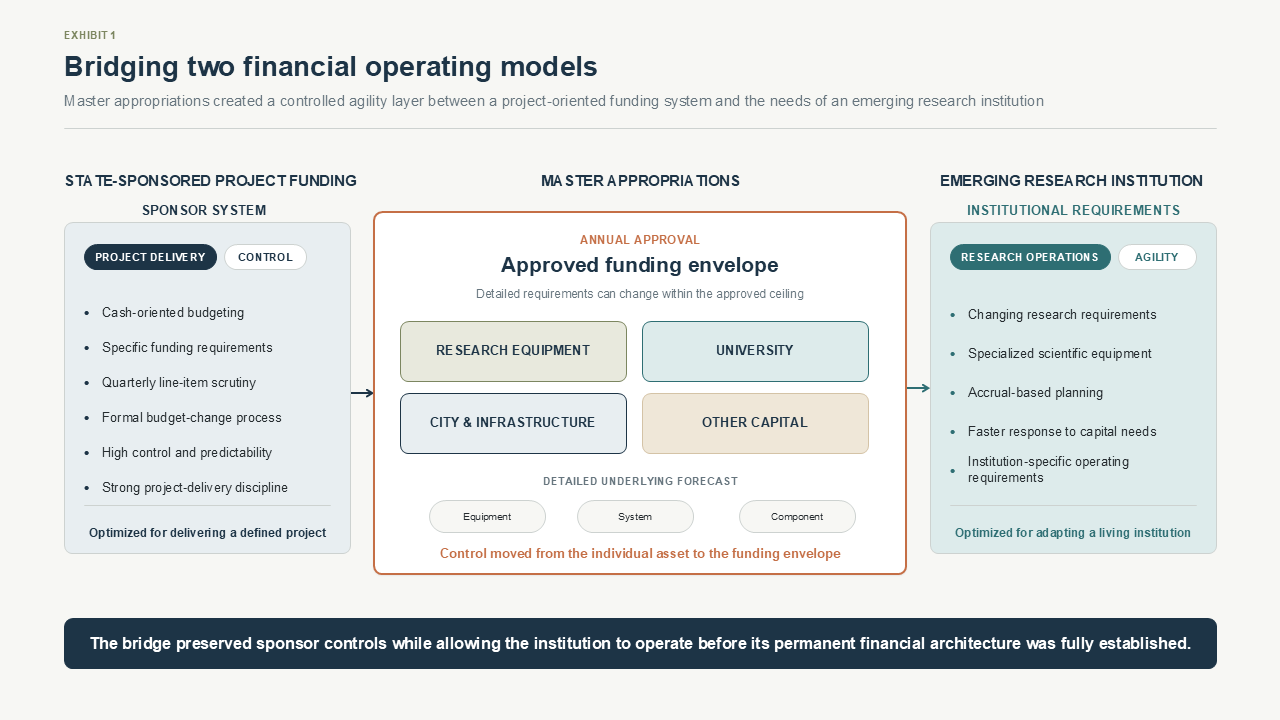
A small number of large master appropriations were created for broad categories of capital expenditure. Rather than attempting to forecast every individual asset precisely, anticipated requirements were aggregated into funding envelopes covering areas such as research equipment, university requirements, city infrastructure and other capital needs.
Detailed forecasts still sat beneath those appropriations. If a master appropriation contained, for example, $30 million, an underlying planning model identified the expenditures that were expected to consume that funding.
But approval occurred, as far a the funding agency was concerned, at the portfolio level rather than exclusively at the individual-asset level.
That distinction was critical.
Master appropriations were among the relatively few funding categories that were reviewed on an annual rather than quarterly line-item basis. Once an appropriation had been established, changing requirements could be charged against the broader approved envelope without repeatedly reopening the entire budget-change process.
From the perspective of a multibillion-dollar giga project, the mechanism effectively created a form of institutional "petty cash"—although the amounts involved could run into tens of millions of dollars yearly on a multi-billion dollar asset base.
The solution, importantly, did not remove financial discipline. It changed the level at which that discipline was applied.
Instead of demanding perfect foresight over thousands of individual capital requirements, governance established an approved ceiling and allowed management greater flexibility within it.
A pocket of freedom within a micro-managed purse system.
That was particularly valuable for scientific assets, where requirements could evolve rapidly and delays could directly affect the institution's ability to conduct research.
Two versions of financial reality
Solving the funding bottleneck exposed another parallel problem.
The sponsor and the emerging institution could look at the same operation and report different expenditures—and both numbers could be correct.
From the sponsor's perspective, the important measure was principally the cash being provided. From the institution's perspective, that did not represent the full economic cost of operating what had been built.
The discrepancy became particularly significant at board level.
Large equipment purchases could be relatively straightforward because cash expenditure and the initial recognition of the asset were visible at approximately the same time. Infrastructure was different. A newly completed building might require little immediate additional cash, but the institution had nevertheless begun consuming an asset with a finite useful life.
The same applied across an unusually diverse asset portfolio: scientific instruments, laboratories, computing equipment, furniture, housing, municipal infrastructure and major buildings.
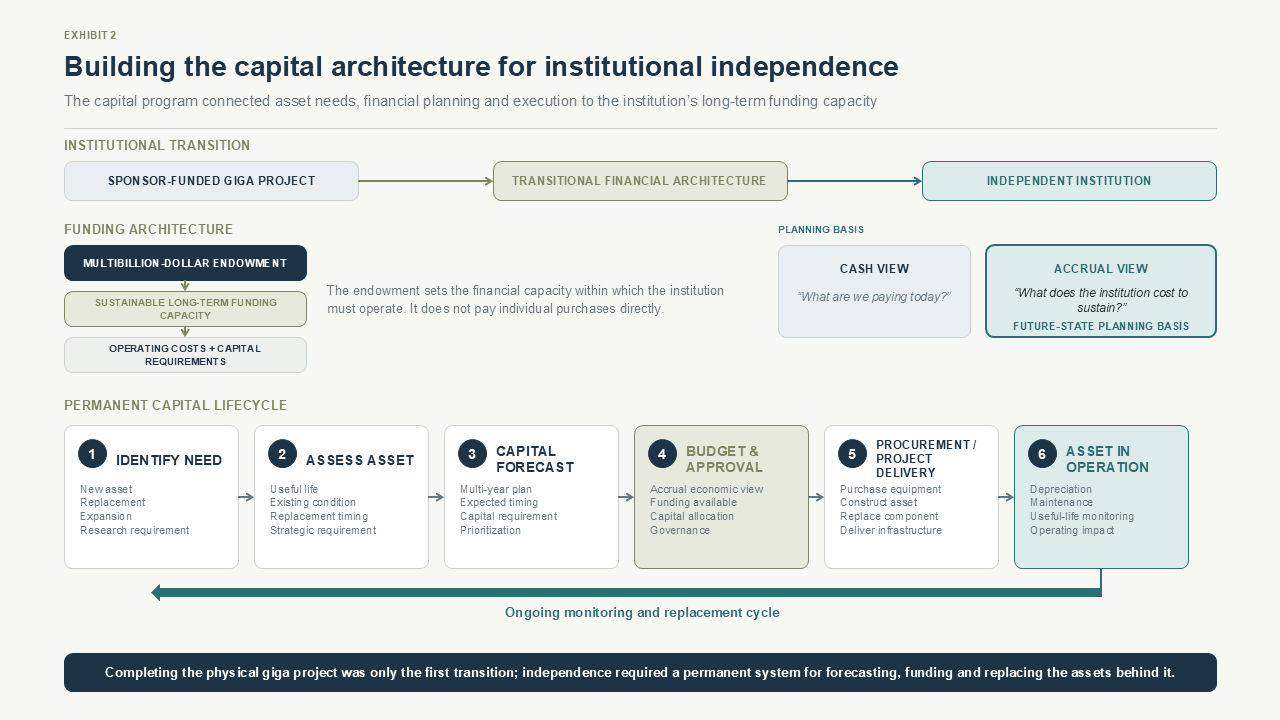
The emerging institution therefore needed to maintain an accrual-based view alongside the sponsor's cash-oriented funding view and reconcile the two for leadership.
This was not an academic accounting exercise. It was essential to understanding what the institution would eventually cost to sustain.
Useful-life assumptions also had to be reconsidered. The sponsor possessed extensive experience managing industrial assets, but advanced scientific equipment and research infrastructure sat outside much of its traditional asset base. The more intricate the building, the shorter the useful life. Something the accounting teams and general ledger codes had not prepared for. Applying inherited assumptions mechanically could distort depreciation and, more importantly, the expected timing of future capital replacement.
That eventual replacement would likely come at a time when the state-sponsored, and cash focused, benefactor had long since exited the relationship. The emerging institution therefore had to put its own stamp on how its assets should be treated.
The objective was not to declare the sponsor's methods wrong. They had evolved successfully for a different institution in a different industry.
The objective was to prevent those methods from becoming the default operating model of the organization being created simply because the sponsor had built it.
The institutional challenge behind the accounting challenge
This distinction was harder to establish than the accounting mechanics alone might suggest.
A significant proportion of the new institution's workforce—roughly 20% to 30% at the time—consisted of employees seconded from the sponsor or people who had previously worked there before joining the new organization permanently.
That created an understandable institutional bias.
The state-sponsored oil company was among the country's most prominent and successful organizations. Employees who had spent much of their careers within it had little reason to question systems that had supported decades of successful execution.
International specialists recruited into the research institution often arrived with a very different reaction: this was not how a global research university normally operated. Nor is this how a city, corporation or any other entity normally operates.
Both perspectives contained logic.
The sponsor knew how to control and deliver enormous projects. The incoming specialists understood how universities, research organizations and internationally oriented institutions were expected to function.
The mistake would have been assuming that one model had to defeat the other.
Master appropriations became part of the compromise. The sponsor could retain the financial controls it required during the support period. The institution gained enough flexibility to function. Meanwhile, accrual accounting, institution-specific asset assumptions, and longer-term capital planning could be developed underneath the temporary funding architecture.
The transition could therefore begin before independence rather than after it.
That timing mattered. The sponsor was expected to provide years of support before the institution eventually operated independently. Waiting until the end of that period to establish an independent financial model would have meant attempting to redesign the institution precisely when the safety net disappeared.
Instead, the financial architecture for independence was built while the sponsor was still present.
Designing backward from the endowment
The new institution also had an unusual advantage: a multibillion-dollar endowment had been established to provide a durable source of future funding.
The endowment was structurally protected and managed separately, providing reasonable visibility into the financial resources that could be expected to support the institution over the long term.
That changed the central planning question.
The issue was not simply "How much money does the institution need this year?" but rather "What level of institution can the endowment sustainably support over decades?"
Answering that required considerably more than a cash-focus budget.
Operating costs had to be understood. The economic consumption of the asset base had to be recognized. Unique useful lives had to be established. Future replacements had to be anticipated. Major construction and refurbishment requirements needed to be incorporated into a long-term capital view.
The institution was effectively being asked to move from an environment in which capital could be requested from a sponsor to one in which its ambitions ultimately had to coexist with a finite, albeit very substantial, long-term funding base.
A cash-flow statement could show whether the institution could pay today's bills.
It could not, by itself, show whether today's institution was creating tomorrow's unfunded capital obligations.
Building the capital program from zero
There was another complication. No mature capital program existed.
There could not have been one. The institution itself had not previously existed.
A complete capital forecasting model therefore had to be developed covering the asset base from the smallest routine investments to the largest infrastructure requirements.
At one end were laptops, furniture and ordinary equipment. Further along were sophisticated scientific instruments, laboratory systems and computing infrastructure. At the other end were buildings, major construction programs, infrastructure replacements and significant components of the surrounding city.
But forecasting the numbers alone would not create a capital program.
The operating mechanisms around the numbers also had to be designed.
Processes were established governing how departments requested new capital assets, how those requests entered the budget cycle, how requirements progressed into procurement, and how the project-management organization would supply or construct approved assets.
Replacement required its own logic. An asset reaching the end of its useful or operational life needed a pathway through forecasting, justification, budgeting, approval, procurement and eventual replacement.
The result was therefore not simply a spreadsheet predicting capital expenditure.
It was a capital operating model connecting asset needs to financial planning and then connecting financial planning to execution.
From construction project to independent institution
Over time, the temporary and permanent elements of the architecture began to separate.
Master appropriations served as a bridge during the period when the sponsor's funding processes and the institution's requirements needed to coexist. The institution ultimately moved toward full accrual accounting as it became increasingly independent.
The capital forecasting and governance mechanisms were designed to endure beyond that transition and the integral elements of the capital-planning architecture remain in use.
The larger lesson extends well beyond accounting.
Giga projects are often discussed primarily in terms of physical delivery: construction schedules, budgets, engineering complexity, procurement and opening dates. Yet some of the most consequential giga projects are not merely collections of assets. They are attempts to create entirely new institutions, industries, communities or economic ecosystems.
Those institutions inherit more than the buildings their project-management organizations construct.
Unless deliberately prevented, they can also inherit the assumptions of their builders.
That creates a particular risk when governments assign highly capable incumbent organizations to develop projects outside their traditional industries. The very capabilities that make those organizations attractive as delivery partners can encourage stakeholders to assume that their operating systems should also become the template for what is being created.
They should not—at least not automatically.
In this case, the state-sponsored oil company's financial architecture was not defective. It reflected an extraordinarily well-capitalized industrial organization accustomed to executing major projects under a particular set of constraints.
A Western-style research institution faced different constraints.
It needed scientific agility. It had an unusually heterogeneous asset base. It needed to understand depreciation and replacement requirements. It had to reconcile research ambitions with the sustainable economics of an endowment. And eventually it needed to operate without treating its former sponsor as an unlimited source of capital.
The solution was not to force an immediate choice between the two models.
It was to build a bridge between them while designing the destination.
That may be one of the less visible requirements of successful giga-project development.
The physical assets can be completed years before the institution behind them is truly finished. And sometimes the most important infrastructure being built is not concrete, laboratories or computing capacity at all.
It is the system that determines how the institution will sustain them once the builders leave.
