
Tracing Paper - Universities Are Selling More of Their Brand. It Might Just Erode Its Value.

Why the expansion of branded certificate programs risks cannibalising the elite degree signal
Elite universities have spent generations building something more valuable than a curriculum, that being a trusted signal.
For employers, the name of a leading university has long served as a shorthand. It does not guarantee intelligence, judgment or future performance. But it has traditionally conveyed several things at once; that a candidate cleared a demanding admissions process, completed a sustained and assessed program of study, operated within a high performing peer group and gained exposure to an institution with a strong record of academic and professional outcomes.
That signal has economic value precisely because it is scarce, difficult to obtain and broadly understood.
Today, many of the same institutions are expanding their brands across a much wider range of certificate, executive, continuing-education and online programs. These offerings can deliver genuine learning. They can help professionals acquire useful skills, change careers or deepen knowledge in a specific subject. Their accessibility is often a feature, not a flaw.
But they are not equivalent to a full-time MBA, masters degree or undergraduate degree from the same institution. They generally do not involve the same admissions hurdle, duration, breadth of curriculum, academic immersion, cohort experience or cumulative assessment. They should not be considered in the same ‘league’.
The problem is not that certificates exist. The problem is that elite university brands can make credentials with radically different levels of rigour appear more similar in the labour market than they truly are.
In the short term, this is an attractive proposition for universities. It expands reach, serves the lifelong learning market and generates new revenue. In the long term, however, it may create a more serious strategic risk: the cannibalisation of the degree’s value as an elite labour market signal.
Key takeaways
Elite universities are extending a scarce brand across credentials that are not academically equivalent. A short certificate can be valuable, but it is a lower-order credential than a selective, full-time degree.
Hiring systems reward recognisable signals, not perfect information. Recruiters, applicant tracking systems and hiring managers often encounter the university name before they understand the qualification behind it.
The likely consequence is gradual signal dilution, not an overnight collapse in prestige. As the same university name appears more widely across different products, employers may increasingly need to ask what “Harvard,” “Columbia,” or another elite institution actually signifies on a candidate’s CV.
The Degree Was Never Just About Content
It is tempting to reduce higher education to the knowledge delivered in a classroom. That is increasingly difficult to defend. Much of the content taught in elite universities is now accessible through books, lectures, online platforms and, increasingly, AI tools.
But this does not mean that a full degree is simply an expensive way to obtain information.
The value of a selective degree has always included the process around the content. Admission is itself a filter. Completion over several years demonstrates persistence and performance across a structured curriculum. A full-time program creates a cohort, an environment and often a network that continues well beyond graduation. In professional degrees, it may also provide access to formal recruitment channels, internships, practical projects and alumni relationships that are not easily replicated by watching lectures online.
That does not make every graduate exceptional. Nor does it mean that a short-cut certificate-holder cannot be more capable than a degree-holder. Labor markets are full of counterexamples.
It does mean that the two credentials represent different achievements and should be interpreted differently.
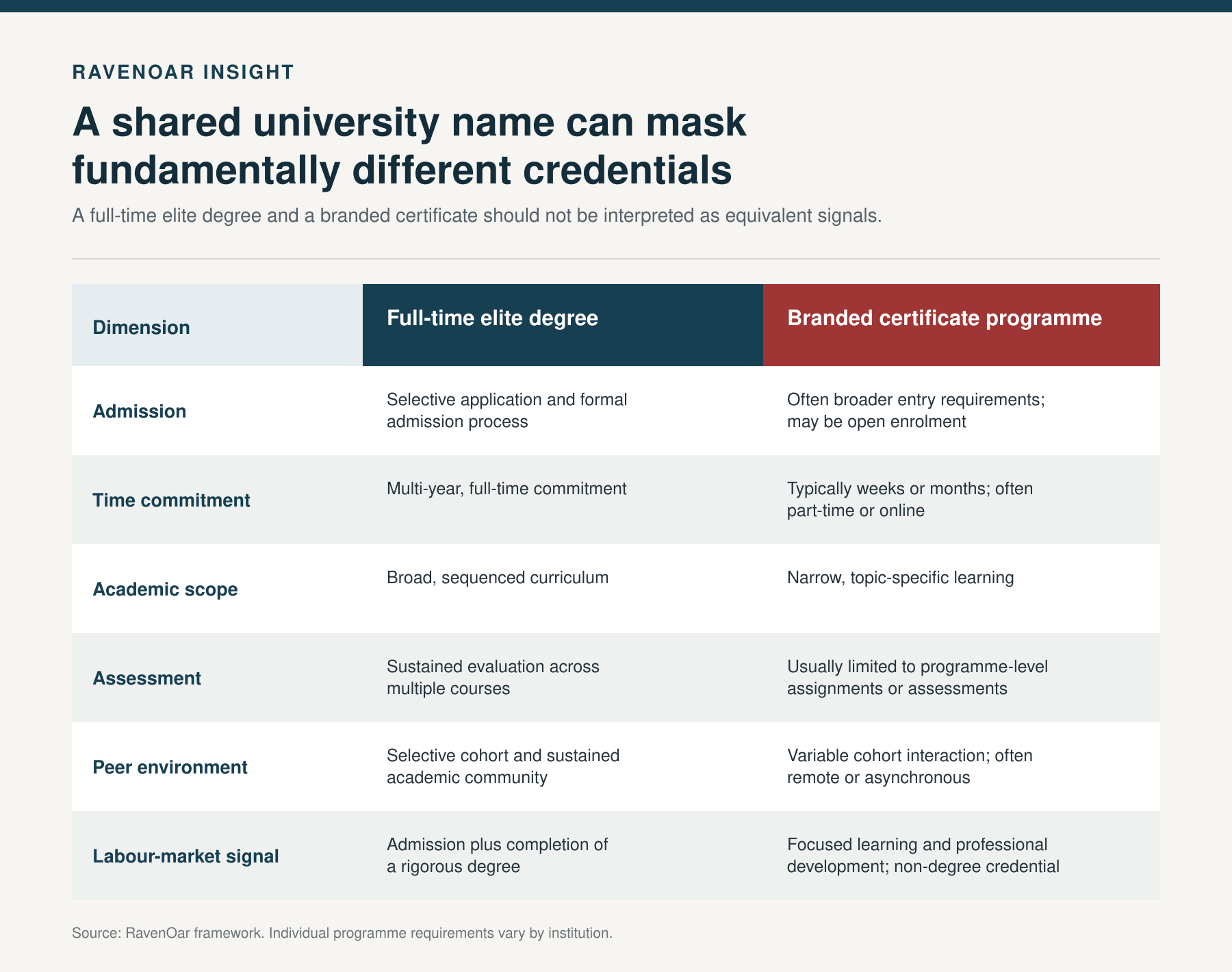
A certificate may show that a professional completed a focused course of learning. A degree from the same institution may show that the individual was admitted through a selective process and completed a substantially broader and more demanding academic experience. The institutional name is shared; the underlying signal is not.
When the market overlooks that distinction, it is not engaging in a nuanced debate about educational philosophy. It is simply collapsing different products into one brand cue.
The Market Sees the Name Before It Sees the Credential
Recruitment is an exercise in decision-making under imperfect information.
Even conscientious recruiters must assess large pools of candidates quickly. They are expected to identify relevant experience, capability, seniority, communication skills and cultural fit from CVs that are often incomplete, inconsistently formatted or strategically presented. Applicant tracking systems can capture degree level and field of study where employers configure them properly and candidates enter data accurately. But many also parse unstructured resumes, match keywords and pass candidates to human review.
In that environment, a familiar university name becomes an understandable shortcut.
The issue is not recruiter incompetence. It would be unreasonable to expect an HR professional to know the admission requirements, duration, academic standards and completion rules for every program offered by every university worldwide. A recruiter may understand perfectly well that certificates are different from degrees while still not know what a particular “Harvard certificate,” “Yale executive program,” or “Stanford online credential” represents in practice.
The risk rises when the institutional name is prominent and the qualification itself is vague, abbreviated or buried beneath it. “Harvard” is easy to recognise. “Four-course graduate certificate completed through a continuing-education division” is not. Particularly when it is not spelled out that way on the resume.
Normal hiring shortcuts, time pressure, imperfect data entry and human oversight make the problem more consequential. The wider the gap in selectivity and academic rigour between credentials carrying the same university name, the greater the cost when that distinction is missed.
This is not an accusation that certificate-holders are necessarily misrepresenting themselves. Many accurately describe what they completed. Nor is it an argument that employers should disregard short programmes entirely.
The issue is structural. The university’s prestige often operates as a high-visibility signal while the nature of the credential operates as a low-visibility detail.
When the Talent Pool Expands but the Signal Does Not
Consider a recruiter or applicant-tracking system (ATS) screening candidates for a role that historically attracted graduates of a particular elite university.
In the past, a search for that university’s name may have produced a relatively small pool of candidates whose credentials shared a broadly comparable foundation. That being selective admission, a full academic program and a recognised degree.
Now imagine that the same search produces a much larger pool.
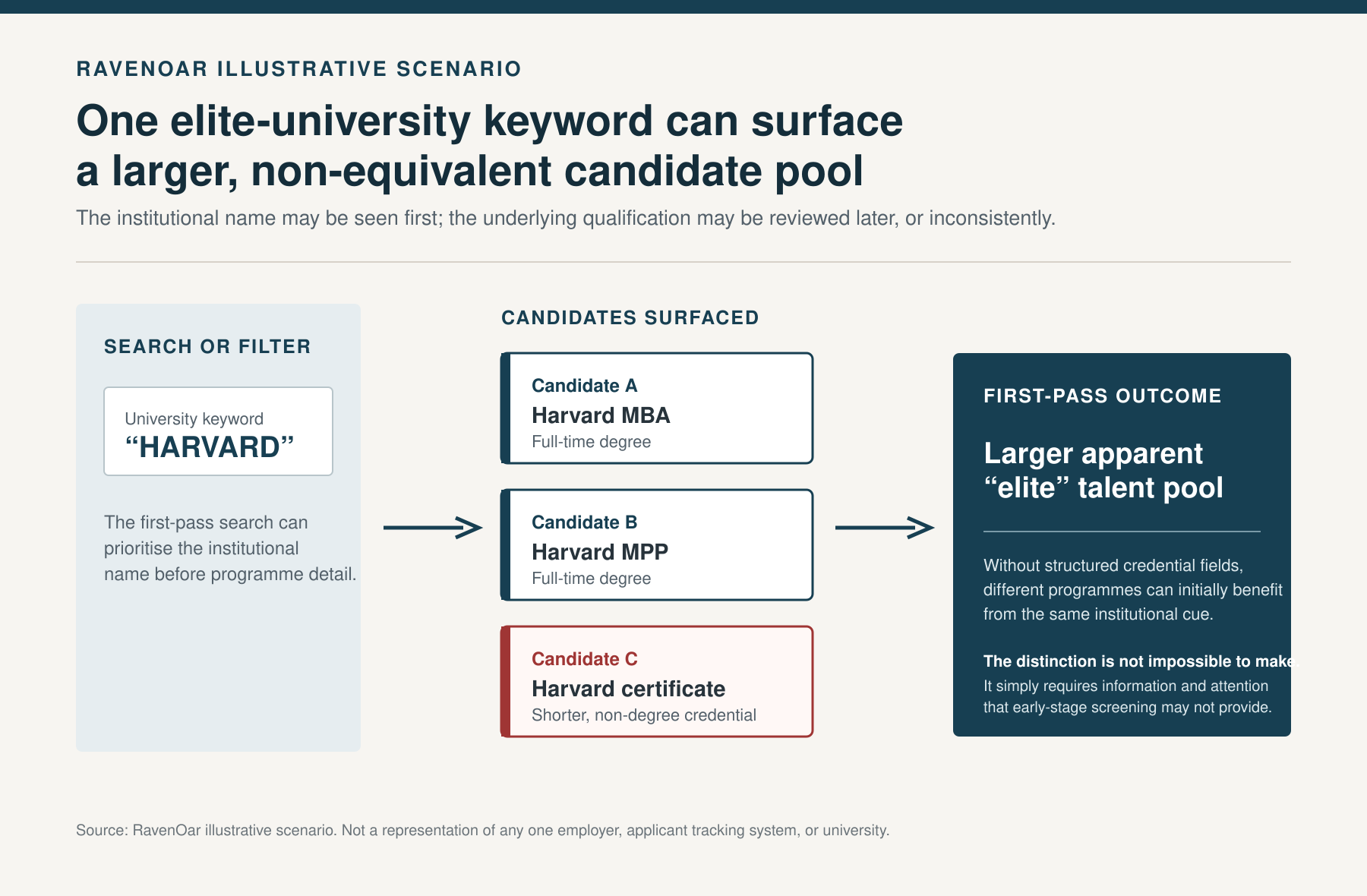
Some candidates hold a full-time undergraduate or graduate degree. Others hold a shorter certificate, executive-education credential or online program carrying the same university name. The underlying achievements are different, but the first-pass signal may look similar.
The same institution appears on the CV or in the system.
A well-designed hiring process can distinguish the two. It can require candidates to state degree level, program name, study mode and verified completion. A diligent recruiter can examine the detail. But real hiring systems operate under time pressure and imperfect information. Some applications will be filtered, prioritised or interpreted primarily through the institution’s name before the underlying qualification receives the scrutiny it deserves.
The effect is an expansion of the apparent “elite” talent pool without an equivalent expansion of elite degrees.
That may seem beneficial. Employers have more candidates to consider and certificate-holders receive a chance to demonstrate their capability. But if the market begins to treat different credentials as interchangeable at the screening stage, the economics become difficult to ignore.
A full-degree typically requires a far greater investment: tuition, foregone earnings, years of study, a demanding admissions process and sustained academic performance. A certificate may require a fraction of that commitment. If both credentials generate broadly the same labour-market benefit because the institutional name is treated as the primary signal, the certificate-holder may achieve a substantially higher return on investment.
This is not an argument that the certificate-holder has done anything wrong. It is a prediction about incentives and rational ROI seeking.
If a shorter, lower-cost credential can capture a meaningful share of the employment premium historically attached to a full degree, rational consumers will increasingly choose the lower cost route. The university may initially benefit from selling both products. But the full degree becomes harder to justify at its existing price and opportunity cost unless it remains visibly, and credibly, more valuable in the market.
In other words, the certificate does not need to become academically equivalent to the degree to cannibalise it. It only needs to become sufficiently equivalent in the eyes of employers.
That is the collision course. The more the market relies on the university name rather than the credential beneath it, the more elite institutions risk reducing the return on the very degrees that established their brands even if their short-term revenue increases are attractive.
The Global Labor Market Magnifies the Effect
The issue is likely to be more pronounced in global labor markets.
Within the United States, recruiters at firms with long-standing campus recruiting relationships may know the difference between an undergraduate degree, a full-time MBA, an executive program and a certificate. They may have dedicated systems, alumni networks or internal experience with particular schools.
Outside those environments, the name itself often travels farther than the institutional detail.
A hiring manager in Dubai, Singapore, Riyadh or São Paulo may recognise an elite American university immediately while having limited reason, or limited time, to understand the architecture of its programs. That is not a criticism of international recruiters, necesarily. It is the predictable result of globalising a brand faster than the market can absorb the distinctions beneath it.
The more a university sells credentials internationally, the more often its name will appear in markets that rely on institutional reputation as a rapid proxy for quality. That can provide an immediate advantage to the certificate holder. It can also create a mismatch between what the employer infers and what the credential actually certifies.
The global effect matters because elite universities do not merely sell education. They sell a reputation that has accumulated over decades, sometimes centuries. A reputation can cross borders extraordinarily well. A nuanced explanation of program level, admissions standards and assessment methods generally does not.
Expansion Can Become Cannibalisation
Universities may understandably view certificate programmes as an extension of their mission. Professional learning is valuable. Mid-career education is increasingly necessary. People should not need to leave work for two years in order to develop a new skill.
But brand extension is not without a respective cost.
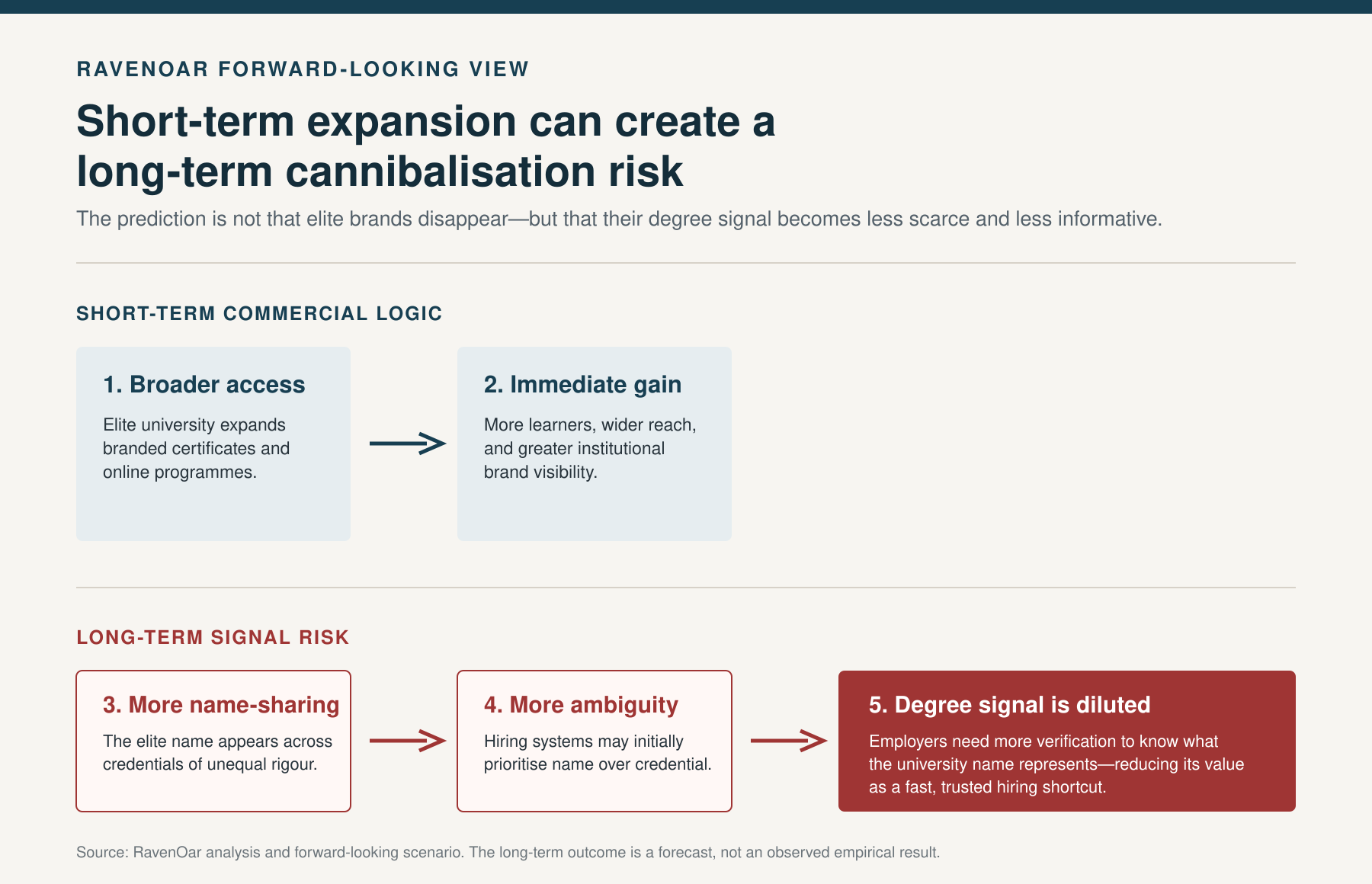
A premium brand can successfully serve more than one market when its tiers are clearly differentiated. Consumers understand the difference between a luxury product and a lower-priced line when the branding, distribution, price and product experience make the hierarchy obvious.
Higher education has a similar challenge. An elite university can offer both a demanding degree and a shorter professional certificate without necessarily damaging either. The risk emerges when the institutional brand does so much of the signalling that the market loses sight of the hierarchy.
The university gains in the short term. It reaches more learners, expands its global presence and attaches its name to many more professional profiles. Certificate-holders gain access to a recognised brand and a potentially useful learning experience.
The cost is borne less visibly. Full-degree holders paid for a signal through selectivity, time, tuition, opportunity cost and effort. If the same institutional name becomes increasingly common among candidates who did not complete a comparable program, the degree-holder’s signal becomes less distinct.
This does not mean that an elite degree immediately loses its value. Prestige is durable, and the best universities retain powerful advantages through selective admissions, world-class faculty, deep alumni networks, major research ecosystems and direct relationships with employers.
But signals do not need to disappear in order to weaken. They only need to become less reliable.
The long-term question is therefore not whether elite institutions will remain prestigious. They almost certainly will. The question is whether their names will remain as useful to employers as a rapid indicator of what a candidate has actually achieved.
Once “Where did you study?” no longer answers that question, hiring markets will start asking a second one: “What exactly did you do there?”
That is the beginning of brand dilution.
The Evidence Is Incomplete—But the Direction Is Worth Watching
There is not yet a clean dataset proving that certificate expansion has reduced the hiring premium associated with elite degrees. It would be difficult to imagine that a university would fund such a study, all things considered. Nor is there publicly available financial reporting that consistently isolates revenue from certificate program from wider executive, professional and continuing-education activity. It is therefore difficult to quantify either the scale of this segment or the degree to which universities are becoming dependent on it. Yet, it is producing tens of thousands of new certificate ‘students’ yearly.
There are already signs that the market is negotiating the relationship between degrees and alternative credentials. A 2024 survey of US hiring managers found high awareness of microcredentials, but lower confidence in their ability to signal specific skills. The same research argued that employers need clearer information on credential quality, rigor, content and relevance.¹
GMAC’s 2026 Corporate Recruiters Survey similarly found that employers globally were more likely to believe that graduate management-degree holders would succeed in their organisations than candidates with microcredentials alone. Yet US employers have become more open over time to microcredentials as an alternative or complement to a graduate business degree.²
These findings do not prove brand erosion, yet. They do, however, show a market in transition. Employers are becoming more receptive to alternative credentials while still recognising, at least in aggregate, that a full degree and a microcredential are not the same thing.
RavenOar’s view is that this tension will become more acute, not less.
The rise of AI may accelerate it. As basic knowledge becomes easier to acquire and online work becomes harder to authenticate, employers may place greater value on signals of selectivity, rigorous assessment, demonstrated judgment and sustained performance. That should strengthen the case for a clearly differentiated elite degree.
But it also raises the cost of ambiguity. If universities allow fundamentally different credentials to trade too heavily on the same institutional name, they may weaken one of the few signals that remains valuable in a more automated and information-saturated labor market.
Elite Institutions Should Sell Learning Without Selling Ambiguity
The answer is not to retreat from continuing education or to treat certificate-holders as second-class learners. It is to make the hierarchy of credentials unmistakable and allow employers to determine whether there is a class-system worth noting.
Elite universities should adopt a clearer credential architecture from a moral perspective.
First, degree and non-degree credentials should be visibly distinct in naming, design, digital verification and alumni communication. An employer should not have to investigate a university catalogue to understand what a candidate completed.
Second, institutions should publish standardised information on program level details. Admissions requirements, duration, attendance model, assessment approach, credit status and whether the program confers a degree. This information should be easy to verify, not merely available somewhere on a web page.
The guidance may be found through current background checks carried out across many international organizations. Several international HR policies mandate that prospective employees go through an equivalency-check on their university degrees whereby their degree is equalised to to a benchmark number-ranking relative to other universities globally. Perhaps the rigor of this process should be extended in order to truly differentiate certificate short programs from that of their full-time counterparts.
Third, universities and professional platforms should make the underlying credential more prominent than the umbrella brand. On LinkedIn, a full-time MBA and a short online certificate should be displayed as different educational categories, not as variations of the same institutional affiliation. This would be considered a tall-ask as the key driver for many of the certificate purchase decisions is the allure of being considered at the equivalent status of full-time degree holders. Regardless, this unlikely implementation would go far to help HR professionals bifurcate the two applicant categories.
Finally, employers should improve their own systems. Hiring teams do not need encyclopedic-level knowledge of universities. But in this new reality, they do need structured fields that distinguish degree type, level, modality and verified completion from a free-text university name search.
These changes would not diminish certificates. However, it would potentially remove the allure for those seeking an elite name short-cut. But the move would allow for honest representation. They would allow certificates to be valued for what they genuinely represent, that being focused learning, professional development and, in some cases, relevant skills. The aim is not to preserve exclusivity for its own sake. It is to preserve honesty in the labor-market signal.
Elite universities built their reputations by making difficult distinctions between admission and enrolment, between attendance and achievement and between exposure to knowledge and demonstrated mastery.
Their next challenge is to keep those distinctions visible rather than pursuing medium-term revenue increases at the cost of long-term brand erosion.
Sources
Northeastern University Center for the Future of Higher Education and Talent Strategy, The Evolution of Hiring: What Managers Know About Microcredentials, 2024.
Graduate Management Admission Council, Corporate Recruiters Survey 2026.
Harvard University, Annual Financial Reports. Harvard’s disclosures combine certificate-related activity with broader executive and continuing education rather than consistently reporting certificate-programme revenue as a separate category.
This article contains RavenOar analysis and a forward-looking view. The predicted long-term effect on elite university brand equity is an inference, not an established empirical finding.
