Clock Work - The key to more productivity is less work hours?
What if the problem with working hours is that they never really end?
The modern working day has a curious characteristic: it often has a defined beginning, but no meaningful end.
Employment contracts may specify working hours. Offices may officially close. Calendars may show the final meeting of the day. Yet email, messaging platforms, shared drives, enterprise systems and office applications remain accessible indefinitely. Work can continue from the train, the sofa, the dinner table or the bed.
For many organizations, this flexibility is considered an advantage. When something is unfinished, employees can stay later. When a deadline slips, the evening can absorb the delay. When meetings consume the day, individual work can be completed afterwards.
But this flexibility may conceal a management problem.
Unlimited access to employee time can become a substitute for organizational efficiency.
If additional hours are always available, inefficient meetings, slow decisions, unclear priorities, poor delegation and excessive workloads do not necessarily have to be resolved. Their cost can simply spill beyond the formal working day.
What would happen if that escape valve disappeared?
Imagine an organization in which routine work genuinely ended at a defined time. At the boundary, employees lost access to email, messaging, shared files and ordinary corporate systems until the next working period. Exceptions would exist for genuinely time-critical roles and emergencies, but after-hours work would no longer be the default mechanism for absorbing unfinished business.
RavenOar refers to this as Operation: Clock-Outperform.
It is not primarily a work-life-balance proposition. Nor is it an argument for working four days instead of five.
It is a management hypothesis: making employee time genuinely finite could force organizations to use that time better, while protecting the recovery that helps employees perform effectively when they return.
Time as organizational slack
Most organizations recognize that capital, equipment and headcount are finite resources. Management systems therefore exist to allocate them.
Employee time is different.
On paper it is finite. In practice, particularly in professional and knowledge work, it is remarkably elastic.
A meeting runs for two hours instead of one. A decision requiring senior approval sits unresolved for three days. A manager distributes work poorly. An unnecessary presentation requires another round of revisions. A team accepts more priorities than its available capacity can reasonably accommodate.
In each case, there is a convenient buffer: more employee time.
The workday stretches.
This creates a form of organizational slack that is rarely recorded on a balance sheet. Employees effectively provide additional capacity whenever the operating system fails to fit the work into the time supposedly allocated to it.
The phenomenon does not require exploitative management. Often nobody explicitly instructs an employee to work late. The organization simply creates conditions in which finishing the expected work requires it.
Research on working hours gives reason to question whether this additional time translates proportionately into additional output. John Pencavel's analysis of British munitions workers found a nonlinear relationship between working hours and output: beyond a point, additional hours produced progressively smaller increases in output. The historical industrial setting makes the precise thresholds inappropriate for modern knowledge work, but the underlying finding is important—**hours and productive output are not necessarily proportional.**¹
That distinction changes the management question.
Instead of asking how much work employees can complete if their time is allowed to expand, organizations could ask how effectively they can organize work within a known capacity constraint.
EXHIBIT 1 — Employee Time as Organizational Slack
When working time is elastic, organizational inefficiency can spill into employee time.
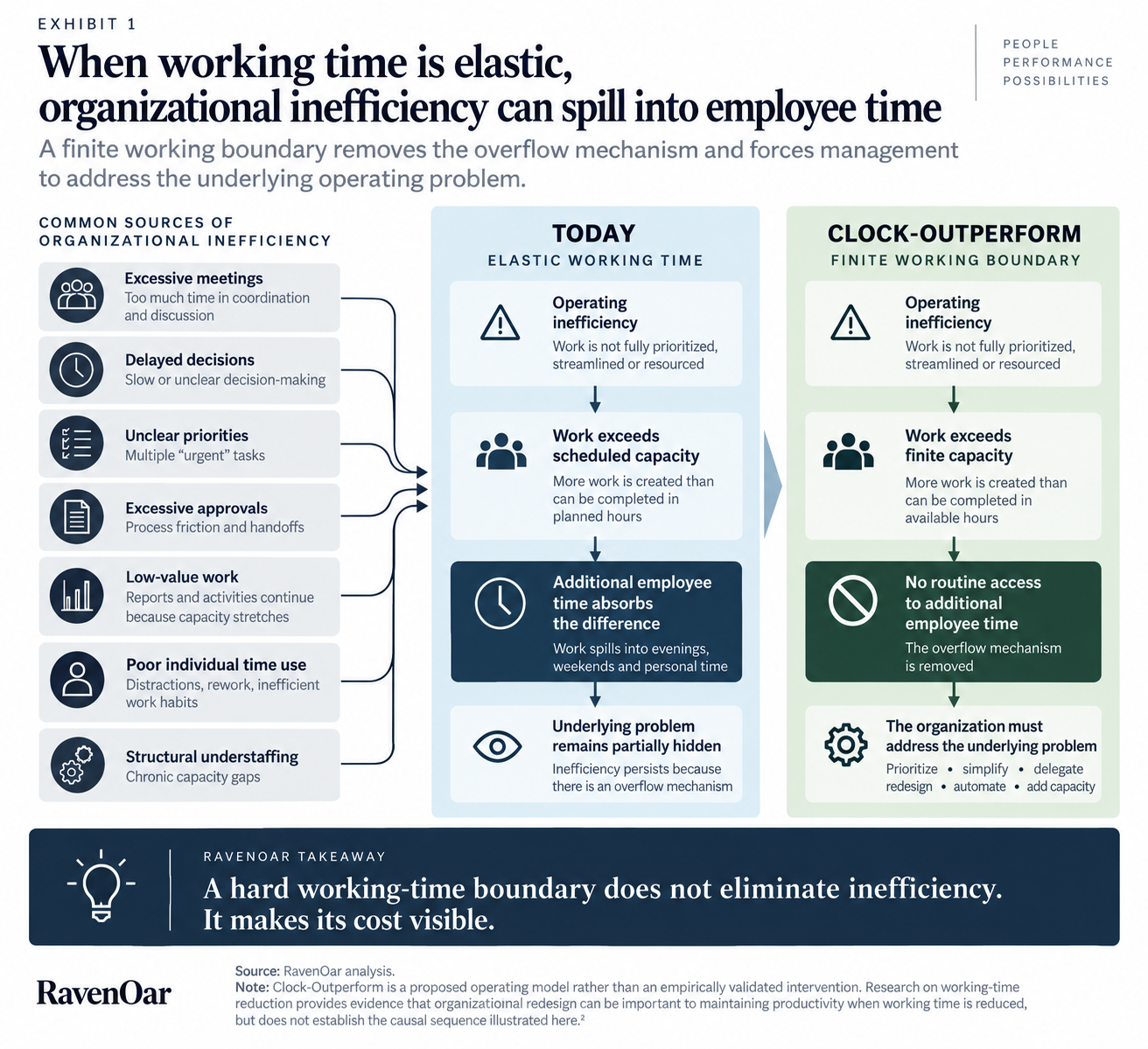
The purpose of a hard boundary would therefore not be to pretend that capacity problems disappear.
It would make them visible.
If a team consistently cannot complete necessary work within its available working envelope, management has to confront the reason. Perhaps priorities need to be reduced. Perhaps meetings need to disappear. Perhaps approval processes are too cumbersome. Perhaps work should be automated or delegated differently.
Or perhaps the organization is genuinely understaffed.
That possibility matters. Clock-Outperform should not become a mechanism for demanding the same impossible workload in fewer usable hours. Sometimes the correct response to a capacity constraint is more capacity.
The distinction is that management would have to recognize the cost explicitly rather than financing it invisibly with employees' evenings.
An organization that can no longer borrow unlimited employee time is forced to reveal its operating quality.
The more interesting lesson from the four-day week
The rapid growth of four-day-week experiments provides an obvious comparison, but perhaps not for the reason usually assumed.
The conventional question is whether organizations can remove a day of work without sacrificing performance.
A 2026 Eurofound systematic review of 75 empirical studies found that working-time reduction can, under some circumstances, coexist with maintained or improved productivity. Importantly, the review also highlights the role of work organization in determining the outcome.²
The widely discussed 2022 UK four-day-week pilot provides a useful example. Sixty-one organizations involving roughly 2,900 employees participated in a six-month trial. Among the 23 organizations for which comparable beginning-and-end revenue data were available, size-weighted revenue increased by 1.4%. Reported resignations and sick or personal absence also declined substantially.³
Those figures should not be overinterpreted. Participating organizations were self-selecting; different measures relied on different subsets of companies; and there was no conventional randomized causal counterfactual. The study's authors also caution that the reported changes in resignations and absence could not be established as statistically significant.
More importantly for Clock-Outperform, participating organizations did not simply remove working hours and hope for the best. Preparation included efforts to reorganize work and improve efficiency.
That may be the more interesting finding.
Scarcity can provoke redesign.
When organizations believe time is abundant, inefficient practices can survive. When available time becomes constrained, meetings, processes, priorities and decision rights receive greater scrutiny.
Clock-Outperform takes that logic in a different direction.
The four-day week changes the amount of scheduled time.
Clock-Outperform changes the availability of additional time.
Scheduled scarcity is not necessarily real scarcity
An organization can officially operate a four-day week while employees remain connected on the fifth day.
It can publish a right-to-disconnect policy while managers continue sending messages at night.
It can encourage work-life balance while simultaneously rewarding people who are always available.
A policy, in other words, is not necessarily a boundary.
Eurofound's research on right-to-disconnect arrangements across Belgium, France, Italy and Spain illustrates the problem. More than 80% of surveyed workers reported receiving work-related communications outside contractual hours, and nearly nine in ten of those workers responded. Among the reasons given for responding were a sense of responsibility, a desire to remain on top of work, perceived expectations to respond, fear of negative consequences and expectations of better career progression.⁴
Crucially, the presence of a right-to-disconnect policy did not appear to be associated with a lower likelihood of employees being contacted or responding outside working hours. Eurofound concluded that policy alone is insufficient to generate the necessary cultural change.⁴
That does not prove that a technical lockout would work. No comparable body of evidence currently establishes that.
But it raises an important design question.
What if the boundary were not merely an instruction?
What if it were real?
Making working time genuinely finite
Under Clock-Outperform, routine corporate access would end at a defined point.
Email stops. Internal messaging stops. Shared files and ordinary corporate systems become unavailable. The organization ceases to treat the hours beyond the boundary as latent productive capacity.
This would obviously require exceptions. Hospitals, transport operations, emergency services, global trading functions, customer-support operations and many other environments cannot simply stop functioning at 5 p.m. A practical model would therefore need boundaries appropriate to roles, shifts and operational requirements rather than one universal clock time.
The principle is more important than the precise hour:
Every employee has a defined working envelope, and routine organizational demand cannot simply spill beyond it.
That changes incentives on both sides.
Organizations must make the work fit.
Employees must use the available time well.
Such a model would create reciprocal expectations. Organizations would commit to a finite claim on employee time; employees, in turn, would be expected to use that envelope with greater focus and discipline.
Clocking out would therefore not represent a relaxation of performance expectations.
Potentially, it would make them sharper.
Restoring the discipline of the clock
There is a useful principle in shift-based and production environments: productive capacity is visible.
A plant manager knows that a production line has a defined number of operating hours. A logistics manager knows when a shift begins and ends. Work must be organized around the capacity available during that period.
Digital knowledge work has weakened those visible edges.
A laptop can always reopen. Another email can always be sent. Another revision can always be made.
That flexibility has enormous advantages. But it also means organizations can avoid confronting whether work has been designed efficiently because the working system has access to an unusually elastic resource: people's private time.
Reintroducing a credible boundary could restore some of the discipline created by finite capacity without attempting to make professional work resemble factory work.
The relevant principle is simply that constraints force choices.
Not every meeting can survive.
Not every task can remain urgent.
Not every decision can wait.
Not every approval layer can be justified.
And not every workload can be disguised as a time-management problem.
The hours outside work are productive inputs too
The organizational case for finite working time has a second mechanism.
It concerns what happens after employees stop working.
The conventional work-life discussion often treats non-working time primarily as something employees value and employers should respect. That is sufficient reason to care about it. Sleep, relationships, exercise, leisure and the ability simply to stop thinking about work have value independent of their effect on corporate performance.
But they may also matter to the organization.
A substantial research literature examines recovery from work: the process through which psychological and physiological systems return toward their pre-stressor state.
A meta-analysis by Wendsche and Lohmann-Haislah covering 86 publications, 91 independent samples and more than 38,000 participants found that psychological detachment from work was associated with a range of outcomes including lower exhaustion, greater life satisfaction and wellbeing, better sleep and task performance, although effect sizes and relationships varied considerably across outcomes and studies.⁶
A separate meta-analysis by Bennett, Bakker and Field covering 54 independent samples and more than 26,000 participants examined detachment, relaxation, mastery and control as recovery experiences. Among its findings, psychological detachment was strongly negatively associated with fatigue, while control over non-work time was positively associated with vigor.⁷
A broader review by Sonnentag, Cheng and Parker similarly concludes that recovery during breaks, evenings, weekends and vacations is relevant to sustaining employee wellbeing, motivation and job performance.⁸
Sleep provides another link. A meta-analysis covering 75 independent samples found a positive overall relationship between sleep and work performance (ρ = .20), although the strength of the relationship varied considerably according to how sleep and performance were measured and the methodology used.⁹
More recent four-day-week research points in a compatible direction. A 2025 multi-country study involving 2,896 employees across 141 organizations found improvements in burnout, job satisfaction, mental health and physical health following work-time reduction. Changes in self-reported work ability, sleep problems and fatigue helped explain some of those wellbeing improvements.¹⁰
None of this establishes that locking corporate systems at a fixed hour will automatically improve employee performance.
It supports a narrower proposition:
Time away from work is not necessarily economically inert. Some of it contributes to the capacity with which employees return to work.
A potential performance flywheel
Putting the two mechanisms together produces the central Clock-Outperform hypothesis.
EXHIBIT 2 — The Clock-Outperform Performance Flywheel
A finite working boundary could create a reinforcing performance cycle.
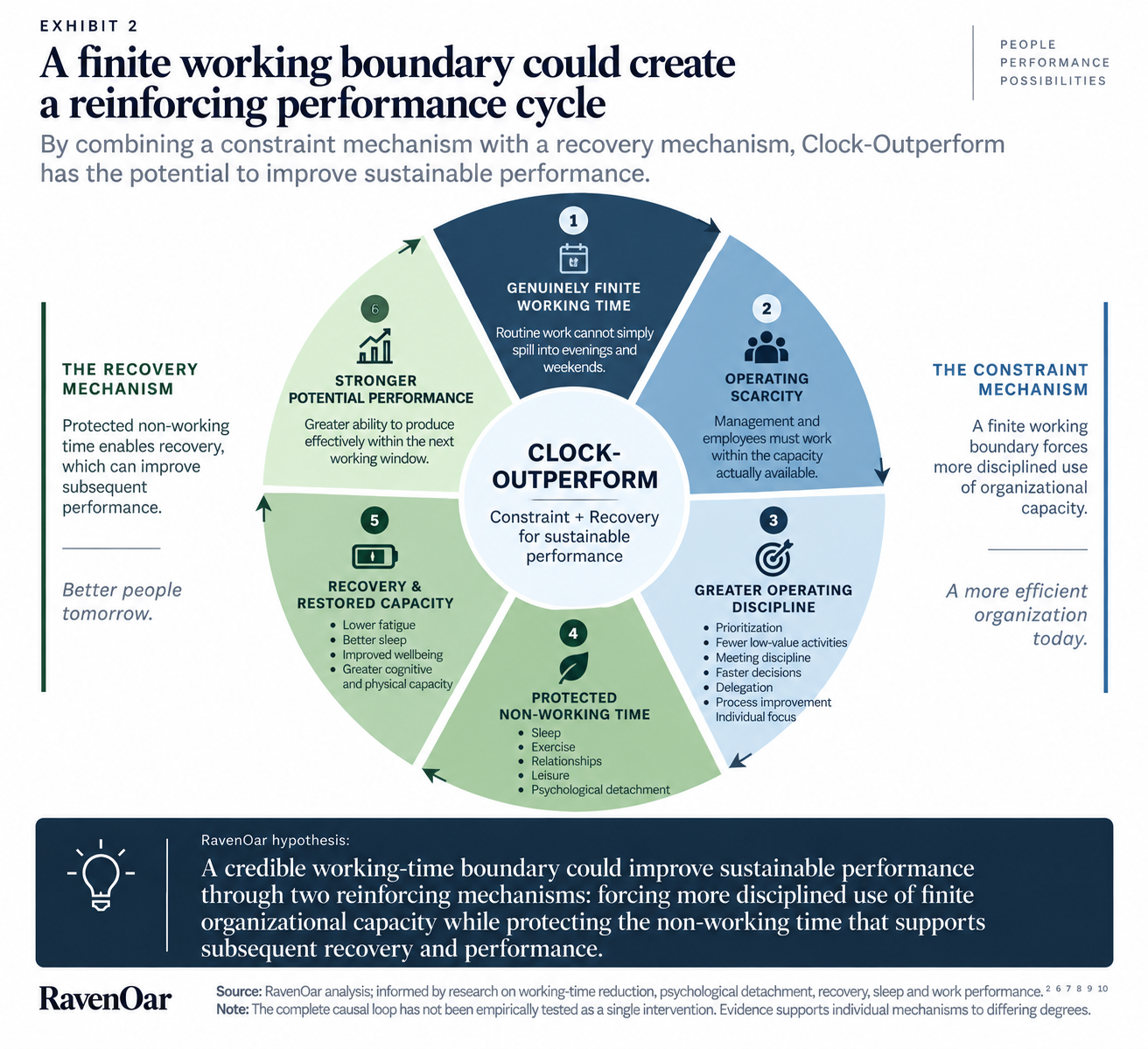
The first half of the cycle is organizational.
A genuinely finite working window creates scarcity. Scarcity increases the pressure to prioritize, reduce low-value activity, improve meetings, accelerate decisions, delegate appropriately, redesign processes and focus individual effort.
The second half is restorative.
A credible end to work protects time that can be used for sleep, exercise, relationships, leisure, psychological detachment or simply rest. Better recovery may leave employees with greater capacity to perform effectively during the next working period.
If that produces stronger performance within the available window, the organization becomes less dependent on after-hours spillover.
The boundary becomes easier to maintain.
The cycle potentially reinforces itself.
This is the central proposition of Clock-Outperform—and also the point at which the evidence must be treated most carefully.
The complete causal loop has not been empirically tested as a single intervention. Research supports its individual components to differing degrees. Recovery is relatively well supported. The role of work redesign under reduced working time has meaningful evidence behind it. The claim that a hard technological boundary would connect those mechanisms into a self-reinforcing organizational system remains a hypothesis.
That is precisely why it is worth testing.
A cleaner test of performance
There is another potential consequence.
Consider two employees doing sufficiently comparable work.
Employee A produces 100 units of relevant output while working 40 hours.
Employee B produces 110 while working 60.
Employee B has produced 10% more—but used 50% more time.
Which employee is performing better?
The answer depends on what the organization values and how performance is measured. In many professional roles, output cannot be reduced to units per hour. Quality, complexity, collaboration, judgment, resources and long-term outcomes matter.
But the example exposes a measurement problem.
When employees are permitted to contribute radically different quantities of time, organizations may find it difficult to distinguish performance from availability.
Research on workplace visibility suggests this distinction can matter. Cristea and Leonardi's study of distributed product-development organizations found that employees could use face time and personal sacrifice as signals of commitment and that these signals could influence access to desirable assignments and career opportunities.⁵
Eurofound's right-to-disconnect research points in a similar direction from a different setting: employees frequently reported responding to after-hours communications because they felt it was expected, feared negative consequences from not responding or associated responsiveness with career progression.⁴
A common time constraint would not eliminate politics, bias or imperfect performance measurement.
But it could remove one variable from the competition.
EXHIBIT 3 — From Availability to Output
When working time is unlimited, output and efficiency can become difficult to distinguish.
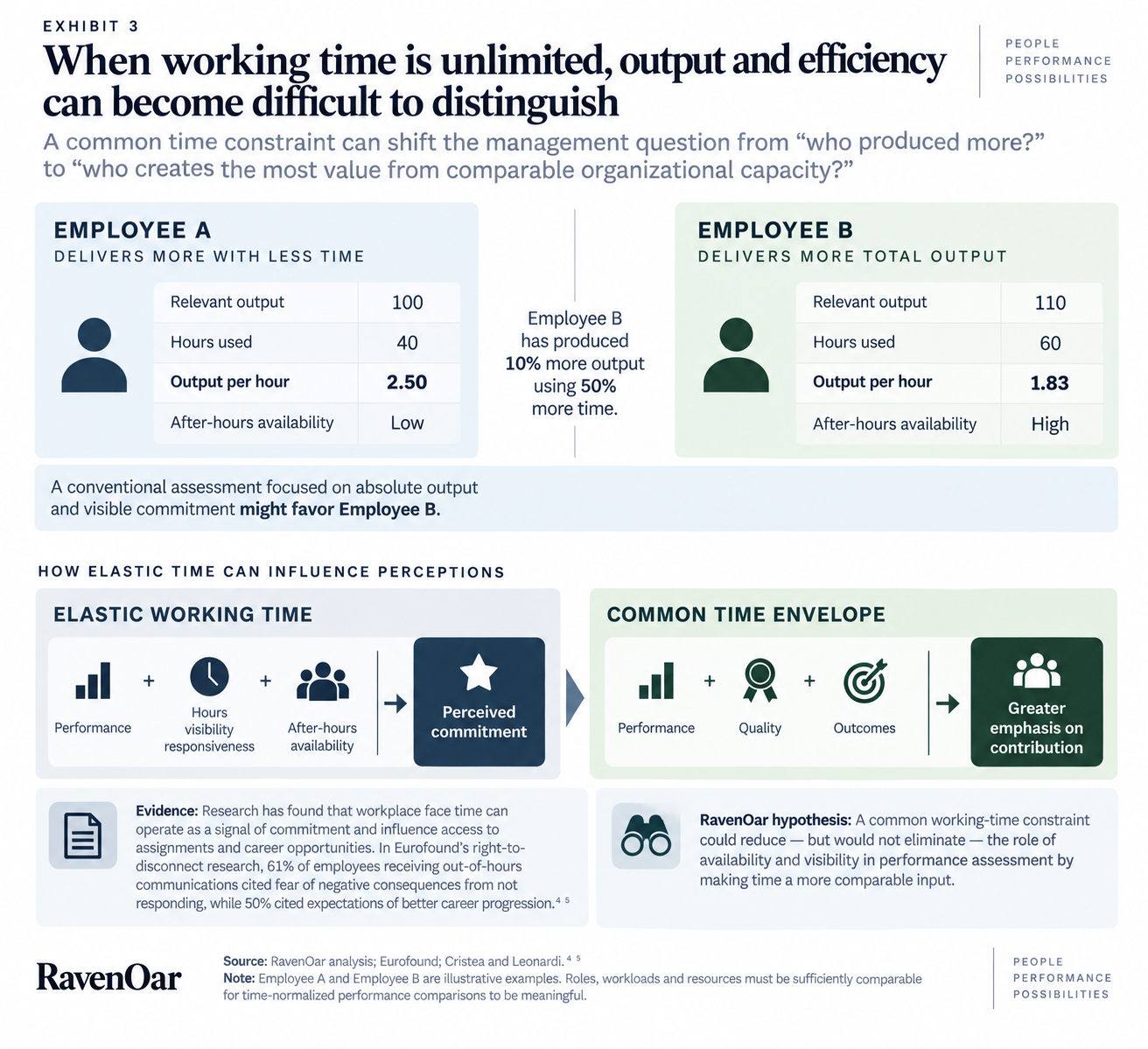
If two employees operate within broadly comparable time envelopes, managers have somewhat less opportunity to interpret sheer availability as evidence of contribution.
The question becomes less:
Who is willing to give us the most time?
And more:
Who creates the most value from the organizational capacity available?
That could have a further fairness implication.
Unlimited-hours cultures inherently favor employees who are both willing and able to surrender more private time. Employees with caring responsibilities, health constraints, long commutes or simply a stronger preference to preserve life outside work may be disadvantaged even when their performance during working hours is strong.
Clock-Outperform would not solve those inequalities.
But a shared constraint could make the playing field somewhat more comparable by making additional private time a less available source of competitive advantage.
Again, this remains a hypothesis. Existing research supports the proposition that visibility and availability can function as signals of commitment; it does not establish that hard time boundaries make performance evaluations fairer.
That distinction matters.
The model also has risks
A hard boundary could fail badly if implemented as an isolated HR policy.
The most obvious failure would be work compression. If an organization simply removes access to additional hours while leaving workloads, staffing, meetings, deadlines and processes unchanged, employees may experience greater intensity rather than greater efficiency. The result could be more stress concentrated into fewer usable hours.
A second risk is circumvention. Employees may move work to personal devices, download files before the cutoff or create informal communication channels. If career incentives continue rewarding after-hours responsiveness, technical controls alone will not solve the cultural problem.
A third is operational rigidity. Different functions have different temporal requirements. A global client team cannot necessarily operate according to the same boundary as a domestic administrative function. Peak periods, emergencies and unusual transactions require flexibility.
And a fourth is managerial misuse. A finite time envelope should reveal genuine capacity gaps—not provide an excuse to demand impossible output within them.
These risks suggest that the Clock-Outperform model is not fundamentally an IT intervention. It is an operating-model intervention. The technological boundary merely makes the constraint credible. For it to work, management would need to redesign the system around it.
From policy to experiment
The proposition is testable.
An organization could select comparable teams and establish a genuinely protected working boundary for an experimental group while maintaining normal arrangements for a comparison group.
Before implementation, workloads and role requirements would need to be assessed. Managers would then redesign meetings, decision rights, communication norms and priorities so that the intervention tested finite working time rather than simple work compression.
The experiment should measure more than employee satisfaction.
Operational measures could include output, quality, error rates, cycle times, missed deadlines, customer outcomes, meeting hours and managerial decision times. Workforce measures could include turnover, absence, sleep, fatigue, psychological detachment and employee experience. Digital activity data could establish whether work actually stopped rather than merely migrating elsewhere.
Performance-management data could also be examined to test whether ratings and advancement become less correlated with visible hours or after-hours responsiveness.
Most importantly, the experiment should distinguish between three possible outcomes.
The first is the Clock-Outperform hypothesis: the constraint drives enough operating improvement and recovery benefit to preserve or improve performance.
The second is neutrality: employees work less outside formal hours while organizational performance remains broadly unchanged. Even this would be consequential because the organization would have surrendered employee time without sacrificing meaningful output.
The third is failure: performance deteriorates materially because the organization genuinely requires more labor capacity or because the work cannot be reorganized around the boundary.
That result would be informative too.
A useful management experiment does not need to prove its hypothesis.
It needs to reveal something the existing operating system hides.
Perhaps the question is not how many days we work
The evidence does not establish that imposing a hard working-time boundary will necessarily improve productivity. No large body of research has yet tested the Clock-Outperform model as proposed here.
But adjacent evidence provides reasons to test it.
Output does not increase proportionately with working hours indefinitely. Reduced-working-time experiments show that some organizations can preserve performance when working time becomes scarcer, particularly when work itself is redesigned. Recovery and sleep are associated with subsequent wellbeing and performance. And research suggests that visibility and after-hours responsiveness can influence perceptions of professional commitment.
Together, these findings point toward a management hypothesis:
Organizations may perform better when employee time is treated as a genuinely scarce resource rather than an indefinitely expandable one.
The four-day week asks whether organizations need five working days.
Clock-Outperform asks a different question.
Does work need unlimited access to the other sixteen hours?
Notes
1. Working hours and output. John Pencavel, “The Productivity of Working Hours,” The Economic Journal, 2015. The study analyzes British munitions workers and finds a nonlinear relationship between hours and output. Its historical industrial context means that its specific thresholds should not be generalized directly to contemporary knowledge work. DOI / Wiley publication
2. Working-time reduction and productivity. Elena Biaggi et al., Working time reduction and its impact on productivity: A systematic literature review, Eurofound, 2026. The review covers 75 empirical studies and emphasizes that the effects of working-time reduction depend partly on how work is organized. Eurofound systematic review
3. UK four-day-week trial. Autonomy and 4 Day Week Global, The Results Are In: The UK's Four-Day Week Pilot, 2023. Sixty-one organizations and approximately 2,900 employees participated. Revenue comparisons were available for only a subset of firms, and the report cautions against treating changes in resignation and absence as statistically established causal effects. Autonomy — UK four-day-week pilot report
4. Right to disconnect. Tina Weber and Dragoș Adăscăliței, Right to disconnect: Implementation and impact at company level, Eurofound, 2023. The research covers employees in Belgium, France, Italy and Spain and examines out-of-hours communications, employee responses and implementation of right-to-disconnect arrangements. Eurofound right-to-disconnect study
5. Visibility and commitment signals. Ileana C. Cristea and Paul M. Leonardi, “Get Noticed and Die Trying: Signals, Sacrifice, and the Production of Face Time in Distributed Work,” Organization Science, 2019. The study examines two globally distributed product-development organizations and the role of face time and sacrifice as signals of professional commitment. DOI / INFORMS publication
6. Psychological detachment. Johannes Wendsche and Andrea Lohmann-Haislah, “A Meta-Analysis on Antecedents and Outcomes of Detachment from Work,” Frontiers in Psychology, 2017. The meta-analysis covers 86 publications, 91 independent samples and 38,124 participants. Frontiers publication
7. Recovery experiences. Andrew A. Bennett, Arnold B. Bakker and J. G. Field, “Recovery from Work-Related Effort: A Meta-Analysis,” Journal of Organizational Behavior, 2018. The analysis includes 299 effect sizes from 54 independent samples involving 26,592 participants. DOI / Wiley publication
8. Recovery and subsequent performance. Sabine Sonnentag, Bonnie H. Cheng and Sharon K. Parker, “Recovery from Work: Advancing the Field Toward the Future,” Annual Review of Organizational Psychology and Organizational Behavior, 2022. Annual Reviews publication
9. Sleep and work performance. Andrea A. Henderson and Kelly A. Horan, “A Meta-Analysis of Sleep and Work Performance: An Examination of Moderators and Mediators,” Journal of Organizational Behavior, 2021. Across 75 independent samples, the authors report an overall corrected sleep-performance correlation of ρ=.20, with meaningful methodological and measurement variation. DOI / Wiley publication
10. Four-day week, recovery and wellbeing. Wen Fan, Juliet B. Schor, Erin L. Kelly and Guolin Gu, “Work time reduction via a 4-day workweek finds improvements in workers' well-being,” Nature Human Behaviour, 2025. The study covers 2,896 employees in 141 organizations across six countries, with 12 control organizations. Participating organizations underwent pre-trial work reorganization intended to improve efficiency and collaboration. Nature publication
Continuous data integration facilitated regulatory compliance, improved citizen satisfaction scores, and minimized unplanned service interruptions across eighteen miles of pipeline.
something