
Pop, Drop and Lock-It: The Benefits from Extending Mandatory VC Lock-In Periods
The Public Market Is Carrying Venture Capital’s Downside - Why disclosure is not enough when the people who shape a company’s exit can reduce their exposure before its business model is proven
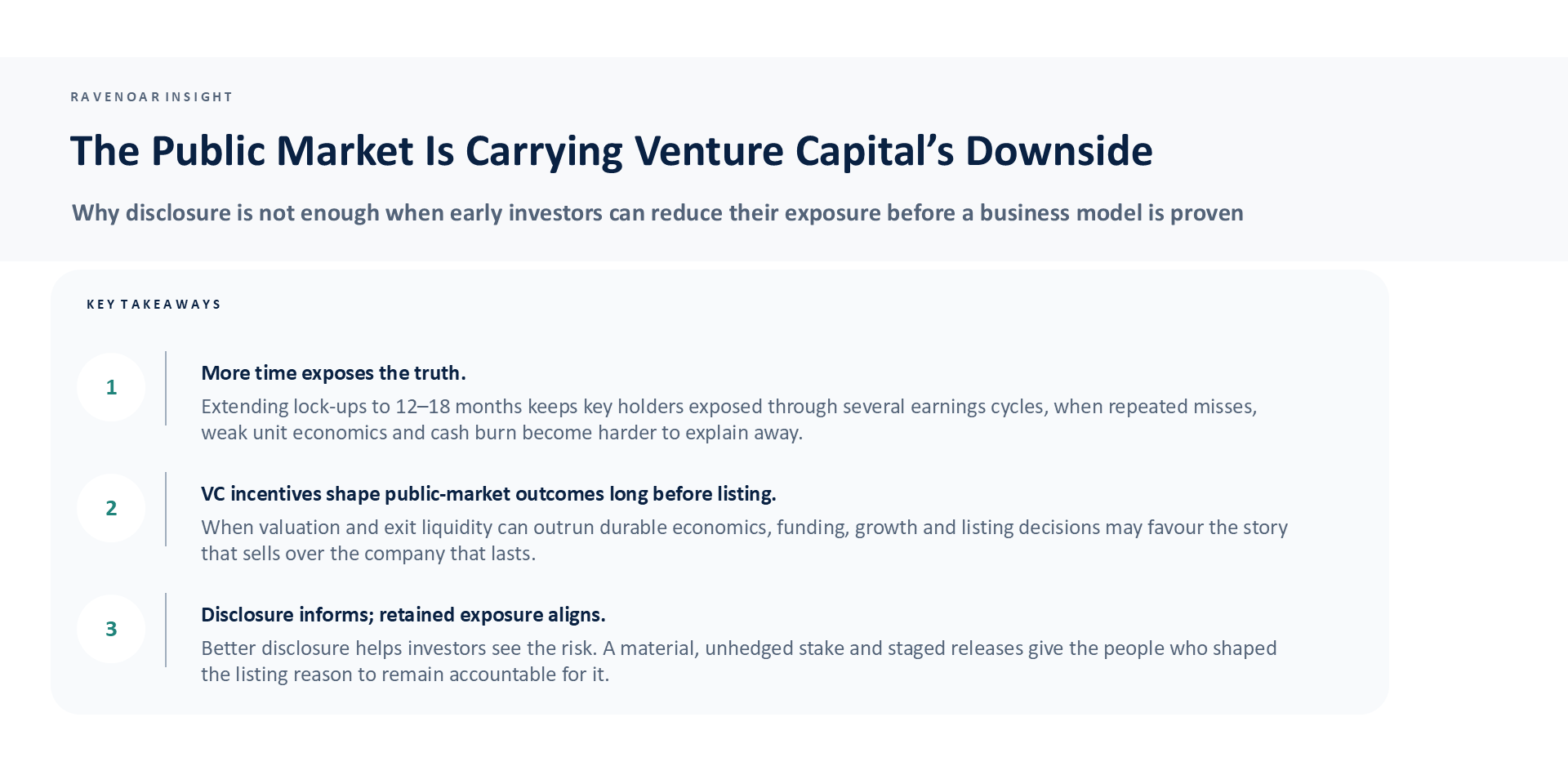
The SPAC boom was often described as a story of exuberance: too much cheap capital, inflated technology valuations, optimistic forecasts and inexperienced retail investors. All of those played a role. But the boom also revealed a more structural problem in the path from venture funding to public markets.
The people who help determine which startups are funded, how aggressively they grow, what valuations they pursue and when they seek an exit do not always remain meaningfully exposed once public investors take over the risk.
That is not an argument against venture capital, ambitious founders or alternative routes to public markets. Venture capital funds innovation that conventional finance would often miss. Nor is every disappointing public company the result of poor incentives. Markets change, business models fail and high-risk innovation necessarily produces losses.
The concern is more specific. When early investors can turn a private bet into public-market liquidity before a company has demonstrated that its economics can endure, the system can reward growth and valuation more immediately than public-market readiness.
The evidence from the SPAC boom makes the problem visible. The policy response should begin by giving the public market more time to test a company’s story before influential early holders can fully leave it behind. It should then move further, toward a more demanding principle: those who materially shape a company’s route to public markets should retain a meaningful, unhedged economic stake long enough to experience the consequences of that decision.
Disclosure tells public investors what insiders know. Retained exposure changes what insiders have an incentive to do.
The risk did not move evenly through the SPAC lifecycle
A SPAC was not simply a shortcut to a public listing. It was a financial structure that created different payoffs for different participants.
At the front of the process, SPAC-unit investors typically received a redeemable share plus warrants. They could support a proposed merger, redeem their shares for their portion of the trust account, and often retain warrant upside. Sponsors, meanwhile, commonly received founder shares, historically a “promote”, and had a strong incentive to complete a transaction before their vehicle expired. The target company’s founders and early investors could gain a route to public-market liquidity. The shareholder who remained after the merger inherited a different proposition: ownership of a newly public operating company, carrying its dilution, execution risk and future financing needs.
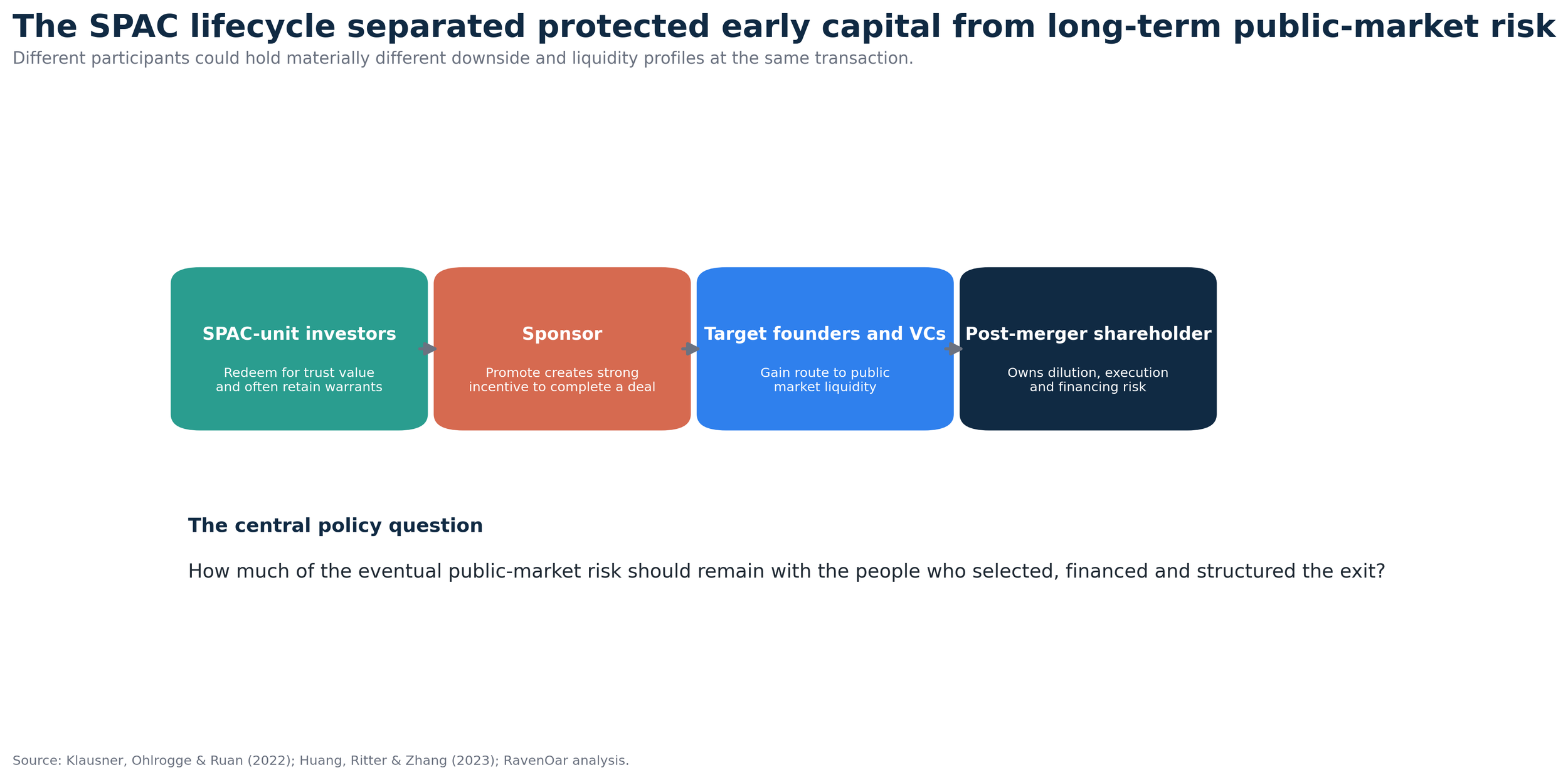
That does not make every transaction unfair. But it does mean that the familiar $10 SPAC reference price could obscure a far more complex allocation of economics.
Research by Michael Klausner, Michael Ohlrogge and Emily Ruan found that, in their 2019–20 sample, the median SPAC held only $6.67 in cash per share at the time of merger despite the $10 reference point. Redemptions, sponsor compensation, warrants and fees could create a substantial economic burden before the combined company began trading.¹
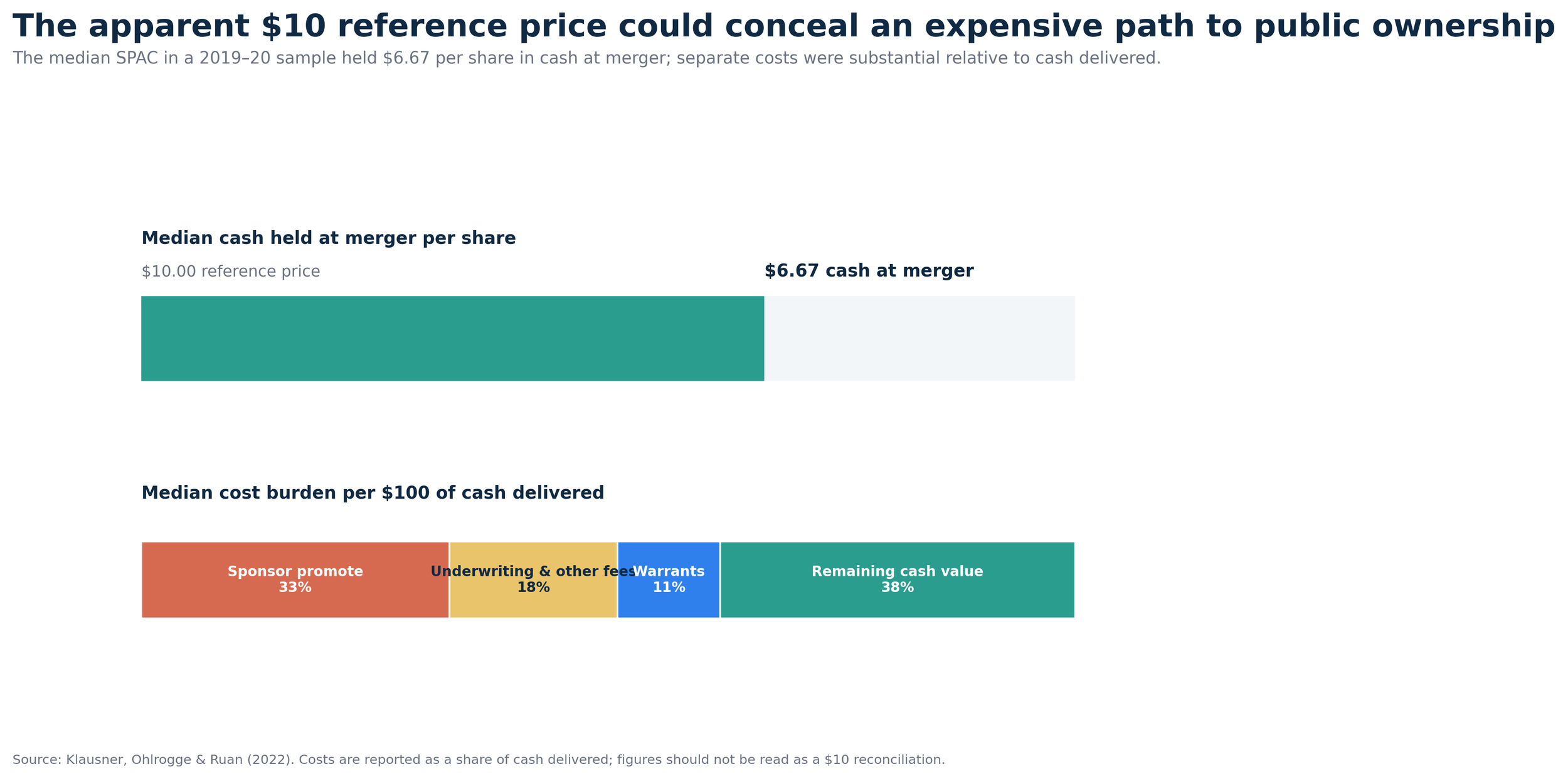
The implication is important. Public shareholders were not merely judging whether a young company would succeed. In many cases, they were judging whether it could create enough value to overcome a capital structure that had already become expensive.
The post-listing record was not a minor correction
The boom’s de-SPAC performance was exceptionally poor.
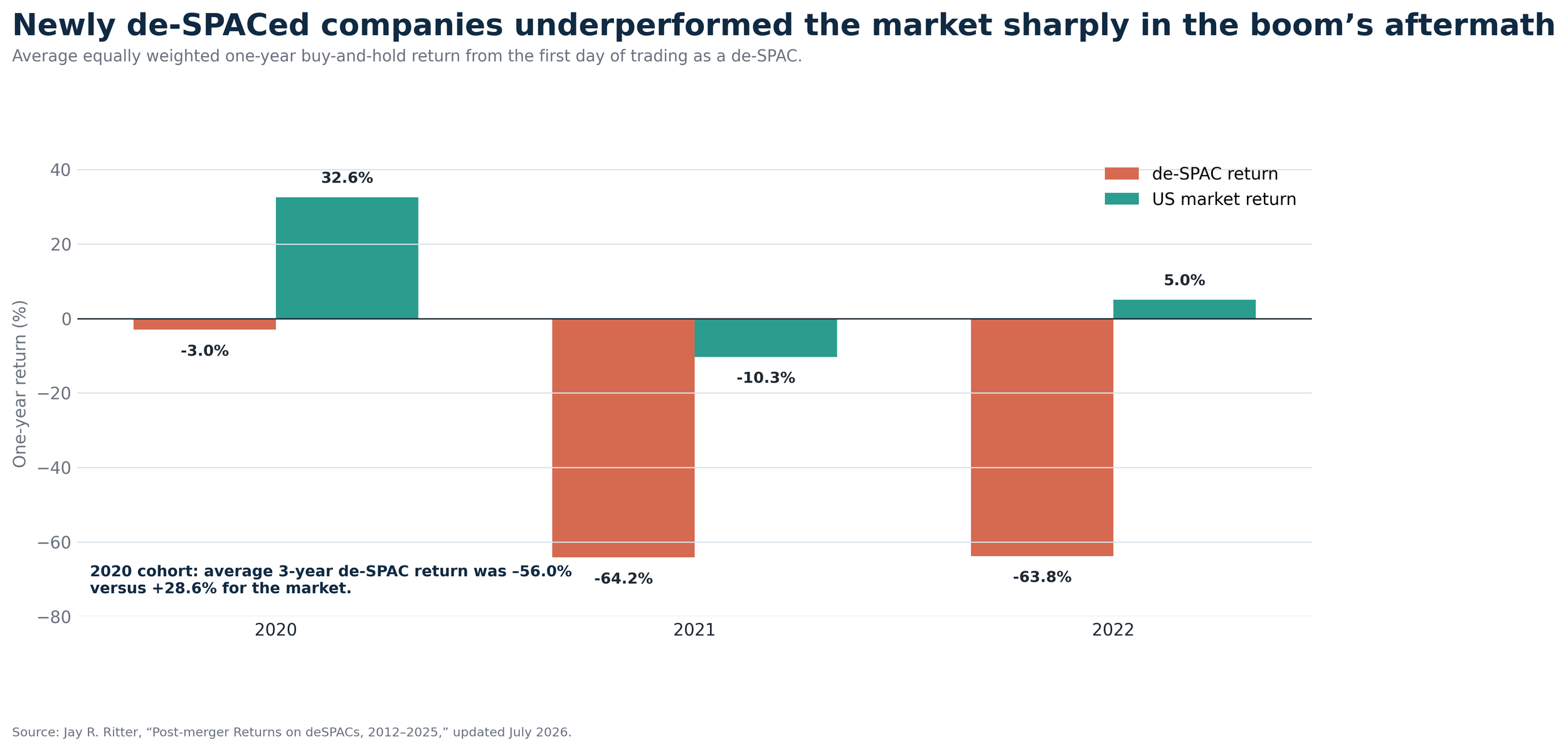
An updated analysis by University of Florida finance professor Jay Ritter found that the 64 companies that completed de-SPAC mergers in 2020 produced an average three-year buy-and-hold return of –56.0%. The corresponding market return over comparable holding periods was +28.6%, implying an average market-adjusted return of –84.6%.
The 198 companies that completed de-SPAC mergers in 2021 produced an average one-year return of –64.2%. For the available period in Ritter’s dataset, their average return was –73.0%, compared with a +7.0% market return.²
These figures should not be used to claim that SPAC structure alone caused the losses. The 2021 cohort was heavily exposed to speculative growth sectors, rising interest rates and a broader reversal in valuations. Some companies may have failed regardless of how they listed.
But the outcomes make it difficult to argue that the boom was simply an episode of public investors mispricing otherwise sound companies. The evidence instead points to a market in which weak underwriting discipline, structural dilution, optimistic projections and transaction incentives could combine to bring fragile businesses into public ownership at valuations they could not sustain.
The key question is therefore not whether public investors received information. It is whether the people who had most influence over the pathway to public markets faced enough downside if the business proved unready.
Venture capital is where the exit logic begins
SPAC sponsors made the conflict highly visible, but venture capital is the more consequential upstream actor.
VCs are often not passive sources of capital. They influence company selection, fundraising strategy, valuation, board composition, executive hiring, growth expectations and potential exit pathways. That influence is one reason venture capital can create genuine value. It is also why its incentive structure matters.
A venture fund is designed around a portfolio. A small number of very large outcomes can determine its overall returns. This can rationally encourage an investor to pursue companies with the potential for exceptional valuation growth, even when the path to sustainable public-company economics remains uncertain.
Again, this is not an accusation that all VCs routinely behave dishonestly. It is a recognition that incentives shape emphasis. A company that achieves a large private valuation and reaches a public-market liquidity event may be a successful investment outcome for an early fund even if the shareholder who buys or holds later faces a weaker proposition.
That gap matters because the exit is not simply the final stage of the story. It can shape decisions far earlier:
Which founders and business models receive initial capital
Whether growth is pursued at the expense of unit economics
How much burn is tolerated to sustain headline revenue expansion
Whether governance challenges are confronted or deferred
When an IPO or de-SPAC becomes preferable to another financing round
Whether a company is treated as ready for public ownership before its economics are sufficiently proven
If investors know, from the first financing round, that they will remain materially exposed for years after a listing, their calculus will necessarily change. Inflated valuations, weak margins, excessive burn and premature public-market exits become less attractive when the investor cannot readily transfer the downside to a new shareholder base.
That is the RavenOar proposition. It is economically plausible and supported by adjacent evidence on incentive design. It has not yet been demonstrated through a large-scale mandatory lock-up experiment—and it should not be presented as though it has.
The system should not require early investors to police themselves
It is tempting to assume that the people closest to a company will naturally act as guardians of the investors who follow them into the public market. That assumption is too generous.
Some venture investors will take a long-term view, remain constructive owners after listing and continue to support a company through its difficult transition to public ownership. Others may focus overwhelmingly on the return available to their fund and their LPs. The market cannot safely depend on every investor recognizing, or choosing to prioritise, its place in the chain of consequences after a public exit.
In the most troubling cases, the relevant question may not be whether an investor can prove that it knew a company would fail. That is an exceptionally high bar and rarely one that participants will acknowledge. The more practical question is whether the structure permits investors to obtain liquidity while fundamental doubts remain unresolved: weak unit economics, persistent cash burn, aggressive forecasts, an overextended valuation or a business model that has not yet been tested outside a favourable private market narrative.
A receptive IPO or de-SPAC market can turn those unresolved doubts into someone else’s problem. Marketing, high-profile sponsors and a compelling growth story can create demand even where the evidence required to establish medium-term viability remains incomplete. Once influential early holders are able to sell, the later shareholder is left to discover whether the story survives repeated earnings calls, quarterly filings, revised guidance and the ordinary discipline of public-market scrutiny.
There is rarely enough empirical evidence to identify a particular VC, founder or sponsor as having deliberately engineered a “pump-and-dump.” Proving that an investor knew a company lacked long or medium-term viability would usually require evidence of private intent that public data cannot provide. Nor should poor subsequent performance be treated as proof of deception; ambitious businesses can fail for legitimate reasons.
But the absence of proof of intent is not the absence of grounds for skepticism. The boom produced a pattern of highly disappointing de-SPAC returns, substantial structural dilution, optimistic forward-looking narratives and powerful incentives for sponsors and early investors to complete transactions or achieve liquidity. That combination does not demonstrate that every deal was improper. It does demonstrate that public investors had reason to be cautious about VC-backed companies brought to market through structures in which the parties closest to the business could face materially different economics from the shareholders left holding the stock.
SPACs historically intensified that concern. Investors did receive transaction documents before a vote or merger; the problem was not an absence of paperwork. But the pre-2024 regime offered more scope for forward-looking projections and different liability dynamics than a traditional IPO, while adding sponsor promotes, redemptions and warrants to the capital structure. The result was a setting in which promotional momentum could outrun the market’s ability to establish whether the underlying business was ready for sustained public ownership.
That is why the answer cannot be to expect restraint from investors whose commercial incentive may point toward liquidity. The system should require enough continued exposure that the people who helped market a company to public investors must remain present when the market begins to test whether the promise was real.
Start with more time
The original policy instinct is therefore right: longer lock-up periods are a meaningful step in the right direction.
A typical six-month restriction may cover only one or two earnings cycles. A 12 or 18 month restriction can require founders, sponsors and major early investors to remain exposed through several mandatory quarterly reports, earnings calls, analyst questions and revised guidance.
That matters because early disappointments can be explained away. A missed revenue target may be presented as a temporary execution issue. Persistent losses can be described as a deliberate investment phase. Cash burn can be positioned as the price of market leadership. A single weak quarter does not necessarily reveal whether a business model is broken.
Repeated scrutiny is different.
As quarters pass, public investors can compare prior projections with actual results. Analysts can question whether unit economics are improving, whether margins are real, whether customer acquisition is becoming more expensive and whether the company can finance its path to profitability. Management is required to update the market through quarterly filings, annual reports and material event disclosures. The story must survive more than an initial investor presentation.
Eventually, explanations either gain credibility through evidence or begin to run out.
The purpose of a longer lock-up period is not to punish early investors. It is to ensure that they remain exposed long enough for the public market to test the story they helped sell.
This is particularly important where early investors have had a central role in setting valuations, governing the company or choosing its route to market. If the company is genuinely sound, continued ownership should be a manageable constraint. If the business has been taken public prematurely, a longer period of exposure ensures that the costs of that decision are not transferred as quickly or as completely to later shareholders.
Existing rules focus primarily on information
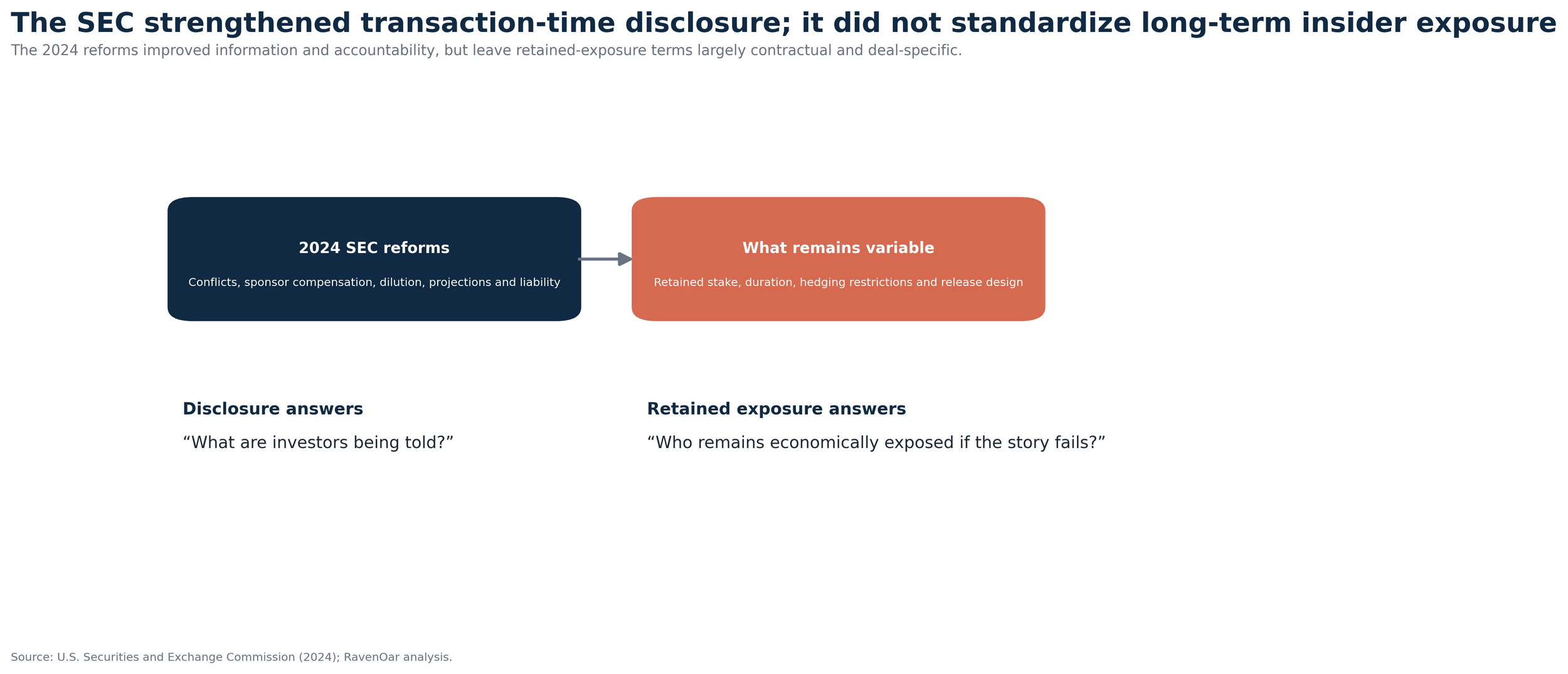
The SEC’s 2024 SPAC reforms materially improved investor protection. The rules require expanded disclosure of conflicts of interest, sponsor compensation and dilution, require additional information about the target company, impose more rigorous disclosure around projections and more closely align certain de-SPAC disclosure obligations and liabilities with traditional IPOs.³
These reforms are important. They correct parts of the earlier regime that allowed transaction economics and projected performance to be insufficiently visible.
But they principally address information and accountability at the point of transaction.
Better disclosure enables investors to see a sponsor promote. It does not necessarily alter the sponsor’s economic reason to complete a deal. Better disclosure can show how much dilution a shareholder may face. It does not require the people responsible for that dilution to hold an equivalent stake through the company’s next several reporting cycles.
The distinction is not semantic. It separates two different approaches to investor protection:
Disclosure asks: Did investors receive enough information to make an informed choice?
Retained exposure asks: Do the people making the most influential choices bear enough of the consequence if that choice proves poor?
Both matter. But they do different jobs.
Then make the exposure credible
Longer lock-ups should be the foundation of reform, not its endpoint.
In the United States, traditional IPO lock-ups are generally contractual, not universally mandated by regulation. Their duration varies, although 180 days has long been common. De-SPAC arrangements are even more heterogeneous, with different restrictions for sponsors, founders, executives and early investors.⁴
A 12-18 month baseline would give public markets more time to conduct the essential work of discovery. But duration alone does not always create alignment. A holder can remain nominally invested while owning too little for the exposure to matter. A stake can be hedged, pledged, distributed or economically transferred. A lock-up can defer a sale without changing the incentives that produced the listing. And a single share-price earn-out can create its own short-term distortions.
The objective should therefore be credible retained exposure, not a blunt universal prohibition on selling.
A more effective framework would combine four elements:
A meaningful retained stake. SPAC sponsors, founder/controllers and influential early investors should retain a defined minimum economic interest after the listing.
A staged duration. Releases should occur gradually over approximately 24 to 36 months, rather than through a single unlock date.
Multi-period performance conditions. A material final tranche should depend on sustained performance, not merely a short lived share-price target, but a combination of market and operating measures appropriate to the company.
Genuine economic exposure. Hedging, pledging and related party transfers that remove downside should be disclosed and appropriately restricted.
This approach would need to be differentiated by role. A founder, a SPAC sponsor and a venture fund have different responsibilities, liquidity constraints and concentration risks. It should also allow narrow provisions for taxes, hardship and genuine fund wind-downs.
The purpose is not to trap founders or VCs indefinitely. It is to ensure that the people with the greatest ability to influence a company’s pre-listing path retain enough at-risk ownership for the company’s first years in public markets to matter to them.
Performance-linked exposure offers a useful precedent
There is already evidence that structure matters.
Recent research on SPAC sponsors finds that a higher proportion of sponsor promote tied to earn-outs is associated with better returns for shareholders who do not redeem. The authors estimate that every 10-percentage-point increase in the fraction of sponsor promote tied to earn-outs corresponds with a 1.8-percentage-point increase in non-redeeming shareholder returns.⁵
This should not be overstated as proof of causation. Deals with better alignment may also differ in sponsor quality, target quality or other unobserved ways.
Still, it offers an important design lesson. The central issue is not whether sponsors, founders and VCs may profit. They should profit when they create lasting value. The issue is whether enough of that profit remains contingent on the outcome experienced by the shareholder who is still there after the transaction closes.
The effect should begin before the listing
The strongest case for retained exposure is not that it prevents a sale on a particular date. It is that it changes what a sale means from the beginning.
A VC considering whether to support another high-valuation financing round would know that a public listing does not fully resolve its downside. A board considering an aggressive expansion plan would know that its key decision makers cannot simply move on after the transaction. A sponsor approaching an acquisition deadline would know that completing any deal is less attractive if a substantial portion of its economics remains tied to the company’s subsequent performance.
That does not eliminate risk. Nor should it. Public markets need companies with ambitious plans and investors willing to fund them.
But it could create a healthier test. Before a company transfers a meaningful share of its risk to public investors, the people who shaped its journey should be prepared to stay exposed long enough to show that their confidence was warranted.
The next phase of public-market reform should not abandon disclosure. It should complete it. Investors deserve to know what insiders are being paid, what dilution they face and what forecasts rest on. They should also be able to see that the people who selected, financed and took the company public remain genuinely invested in the outcome.
The market does not need fewer successful exits. It needs exits in which success remains connected to the durability of the company left behind.
Sources
Michael Klausner, Michael Ohlrogge and Emily Ruan, “A Sober Look at SPACs,” Yale Journal on Regulation, 2022.
Jay R. Ritter, “Post-merger Returns on deSPACs, 2012–2025,” updated July 2026. Returns are equally weighted buy-and-hold returns from the first close as a de-SPAC; later cohorts use the available observation period specified in the source.
U.S. Securities and Exchange Commission, “SEC Adopts Rules to Enhance Investor Protections Relating to SPACs, Shell Companies, and Projections,” January 24, 2024.
Rongbing Huang, Jay R. Ritter and Donghang Zhang, “IPOs and SPACs: Recent Developments,” 2023.
F. Feng et al., “The Incentives of SPAC Sponsors,” 2026.
