
The NBA Doesn't Have a Three-Point Problem. It Has an Optimization Problem.
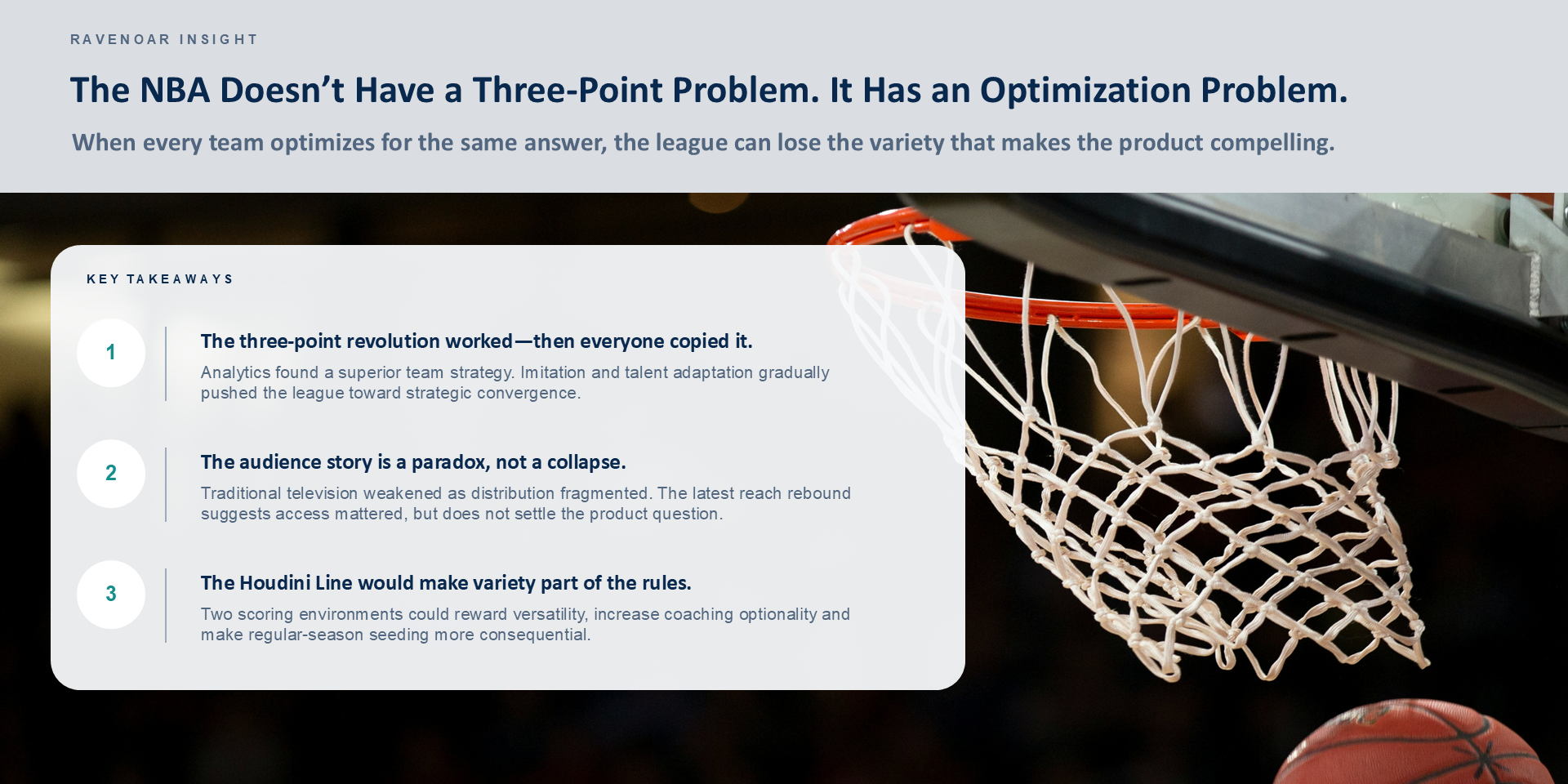
The three-point evolution showed what happens when analytics discovers a better way to play. Its next lesson may be what happens when everyone discovers the same answer.
The NBA enters the second half of the 2020s from a position that appears remarkably strong.
In 2024, the league agreed to new 11-year national media agreements with Disney, NBCUniversal and Amazon, reportedly worth approximately $76 billion.[1] The agreements dramatically expanded distribution: approximately 75 regular-season games are now scheduled for broadcast television each season, compared with a minimum of 15 under the previous arrangement, while nationally televised games are also available through broadly distributed streaming platforms.[2]
The early results have been striking.
During the 2025–26 regular season, the NBA reported that 170 million people in the United States watched games across ABC/ESPN, Amazon Prime Video, NBC/Peacock and NBA TV—the league's largest reach in 24 years and an 86% increase from the previous season.[3] The postseason subsequently produced the NBA's largest audiences in decades. The 2026 Finals between New York and San Antonio averaged 20.6 million viewers, the most-watched NBA Finals since 1998.[4]
By those measures, there is little to save.
But underneath the commercial success sits a more complicated question about the product itself.
Over roughly the same period in which professional basketball became more sophisticated analytically and more valuable commercially, the basketball being played became increasingly optimized around one particular action: shooting from behind the three-point line.
The transformation was rational.
A three-point shot does not need to be converted as frequently as a two-point shot to generate the same expected scoring return. Analytics departments increasingly quantified that advantage. Coaches incorporated it. Front offices recruited around it. Players developed accordingly.
Eventually, an insight became a strategy, the strategy became an orthodoxy and the orthodoxy began reshaping the sport.
The issue is not that NBA teams are making irrational decisions.
It may be precisely the opposite.
The NBA may be experiencing what happens when rational competitors optimize so successfully that they begin optimizing themselves toward similarity.
That presents an unusual challenge for a sports league.
A team exists to win basketball games.
The NBA exists to make basketball games worth watching.
Those objectives usually reinforce one another. But, they do not necessarily have to.
The three-point evolution worked
Criticism of modern basketball frequently begins from the wrong premise of ‘un-watchability’ from too many ’threes’ being shot.
Teams should not shoot fewer three-pointers simply because previous generations did.
Professional basketball teams are competitive organizations. If one approach produces superior results, teams should identify it and exploit it. A front office knowingly adopting an inferior strategy because it produces more aesthetically traditional basketball would not be preserving the game. It would be failing at its job.
The rise of the three-pointer is therefore better understood as a triumph of optimization.
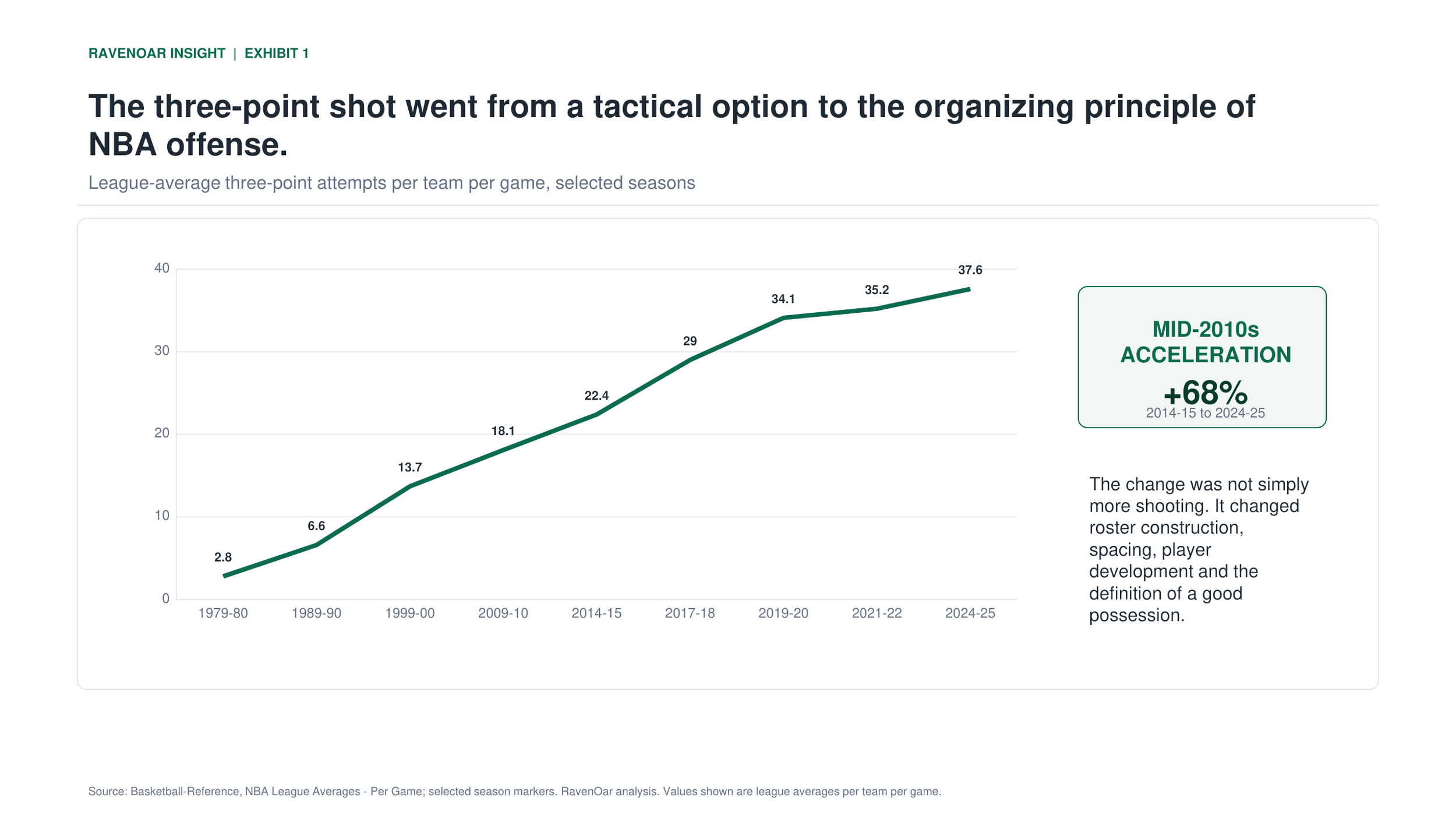
When the NBA introduced the three-point line in 1979, teams barely used it. The transformation since then has been extraordinary. By 2024–25, the average NBA team attempted 37.6 three-pointers per game from 89.2 total field-goal attempts—meaning more than 42% of all field-goal attempts came from behind the line.[5]
The following season, teams still averaged 37.0 attempts from three per game.[5]
The mathematics help explain why.
A player making 50% of 100 two-point attempts produces 100 points.
A player needs to make only 1/3 of 100 three-point attempts to produce the same 100 points.
Of course, real basketball is considerably more complicated than that equation. Shot quality, offensive rebounding, turnovers, free throws, defensive positioning and the ability of perimeter shooting to create spacing all matter.
But the basic arithmetic changes the economic value of space on a basketball court.
It changes which shots are considered desirable ,which players teams employ, defensive schemes, player development.
It also changes where a seven-footed giant stands.
And once one organization discovers an advantage, competitors cannot simply decline to participate.
This is where successful optimization begins creating an unusual problem.
When everyone finds the answer
Competitive advantage is usually temporary.
An organization discovers something its competitors have not. It benefits until competitors imitate the innovation, develop a counterstrategy or discover something better.
But basketball operates inside a common rules architecture.
If those rules systematically reward a particular behavior, competitors do not necessarily respond by developing fundamentally different strategies.
They can converge on the same one.
The result is a form of strategic homogenization.
This is not merely criticism from nostalgic fans. In December 2024, NBA Commissioner Adam Silver acknowledged that the league was studying the increase in three-point shooting. More importantly, he said criticism that NBA offenses were becoming increasingly “cookie cutter” and that teams were copying one another was something the league should take seriously.[6]
That description matters more than the raw number of three-pointers.
The problem is not necessarily abundant three-point attempts. It is similarity.
A three-point shot can be spectacular. Players pulling up several feet behind the line is one of the defining spectacles of modern basketball. A center capable of stretching a defense to the perimeter introduces tactical possibilities previous generations barely contemplated.
The innovation itself is not the problem.
The problem arises when an innovation becomes sufficiently economically attractive that every organization must increasingly orient itself around it.
Optimization has then stopped producing differentiation. It is producing convergence.
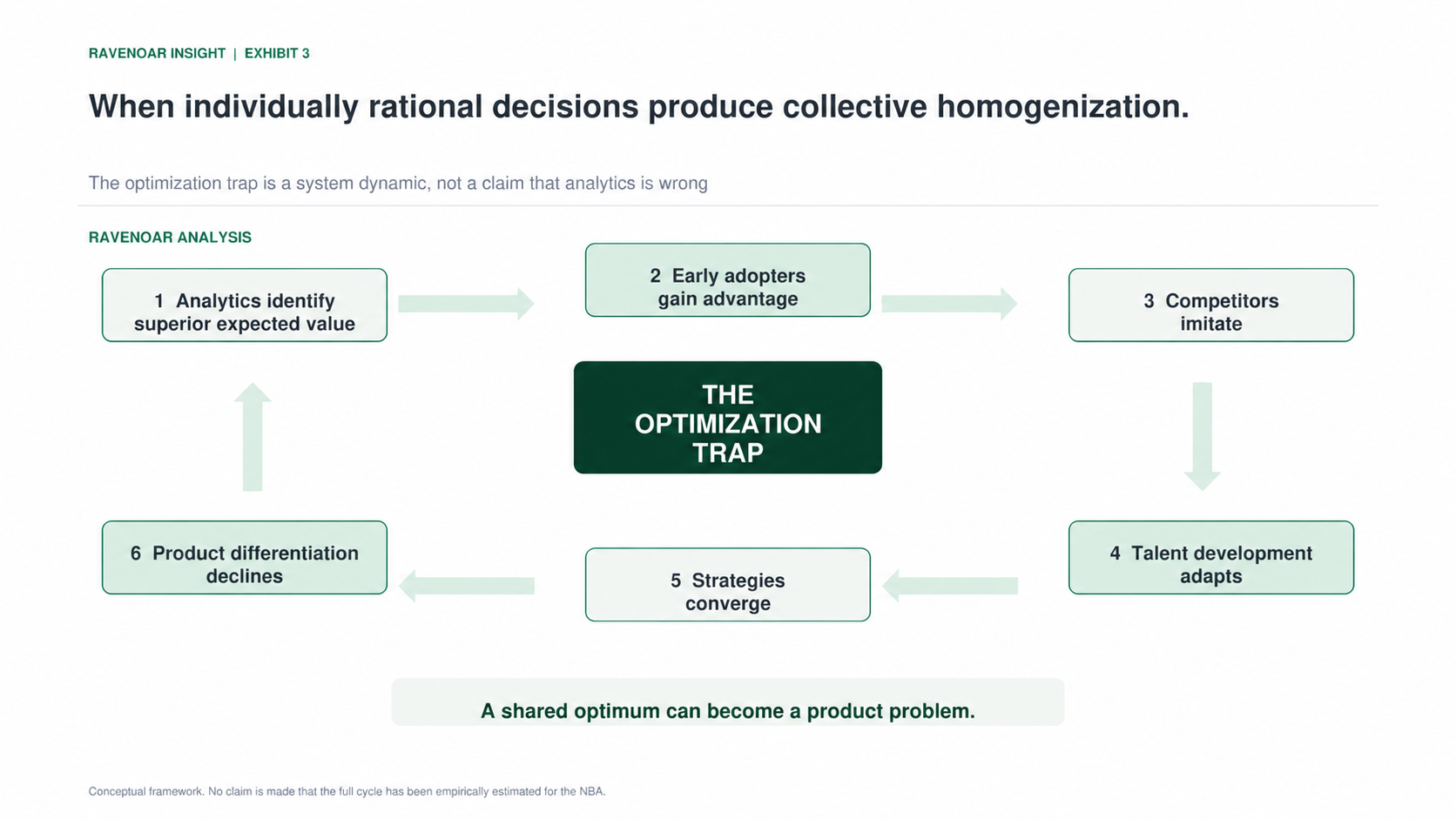
Analytical insight. Superior expected-value strategy emerges. Early adopters gain competitive advantage. Competitors imitate. Player development adapts. Roster construction converges. Playing styles become more similar.
The entertainment product risks becoming more homogeneous.
The paradox extends beyond basketball.
What is individually rational for every competitor can produce a collectively less differentiated market. And NBA teams cannot be expected to solve that problem themselves.
No general manager is responsible for protecting the aesthetic diversity of professional basketball.
The league is.
Did audiences notice?
This is where the argument becomes difficult, and more interesting.
It would be tempting to draw two lines on a chart, show three-point attempts increasing while television audiences weakened during parts of the same period and declare the case closed.
The evidence does not support that conclusion.
There was, however, meaningful erosion.
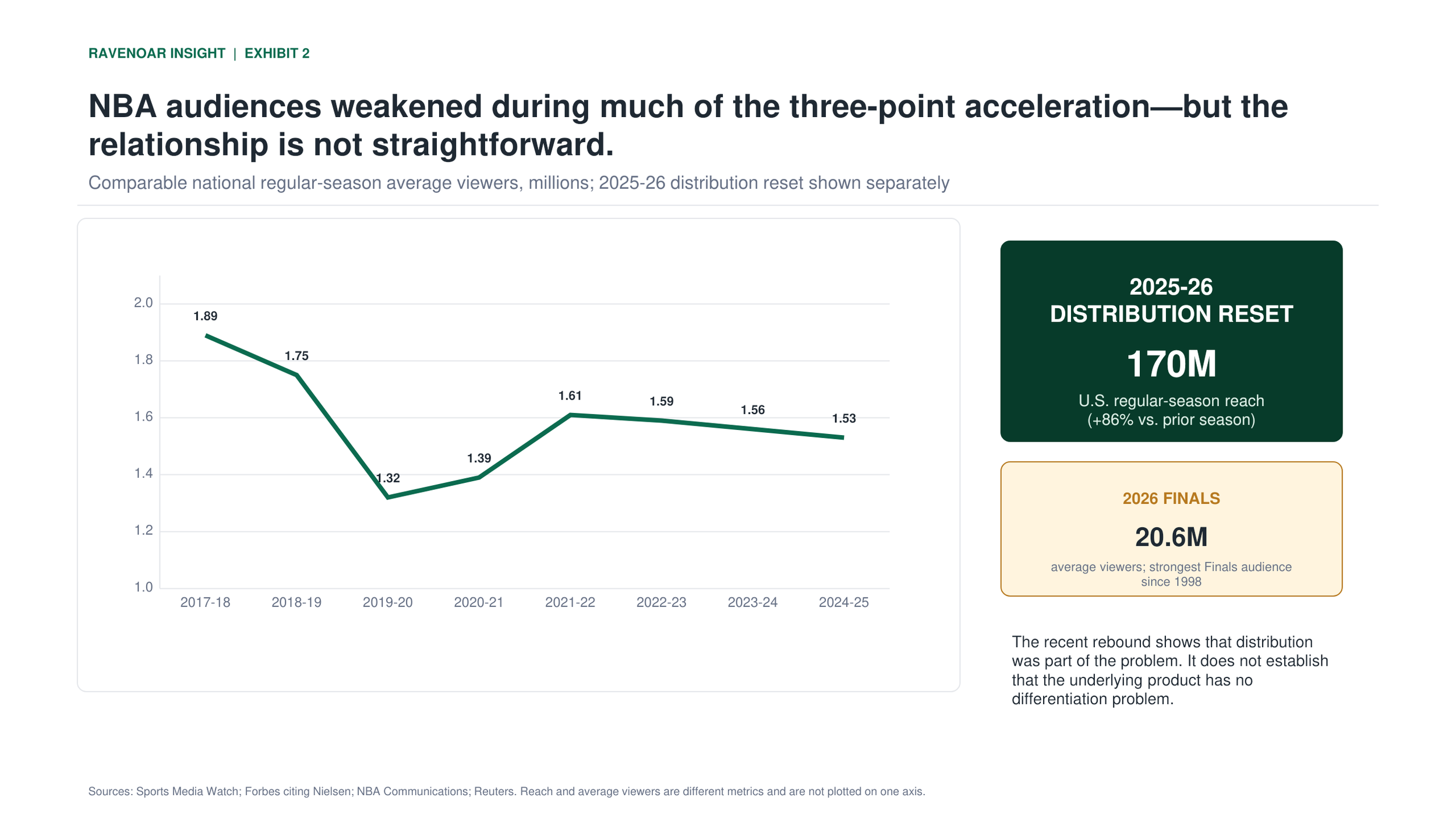
The 2017/18 NBA regular season averaged approximately 1.89 million viewers across ABC, ESPN and TNT.[7] By the 2019–20 All-Star break, national games were averaging about 1.64 million viewers, 13% below the comparable previous-year period.[8]
The pandemic subsequently made historical comparisons particularly difficult. The shortened 2020–21 season averaged approximately 1.36 million national viewers. Audiences recovered to 1.61 million in 2021–22 and averaged 1.59 million in 2022–23.[9]
In 2023–24, ABC, ESPN and TNT averaged approximately 1.56 million viewers, down 1% from the previous season.[10] In 2024–25, the same three national partners averaged 1.53 million, another 2% decline and the lowest average since 2020–21.[11]
There is therefore a legitimate historical audience story here.
But there is not a clean year-on-year collapse.
Nor can the rise of three-point shooting credibly be isolated as a sole cause.
Traditional television itself was shrinking. ‘Cord-cutting’ reduced the addressable linear TV audience. The availability and popularity of individual stars changed. Pandemics disrupted schedules. Social media created entirely new ways to consume basketball without watching a complete game. Different franchises cycled in and out of national relevance. Streaming fragmented media consumption.
Indeed, the NBA's share of the remaining television audience sometimes looked considerably healthier than its absolute viewer count. Sports Media Watch noted that despite relatively low absolute audiences in 2022–23, the NBA captured its highest share of the primetime television audience in roughly two decades.[9]
The responsible conclusion is therefore narrower:
Traditional national NBA television audiences weakened during a substantial period in which three-point volume and offensive convergence increased. The two trends overlapped, but the available evidence does not establish that one caused the other.
That does not make dissatisfaction with the product irrelevant.
It makes it a hypothesis worth investigating.
The customers who quietly disappear
There is another constituency that deserves particular attention. The people who already loved basketball.
Professional sports leagues spend enormous amounts of energy acquiring the next generation of fans. They should. A league that fails to replenish its audience eventually becomes culturally irrelevant.
But customer acquisition can obscure customer retention.
A fan who grew up watching the NBA in the 1980s, 1990s or early 2000s experienced a visibly different product.
Post play was more prominent. Mid-range shooting occupied a larger portion of the offensive repertoire. Positions were more specialized. Centers, power forwards and guards were expected to perform more distinct functions. Teams could look stylistically different because the mathematical hierarchy between different forms of scoring was less overwhelming.
Some of that basketball was inefficient by contemporary analytical standards.
That does not necessarily mean it was inefficient as entertainment.
This is an important distinction.
The NBA is simultaneously a competitive system and an entertainment business.
An innovation can improve the former while making portions of the audience believe it has diminished the latter.
There is no shortage of anecdotal frustration from long-tenured fans about three-point volume, reduced stylistic variation and the perceived disappearance of elements of basketball they originally enjoyed. The criticism has even come from players associated with the modern game's transformation. In 2025, Golden State's Draymond Green described contemporary NBA basketball as “boring,” arguing that analytics had pushed offenses toward threes and layups at the expense of the possession-by-possession strategic contest he valued.[12]
But anecdote is not churn data.
The evidence currently available does not empirically demonstrate that older viewers have abandoned NBA basketball because of three-point shooting. Although many have.
In fact, S&P Global's 2024 consumer research found that approximately 30% of U.S. NBA viewers were aged 55 or older—exactly the same share as viewers under 35.[13]
That finding should make the NBA more interested in legacy-fan dissatisfaction, not less.
Older viewers remain a substantial part of the customer base. The difficulty is that sports churn can be unusually hard to observe.
A software subscriber cancels a subscription. A shopper stops purchasing a brand.
A lifelong basketball fan can disengage almost invisibly.
Sixty games watched becomes thirty. Thirty becomes ten. Ten becomes the playoffs.
Eventually the fan still knows the stars, still reads about trades and may still identify as an NBA fan but rarely sits through an entire Tuesday night game.
There is no cancellation form explaining why.
For the NBA, this creates an unusual customer-retention problem.
The relevant question is therefore not whether younger fans or older fans are “right” about what basketball should look like. It is whether the league can continue attracting new consumers without unnecessarily surrendering elements of the product valued by existing ones.
Distribution may have solved a different problem
The 2025–26 season makes any simple “NBA ratings crisis” argument obsolete.
That is useful.
The new media agreements fundamentally changed accessibility. All nationally televised games became available through broadly distributed streaming services, while the number of regular-season games available on broadcast television increased from a minimum of 15 under the old agreement to approximately 75 annually.[2]
NBC returned to NBA coverage. Peacock and Amazon Prime Video became major distribution channels. ABC and ESPN remained central components of the national package.
The results were immediate.
The NBA reported that 170 million Americans watched regular-season games across the national platforms during 2025–26, up 86% from the previous season and the league's greatest reach in 24 years.[3]
Then the post-season accelerated the story.
The 2025 postseason on ABC and ESPN had already averaged 6.13 million viewers per game, 10% above the previous year, while the Finals generated a record five billion social-media views globally.[14]
In 2026, the Finals averaged 20.6 million viewers, the largest audience since Michael Jordan's final Chicago championship season in 1998.[4]
The NBA plainly still possesses enormous latent consumer demand.
The distribution changes therefore resemble something close to a natural experiment.
The three-point line did not disappear.
The fundamental product did not suddenly revert to 1995.
Distribution changed.
And reach expanded dramatically.
That suggests at least part of the NBA's previous audience problem was not that people had stopped wanting basketball. It was that the mechanisms through which basketball reached consumers had become less effective.
But solving a distribution problem does not establish that there is no product-design problem.
Two Different Audience Problems
DISTRIBUTION
Can consumers conveniently find and watch NBA basketball?
More broadcast exposure
broader streaming access
platform reach
PRODUCT
How differentiated and compelling is the basketball once consumers arrive?
Strategic variety
meaningful matchups
tactical uncertainty
stylistic contrast
The NBA has demonstrated the power of the first growth lever.
The question is whether another remains available.
Do not ban the ‘three’
Most proposed responses to three-point proliferation attack the shot itself.
Move the line farther away. Eliminate the corner three.
Change defensive rules. Introduce a four-point shot.
Or abolish the three-pointer entirely.
All have the same underlying weakness. The league would once again be deciding which version of basketball teams should play.
There may be another option. Do not decide. Let the teams decide.
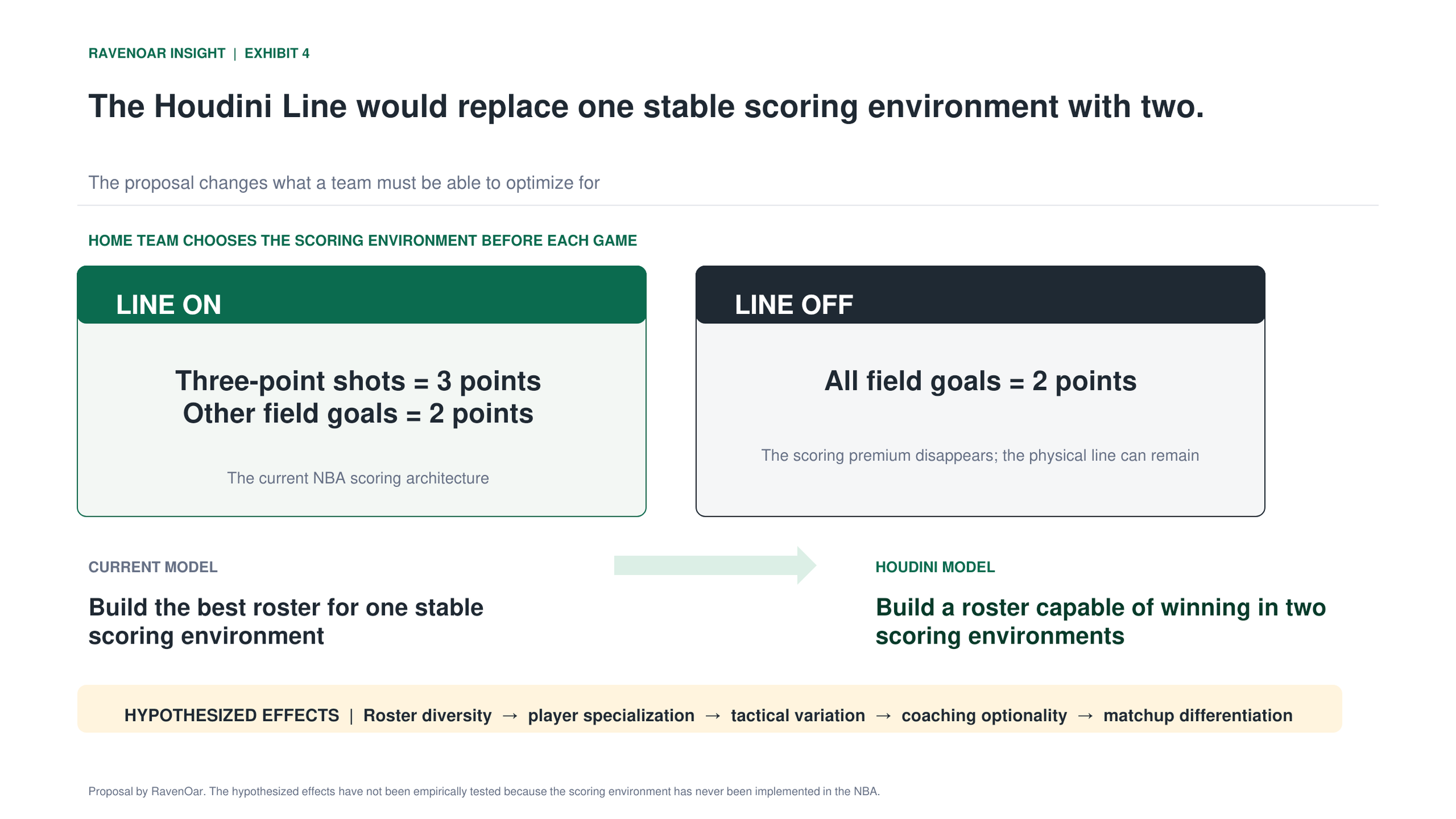
Before each game, allow the home team to determine whether the three-point line will be active.
Call it the Houdini Line.[15]
When activated, basketball operates exactly as it does today. Shots beyond the line are worth three points.
When de-activated, the line effectively disappears. Every successful field goal is worth two points.
Nothing else changes.
The proposal sounds radical because professional sports generally seek uniform playing conditions.
But strategically, the variability is the point.
The Houdini Line would create two scoring environments inside one league.
Once teams must win under both, the optimization problem changes completely.
Destroying the single optimum
Imagine a team constructed overwhelmingly around perimeter shooting.
At home, it can activate the three-point line and exploit that advantage.
Away from home, opponents know exactly what to do when playing against this team.
Turn it off.
Suddenly a roster capable of producing extraordinary expected value in one scoring environment must survive another in which its primary mathematical premium has disappeared.
The rational response would not necessarily be to abandon three-point shooting.
It would be to diversify.
Teams would need players capable of generating efficient offense near the basket. Post play could acquire greater situational value. Mid-range specialists might become more useful in 3-line-off games. Size could carry a different economic premium. Coaches would need offensive systems capable of shifting according to the scoring environment.
Three-point specialists would remain valuable.
The Houdini Line does not attempt to return basketball to an earlier era.
It makes both eras strategically relevant.
From One Optimum to Two Environments
This is the central idea.
Do not tell organizations to stop optimizing.
Give them a harder problem to optimize.
Harder optimization may produce greater diversity.
Home court becomes a strategic asset
The consequences extend beyond shot selection.
Home-court advantage currently derives from familiar surroundings, reduced travel and, most visibly, the crowd.
The Houdini Line adds something different, control over the competitive environment.
Suppose a perimeter-oriented team faces an opponent with superior interior scoring.
At home, the perimeter focused team activates the line.
When the opponent hosts the rematch, who is respectively less perimeter focused, it would strategically deactivate the line.
The same two teams have now played two strategically different basketball games.
That becomes particularly consequential in the postseason.
In a seven-game series, the higher seed hosts Games 1, 2, 5 and 7.
Under today's structure, home-court advantage changes the location only.
Under the Houdini system, the higher seed could gain additional control of the scoring architecture in four of seven games—including Game 7.
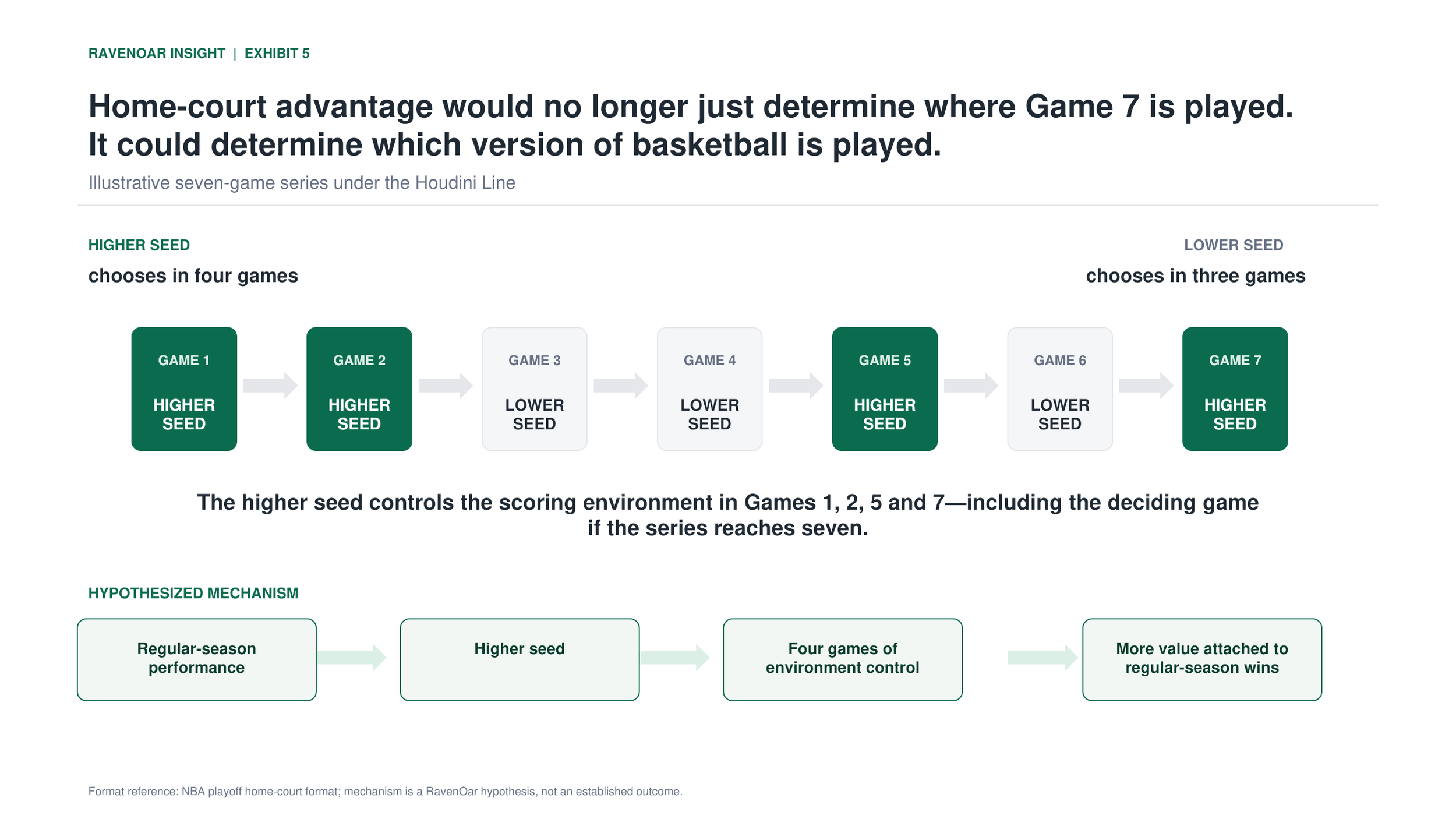
Regular-season positioning consequently acquires an additional strategic reward.
That matters in a league in which 20 of 30 teams can currently reach either the playoffs or Play-In Tournament.[16]
The Houdini Line could make where a team qualifies matter differently.
A higher seed would not simply receive an advantageous home crowd.
It could determine which version of basketball decides the series.
This is not an incidental feature of the proposal.
It potentially connects product diversity with another persistent NBA challenge: making the regular season feel consequential.
Coaches get another chessboard
The change could also shift value toward coaching.
Contemporary NBA basketball already contains enormous tactical complexity. The suggestion that modern basketball has no strategy is plainly incorrect.
But most strategy occurs inside a stable scoring architecture.
The Houdini Line introduces another layer.
Should a team maintain two substantially different offensive systems?
Does it alter its starting lineup when the line is inactive?
How many roster positions should be allocated to players whose value disproportionately increases in one environment?
Would a coach ever activate the three-point line against a superior shooting team because the spacing advantage matters even more to his own offense?
Could a franchise deliberately construct a roster designed to be very good under both systems rather than dominant under either?
Those decisions create matchup-specific uncertainty before the ball is tipped.
Scouting becomes harder.
Roster construction becomes harder.
Player valuation becomes harder.
And complicated competitive environments create more opportunities for organizations to become strategically distinctive.
That is precisely what convergence threatens to remove.
The labor market changes too
Rule design does not merely determine how basketball looks.
It determines whose skills are valuable.
The introduction of the three-point line eventually created enormous economic value for shooting ability. The analytics revolution amplified that value. Players at almost every position have consequently been incentivized to develop perimeter shooting.
That is not inherently undesirable. But every scoring architecture subsidizes some skills relative to others.
The Houdini Line would alter those relative prices.
A player whose limitations make him difficult to use in a three-point environment might become considerably more valuable when every field goal is worth two. Interior defenders, rebounders, post scorers and other specialists could occupy different strategic niches.
At the same time, elite shooters remain elite shooters.
A Stephen Curry-esque player does not cease being valuable because a particular basket is worth two points. Extraordinary shooting still stretches defenses and creates space.
What disappears in line-deactivated games is the additional mathematical premium attached to crossing one particular piece of hardwood.
The larger labor-market effect could therefore be increased value for optionality.
Players capable of functioning across both environments may command premiums. Teams may allocate roster positions differently. Youth development could eventually respond by rewarding a broader portfolio of skills.
That final effect would take years.
But professional rules influence what children practice long before those children become professionals.
The NBA does not merely reflect basketball culture. It helps manufacture it.
This could fail
A proposal this disruptive deserves skepticism.
The first objection is fairness.
Why should the home team determine something as fundamental as the value of a basket?
Because creating a strategic home advantage is partly the point. But implementation would still matter. Teams could be required to declare their choice well before tip-off, giving opponents adequate preparation time and preventing theatrical last-second decisions.
A second problem is statistical continuity. Career scoring records accumulated under two scoring systems would become harder to compare.
That is true.
But professional sports already evolve through changing rules, season lengths, pace, equipment, playoff formats and competitive environments. Statistical comparability across eras has never been perfect.
The NBA has several environments in which rule experimentation could be conducted before any regular-season implementation. A controlled trial could measure shot distribution, offensive efficiency, spacing, lineup choices, player movement and, most critically, fan response.
If strategic convergence has reduced product differentiation, introducing variable scoring environments may increase tactical and stylistic diversity. That diversity may improve the entertainment product for some consumers without eliminating the version of basketball others currently enjoy.
The first claim can be tested on the court.
The second can be tested with consumers.
The bigger lesson is not about basketball
The three-point debate illustrates a broader management problem.
Organizations are taught to optimize. Find the highest-return activity.
Measure it. Scale it.
Remove inefficiency. Repeat.
At the level of the individual organization, the logic is compelling. But industries are ecosystems.
When every competitor receives similar data, employs similar analytical tools, recruits from similar talent pools and optimizes toward similar measures, the result can be convergence.
The competitive question eventually changes.
It is no longer ‘Who has found the best answer’? but rather ‘How do we design an environment in which there can be more than one good answer’?
Sports leagues have an unusual ability to intervene because they control the architecture inside which competitors optimize.
The NBA has done this repeatedly. The shot clock. The three-point line. Hand-checking. All changed basketball.
Rules are not sacred constraints surrounding the product.
The rules are part of the product.
The three-point revolution demonstrated what happens when basketball discovers a better answer.
The next evolution may require something more difficult: creating a game in which there is no single answer at all.
The NBA should not be trying to determine which version of basketball is best.
It should design a competitive system in which more than one version of basketball can win.
And so the answer to excessive optimization should therefore not be de-optimization.
It should be better system design.
References
1. ESPN, What NBA's new TV deal means for the league, players, teams and fans, July 25, 2024. The 11-year Disney/NBCUniversal/Amazon agreements run from 2025–26 through 2035–36 and were reported at roughly $76 billion.
2. NBA Communications, NBA signs new 11-year media agreements with The Walt Disney Company, NBCUniversal and Amazon Prime Video through 2035–36 season, July 24, 2024. The NBA stated that approximately 75 regular-season games would be available on broadcast television annually, versus a minimum of 15 under the preceding agreement.
3. NBA/AP, NBA regular season delivers most viewers in 24 years, April 15, 2026. The NBA reported 170 million U.S. viewers across its national platforms, up 86% from 2024–25.
4. NBA Communications, Knicks-Spurs delivers most-watched NBA Finals since 1998, June 16, 2026. The five-game Finals averaged 20.6 million viewers; Game 5 averaged 24.5 million and peaked at 33 million.
5. Basketball-Reference, NBA League Averages—Per Game. League averages show 37.6 three-point attempts and 89.2 total field-goal attempts per team per game in 2024–25, followed by 37.0 and 89.1 respectively in 2025–26.
6. ESPN, Adam Silver looking into critiques of increased 3-point volume, December 17, 2024. Silver confirmed that the NBA was studying three-point volume and said criticism of increasingly “cookie cutter” offenses deserved serious consideration.
7. Sports Media Watch, NBA Viewership Up Across the Board in 2017–18, April 2018. ABC, ESPN and TNT averaged 1.89 million viewers during the regular season.
8. Sports Media Watch, As stretch run begins, NBA down double-digits, February 2020. National games averaged 1.64 million viewers through the 2019–20 All-Star break, 13% below the comparable previous-year period.
9. Sports Media Watch, NBA ratings deep-dive: Where does the league stand?, April 2023. The 2022–23 regular season averaged 1.59 million viewers versus 1.61 million in 2021–22; the analysis also provides historical context for the pandemic-era lows and changing television audience share.
10. Sports Media Watch, NBA regular season viewership up slightly despite Christmas low, April 2024. ABC, ESPN and TNT averaged 1.56 million viewers in 2023–24, versus 1.59 million the previous season.
11. Forbes, NBA Ratings Declined By 2% During The 2024–25 Regular Season, April 17, 2025. ABC, ESPN and TNT averaged 1.53 million viewers, down from 1.56 million in 2023–24.
12. ESPN/AP, Draymond Green calls NBA games boring: “No substance”, February 15, 2025. Green criticized the analytical emphasis on threes and layups and argued that some contemporary games lacked the strategic possession-by-possession quality he valued.
13. S&P Global Market Intelligence, Global NBA basketball viewers, 2024, March 28, 2024. Survey research found approximately 30% of U.S. NBA viewers were 18–34 and another 30% were 55 or older.
14. NBA Communications, 75 million people watch 2025 NBA Finals on ABC in U.S., up 16% vs. last year, June 25, 2025. The 2025 postseason on ABC/ESPN averaged 6.13 million viewers per game, up 10%, while the Finals generated a reported five billion global social-media views.
15. Thor&Hammer, How to Save NBA Basketball: The 3-Point Houdini Line, November 1, 2023. Original proposal for allowing the home team to elect whether the three-point scoring premium operates, together with proposed implications for roster construction, home-court advantage, player valuation and stylistic diversity.
16. NBA, SoFi Play-In Tournament history and 2025 postseason format. Seeds 7–10 in each conference enter the Play-In process, meaning 20 of the league's 30 teams can finish the regular season with access to either the playoffs or Play-In Tournament.
17. NBA, Emirates NBA Cup: Frequently Asked Questions. All 30 teams participate in group play and eight progress to the knockout stage, illustrating the league's willingness to alter competitive architecture to create additional regular-season stakes.
